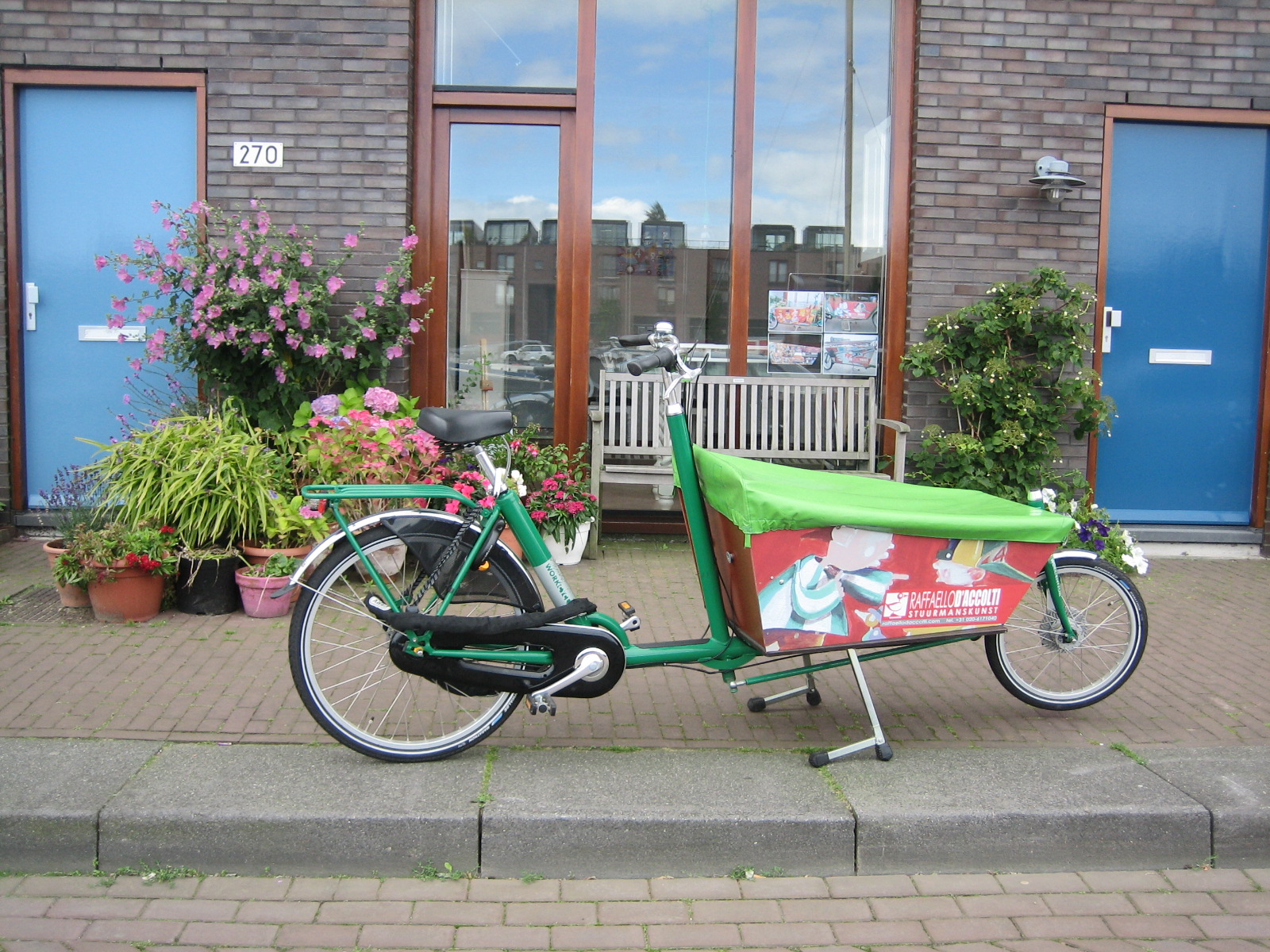
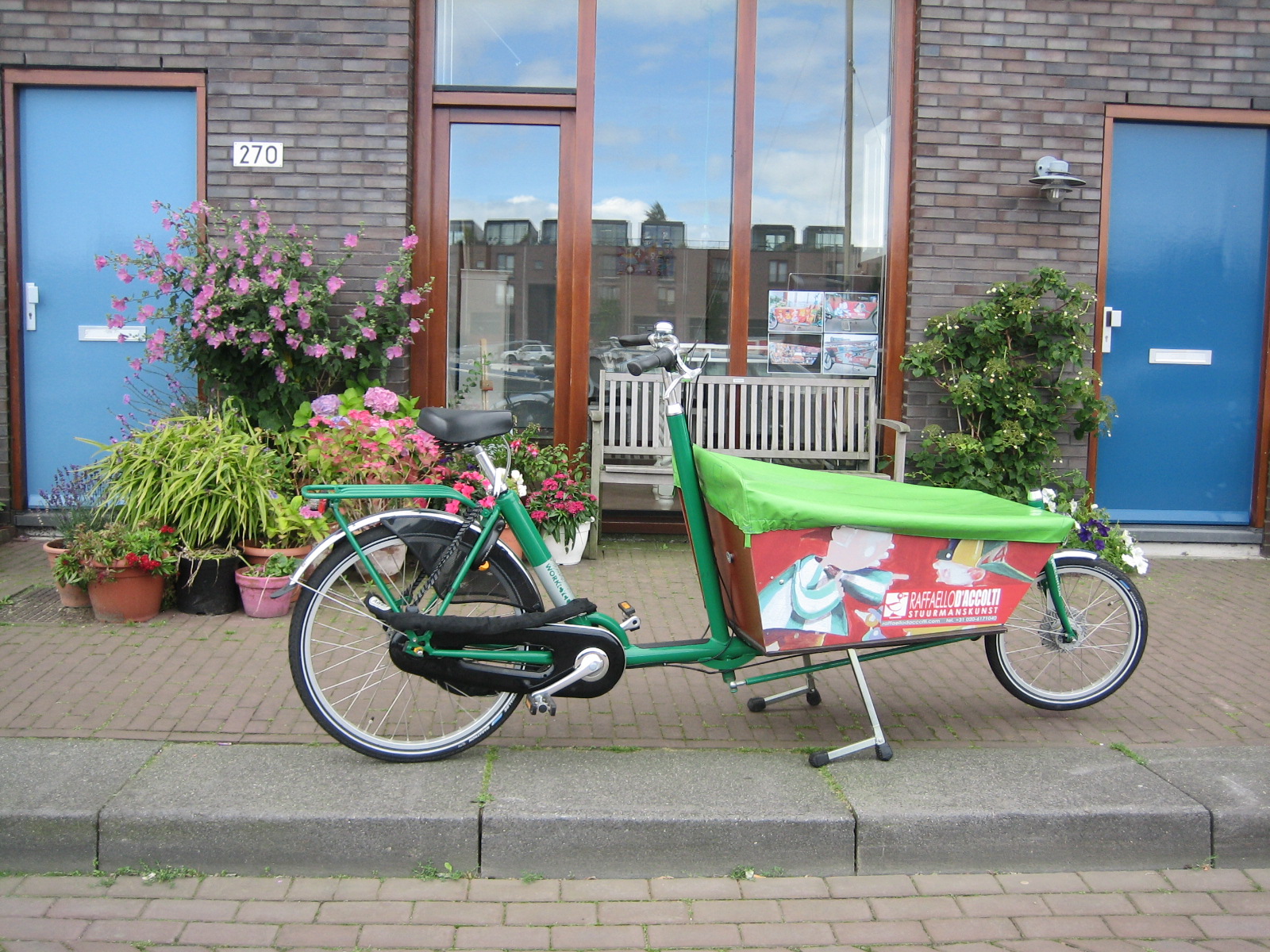
Bike-sharing Barcelona (vs. Rome)
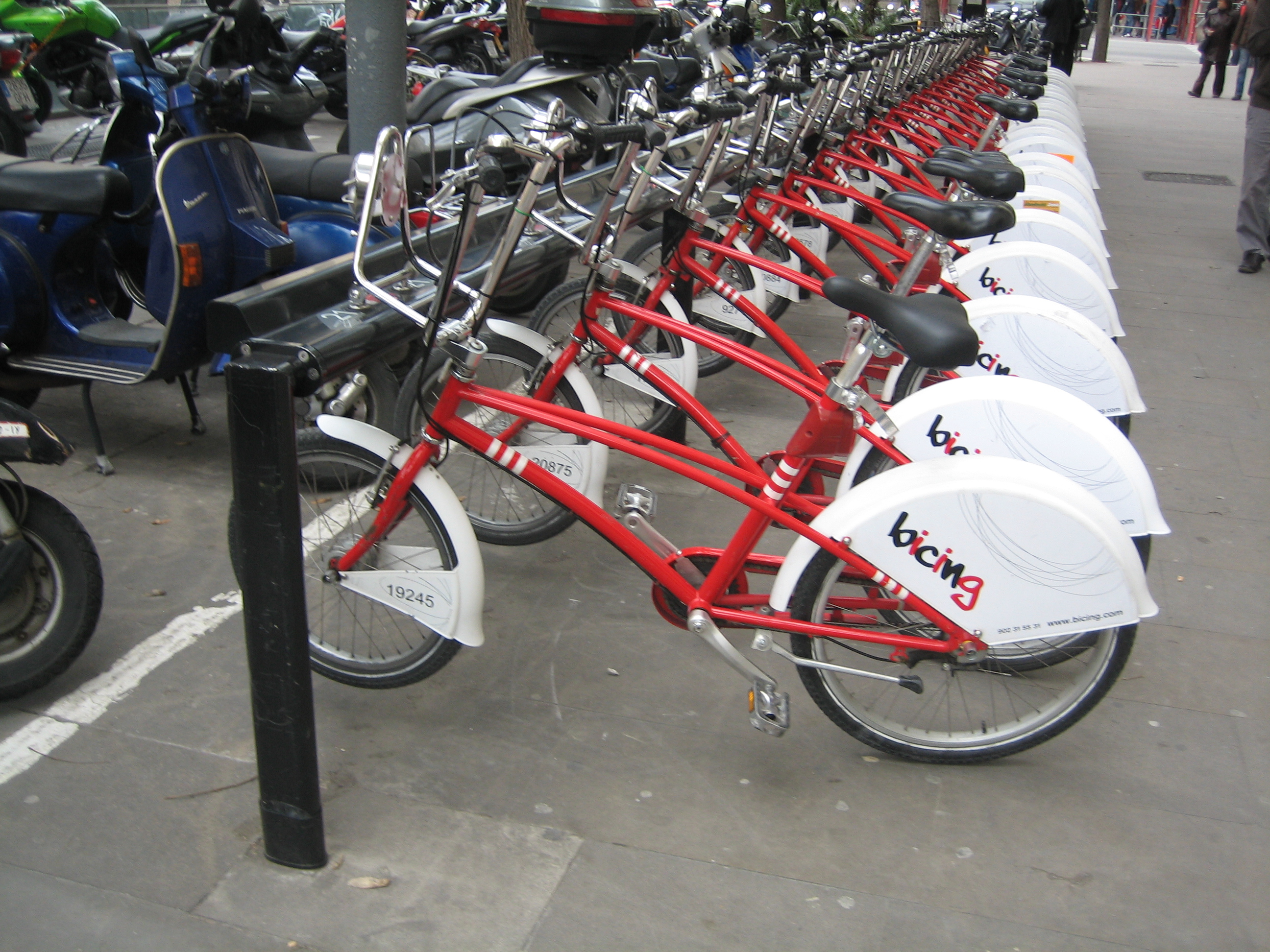
Bike-sharing Barcelona
To get the blog active again after a lengthy summer lapse, I’m publishing here a brief article gleaned from some of the Italian-language sites, translated loosely by me and Google. The original (author, francesco100) is at http://noparcheggiviaalbalonga.wordpress.com/
Barcelona in 2007 decided to establish a bike-sharing system, called Bicing, which along with a more modern network of cycle paths would provide a serious alternative to the car. There are over 400 bike sharing locations around Barcelona, containing over 6000 bikes. If you consider that Barcelona and Rome started their experiment with the bike-sharing at the same time, the comparison is merciless. In Rome, in fact, there are fewer than 20 stations with less than 200 bikes, poorly located. Many bikes are lost. We would do better not even to consider the case of Rome.
On August 4, researchers published in the British Medical Journal published the results of research on the health effects on the citizens of Barcelona caused by the introduction of that city’s bike sharing system. Bike sharing encourages people to leave their cars and instead take the bike and public transport. The researchers looked at the effects on pollution and on the benefits of increased physical activity. The result is that every year in Barcelona the bike-sharing program saves lives at least 12 people and reduces emissions of carbon dioxide in the air by more than 9 000 tonnes per year. The effect of bike sharing is a waterfall. More bikes to encourage other cities to leave their cars and take your own bike. Then there is also an imitation effect. However, the presence of cars in circulation is a disincentive to cyclists, riding between the cars not being pleasant. A policy for mobility that keeps cars on the road so would increase the use of bicycles with additional effects on health and less pollution. A self-perpetuating process. More bikes, less cars, and therefore more bikes. But if you do so to increase the use of the car, it discourages the use of the bike and then further increase the cars and so on.
The success of bike sharing in Barcelona was amazing. Of 1.6 million inhabitants, 11% of residents of Barcelona have bought the card, while 1, 7% use the bike-sharing every day. It is estimated that more than 25 000 people every day have left the car to take the bike (or use bike sharing) after the introduction of bike sharing.
Returning to Rome, until 2013 there will be no change to the current policy of inaction on the bike-sharing, bike lanes do not make it, despite the announcements of the city plan for cycling, for the construction costs of the new underground are soaring at the speed of sound (for the benefit of whom?), and in return will provide thousands of more parking spaces for cars, so that those who use the car are as comfortable as possible. And if the British Medical Journal published a study on Rome, what results could we expect?
Dutch Urbanism
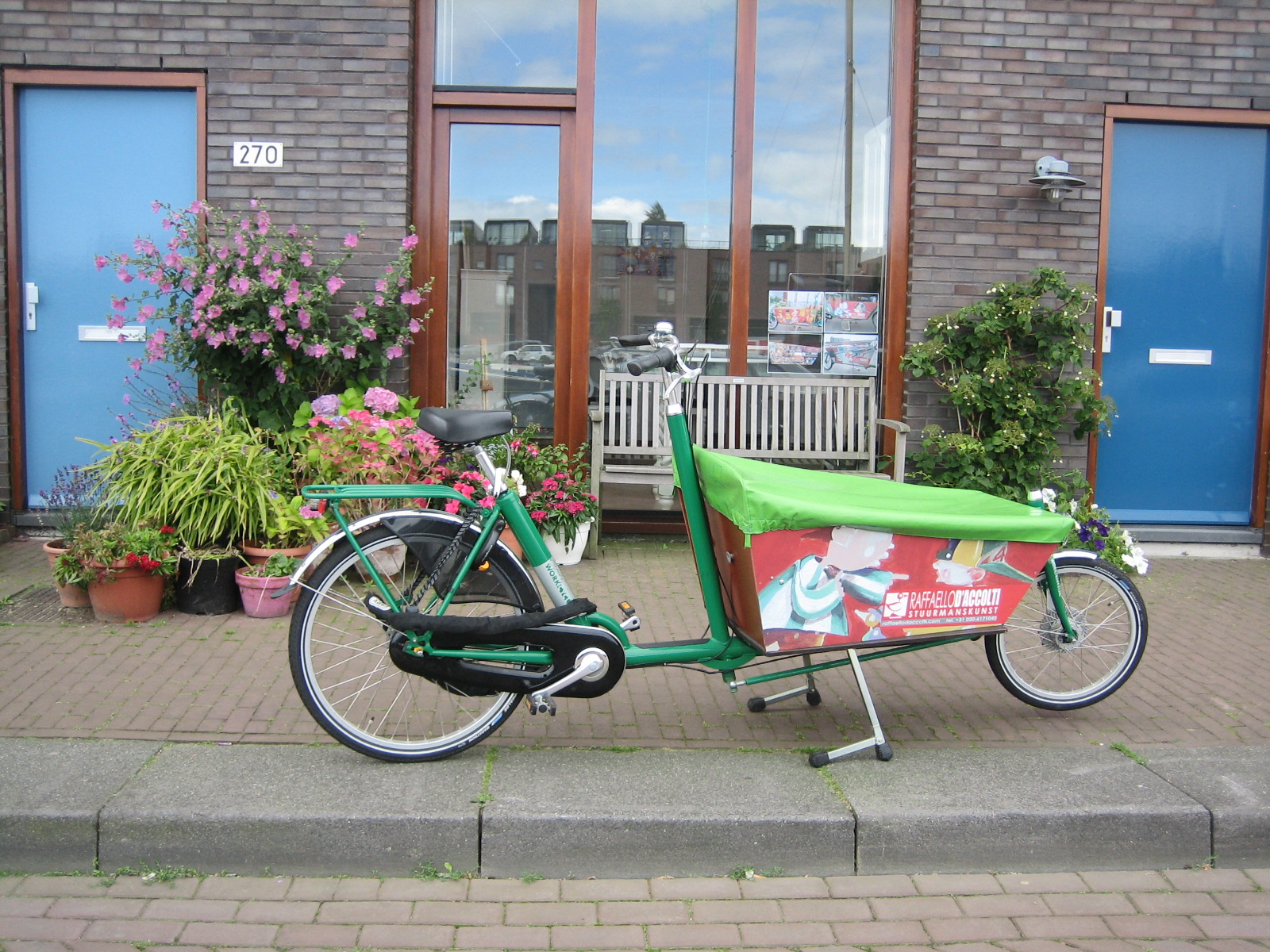
Last weekend I went on a long-awaited reconnaissance mission to northern Europe, to cities that have a reputation for livability and sustainability that Rome can no longer claim. In fact, my trip was bookended by a transit strike the day of departure (resulting in massive delays, confusion, stress and expense) and another potential transit disaster upon my return caused by a fire at Tiburtina Station which shut down much of central Italy’s train system. These problems seemed to be accepted with resignation and little information, absorbed like bad weather about which little can be done.
By contrast, in Holland transit not only worked well, but it was well-used. At Schiphol airport there is a bonafide train station with frequent, economic trains to the center of town. Once there one is confronted with two smart options: walk (or rent a bike) to reach destinations in the pedestrian friendly center, or hop on transit (metro/tram/bus) to go further afield. Cars exist but are a rarity, like an old-fashioned, nostalgic presence amidst more efficient modes of transportation.
Despite terrible weather, cold and rainy, I was able to explore the neighborhoods that interested me, especially Zeeberg and Ijberg, new mixed-use developments on formerly industrial (or formerly non-existent) islands, but also projects from the early 20th century in Rotterdam and Amsterdam, projects where urbanism of a human scale made space for semi-public activities and abundant green (and blue). I saw much new construction, but unlike Rome, where architects are often absent (despite having a surplus of them) here the hand of designers was ever-present. Designers and planners, because on deeper investigation it was clear that questions of infrastructure, water, waste, energy and effective land-use had been addressed in depth, through community involvement and interdisciplinary brainstorming, long before buildings began to emerge. Although neighborhoods like Ijberg were clearly still under construction, the transit system was fully functional, a high-speed tram/train which went underwater at one point making the connection from the central station to the tip of the new island.
I had seen a documentary about the West 8 project for Borneo Sporenberg which explained the rationale behind the planning, and at this point it is clearly a success.
Although Rome is not Amsterdam, there are certainly lessons to be learned. Both cultures share a sense of flexibility; in Holland it has been embraced in the form of liberal regulations but carefully enforced, while in Italy it involves strong regulations weakly enforced, but the result is often similarly anarchistic. In Holland clearly people were free to enjoy city life without compromising others, while Rome still suffers from the privileging of the automobile at the expense of its human master.
Empty public spaces
Two weeks ago I was sitting in a small square that overlooks the ruins of the Imperial Fora, a shady spot with a prime view of Augustus’ Temple of Mars Ultor and Trajan’s Column in the distance. It fascinated me that, even on this scorching afternoon hordes of tourists were baking for hours in the Foro Romano, yet this cool spot surrounded by equally impressive sights was empty. The reason for my unexpected solitude in a place I expected to be a popular destination was simple: the site is simply not on the map for most tourists’ itineraries.
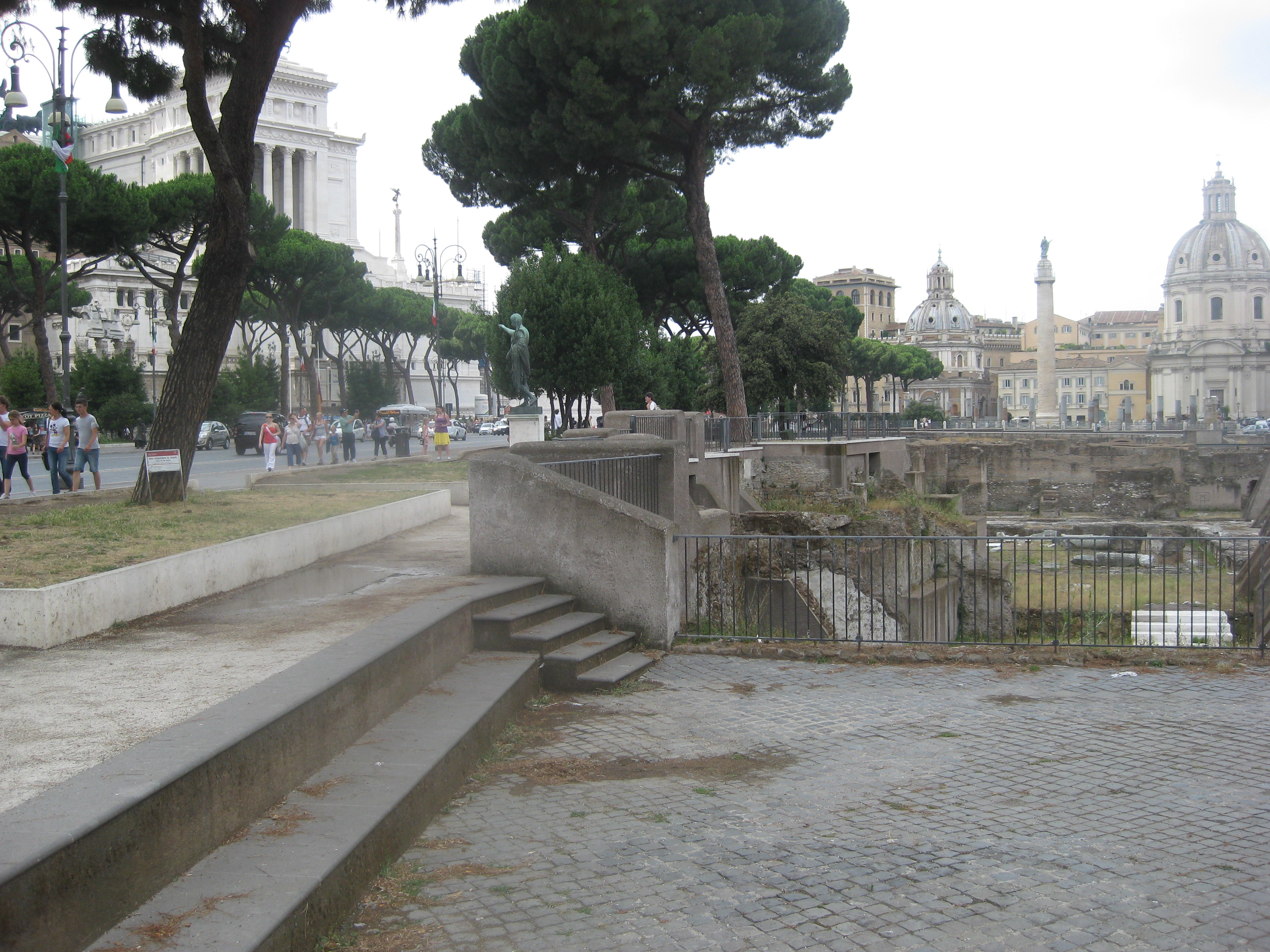
Small square overlooking the Imperial Fora
What strikes me most about these tourist tunnels is how easy it is to escape them. Make one turn off a major thoroughfare and you can be entirely alone on an empty street. The pathways seem to be as deeply rooted as the monuments themselves, carved into the city by road signs and tour groups. If you ever see a tourist alone in Rome, he is sure to have his map out, trying frantically to find his way back to the crowds.
Indeed, it is entirely unnecessary to leave the historic center and venture outside the Aurelian Walls to escape those crowds. The following are my observations of five more public spaces in Rome that, like the Imperial Fora, are completely accessible from major thoroughfares, completely worth visiting, and completely empty. I spent a considerable time sitting in each of these spaces–sketching, reading, or merely enjoying my surroundings– and in each place I was never joined by more than a handful of other visitors, tourist or local, most of whom merely passed through without stopping to appreciate, or even notice, the place they were in. My goal in observing each of these places was to discover the reason why they are empty, and in doing so reflect on how to turn these spaces into stops on the map instead of places to walk past without seeing.
PIAZZA DELLA REPUBBLICA
In many ways, the Piazza della Repubblica should be the modern equivalent of Piazza del Popolo. Piazza del Popolo was designed as a place of welcome and impressive grandeur, as travelers from the north during the Renaissance invariably traveled down the Via Flaminia and entered the city at this northern gate. Hence the illusionistic symmetry of the two churches that both frame the central obelisk and divide the main pathways southward into the center of the city– the Via del Babuino, the Via del Corso, and the Via di Ripetta.
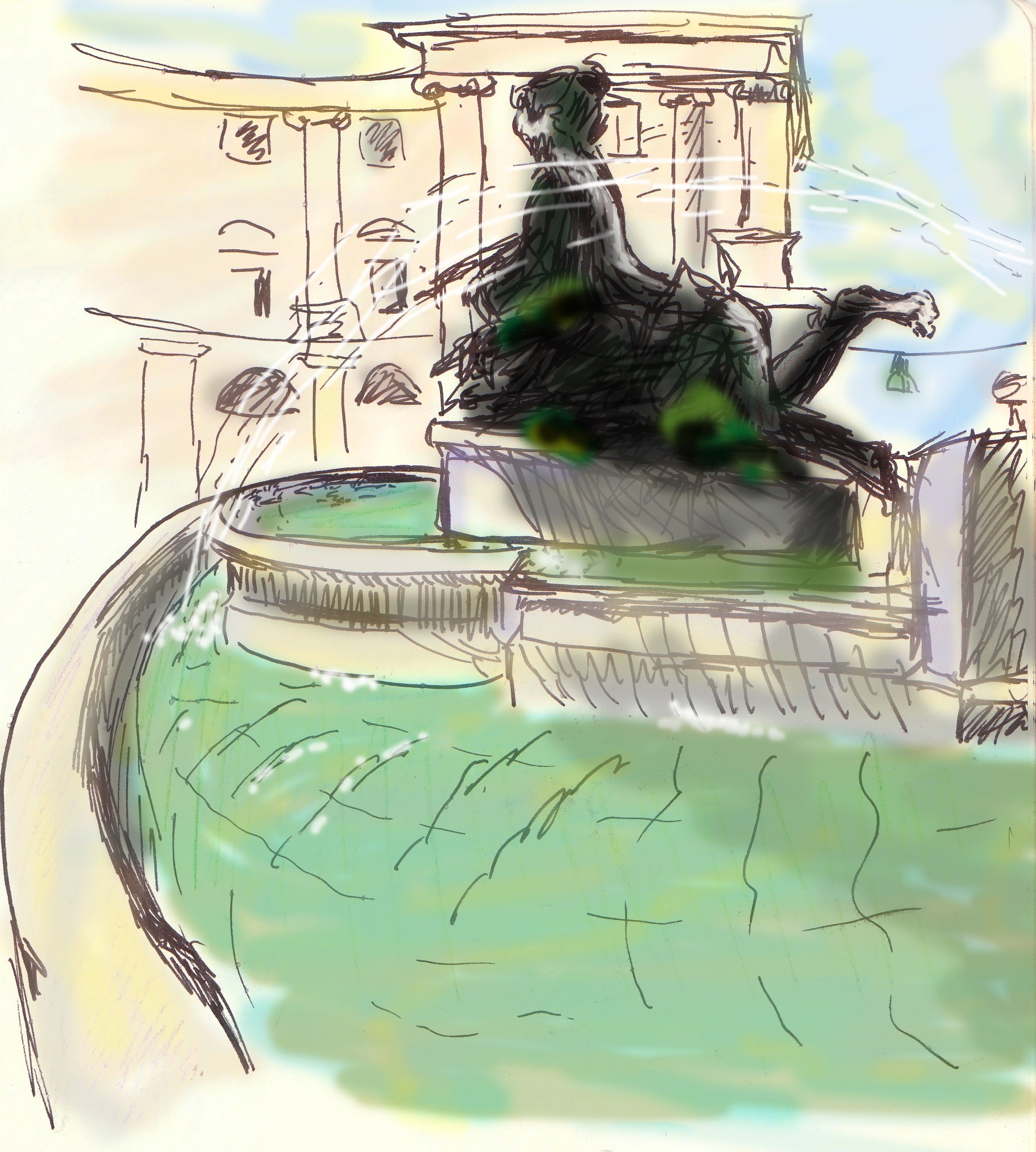
Today, most visitors arrive in Rome at the Termini train station. The view when one steps out the front doors (and past the endless rows of buses and street merchants selling bubble machines and counterfeit watches) is of the grand Fountain of the Naiads at the center of Piazza Repubblica, which takes its circular shape from the footprint of the ancient Baths of Diocletian.
The view would indeed be impressive to arriving travelers were it not blocked entirely by cars and buses on the major road between the piazza and the station.
PIAZZA SANT’IGNAZIO
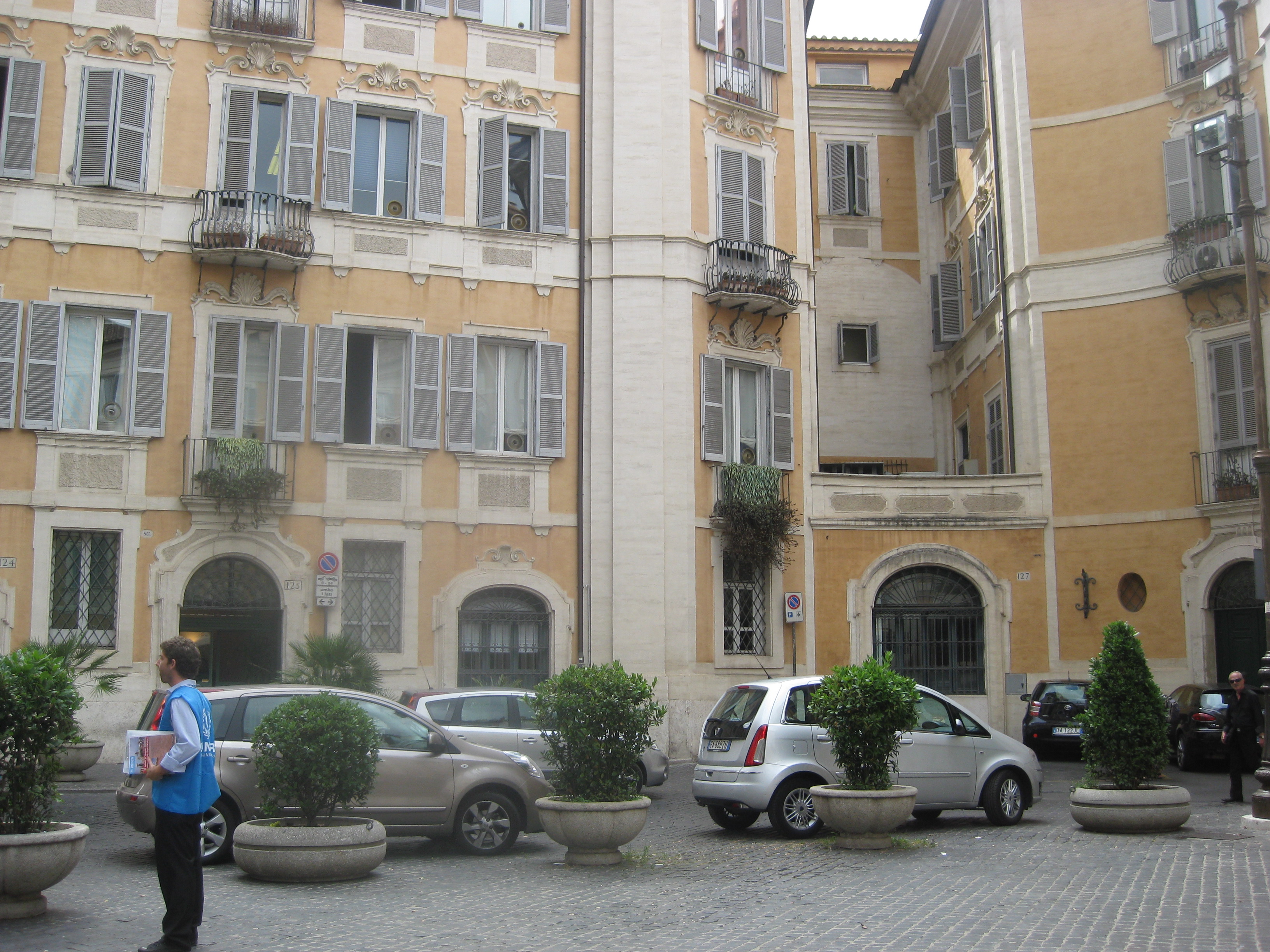
This small gem of a piazza that sits directly on the main path between the Corso and the Pantheon is especially dear to my heart, as I spent my last semester at school researching its construction and history. Designed in the 18th century by Filippo Raguzzini, one of the few Rococco architects in Rome, the piazza has long been tied to the traffic that travels on the intertwining streets that meet there. The 17th century Jesuit church that dominates the square necessitated a larger square for viewing the facade than existed at the time, and Raguzzini’s ingenious solution to the difficult problem presented by the small space created a scenographic setting that creates a semi-enclosed from which to contemplate the the delicately curving apartment houses and massive travertine church facade. It’s nothing like any other space in Rome, and is both architecturally interesting and simply a pleasant spot to take a break from the crowded and noisy Campo Marzio area.
IL TEVERE
To be fair, the banks of the Tiber are rarely frequented by day because, in most places within the historic center, they aren’t particularly worth visiting. The graffiti, piles of trash, and ill-kept pathways that characterize the Tiber are indeed unappealing, and it is quite understandable that the long staircases leading down the embankment walls are usually empty.
But in some places the muddy water, which is an unnatural color somewhere between gray-green and dirt brown, gives way into patches of a cleaner, pleasanter river. One particularly appealing spot is underneath the Ponte Vittore Emmanuele II, just south of the banks beneath the Ponte Sant’Angelo where private venues (like a 10 Euro/day swimming pool) have taken over.
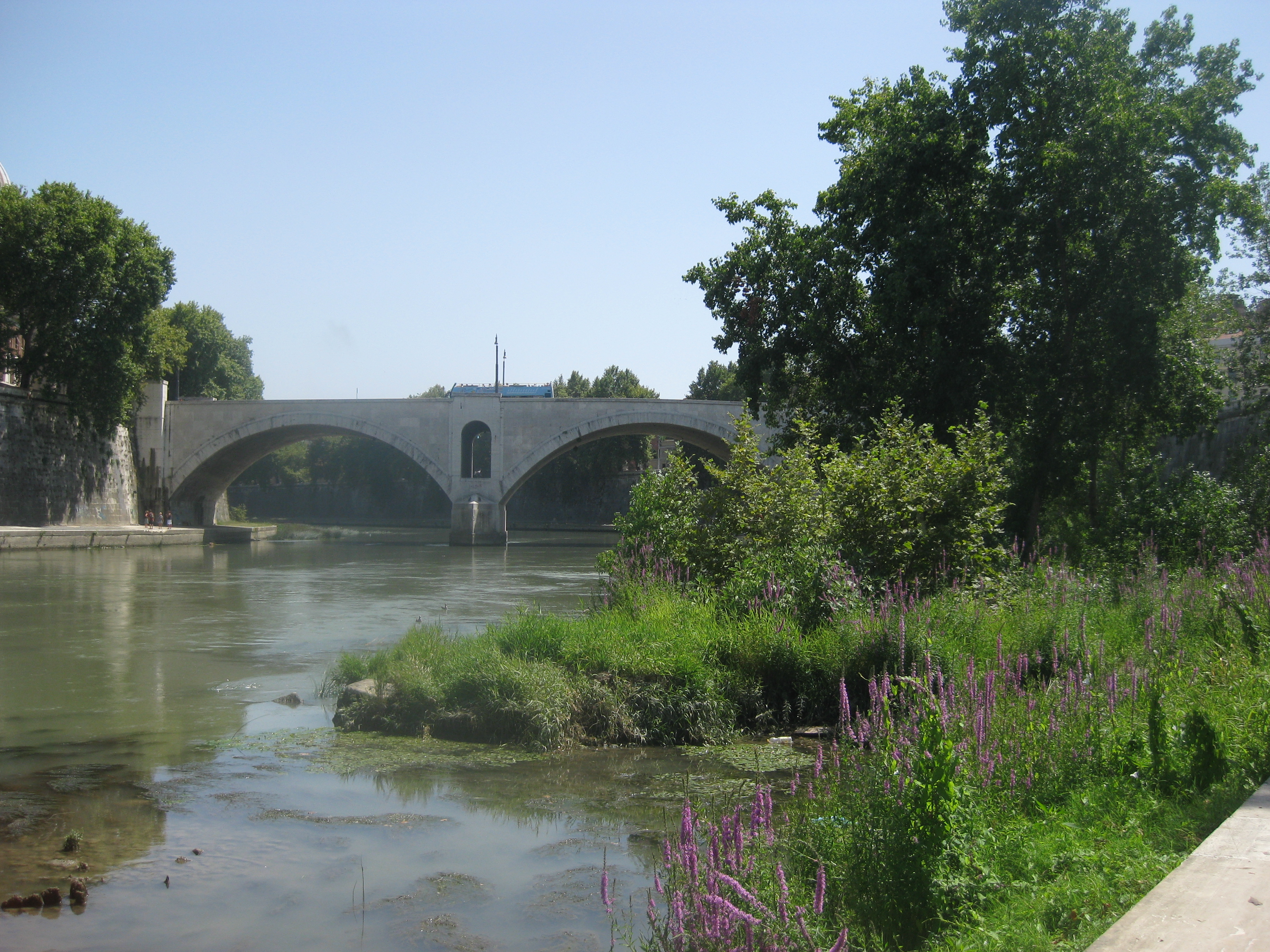
On the Tiber, under the Ponte Vittore Emmanuele.
Unlike the crowded pool (understandably popular on a day with temperatues in the high 90s), my spot under the bridge had no people at all. Its only visitors were dozens of ducks and seagulls, doubtless attracted by the relatively lush vegetation that creates something of an oasis on the otherwise barren and dirty Tiber.
PARCO CARDINALE ANTONIO FRANCESCO ORIOLI
This tiny public “park” (though it’s really nothing more than a few trees and seating areas) is on the Janiculum hill, just south of the Vatican. Though small it is a pleasant spot, with plenty of shade and the kind of views of the city that you can only get from the Gianicolo. Looking up the hill from the banks of the Tiber, the park looks like an invitingly verdant spot perched above the chaos of the city.
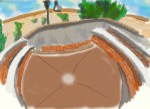
After you’ve climbed up the hill, you find rounded seating areas with cool benches shaded by a canopy of trees, laid out in an interesting terrace of brick circles. Though it sits right above a tangle of roads, the park’s height makes it quiet and serene. As I sat there the only people nearby were a group of locals waiting for a bus and a few passing tourists.
CIRCO MASSIMO
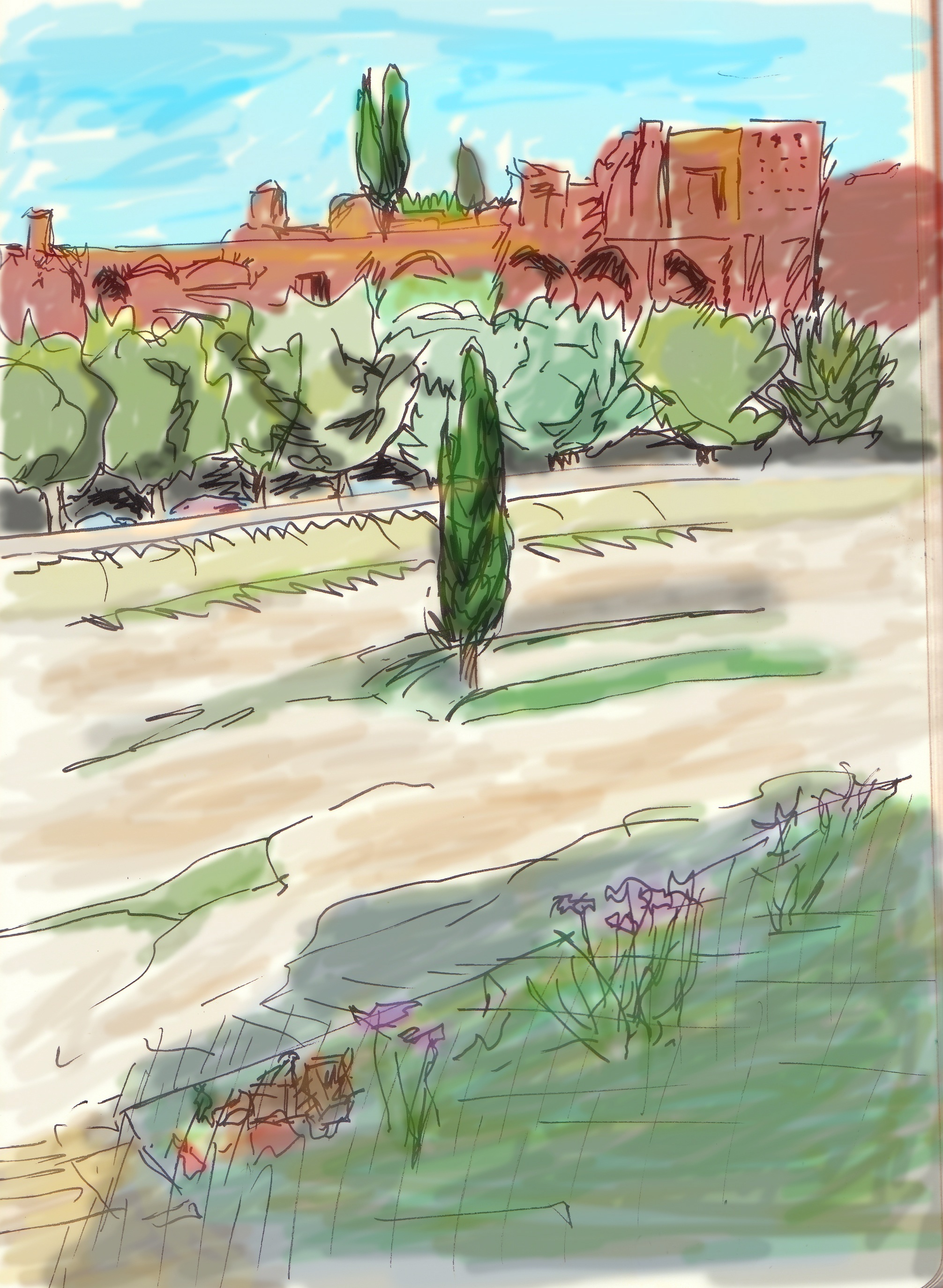
The Circus Maximus is a bit different from the other places on this list in that it is not bypassed by tourists—it is in fact sought out by many as one of Rome’s most famous ancient sites. I’ve included it here, however, because when those tourists arrive they are often confused and disappointed by what they find. The site resembles the ancient Circus only in shape, maintaining the oblong footprint but today containing nothing but patches of dusty grass, construction work, and endless piles of trash. Without much shade aside from a few trees along the edges, the expansive space is not a pleasant place to linger. Yet the site’s history and the fabulous view the raised southern edge offers of the Palatine hill make it worth attention.
All of these places have some common problems that make their seemingly obvious value as destinations somehow unappealing to potential visitors.
3. LACK OF SHADE
One of the surest ways to make people want to spend time in a place in Rome is to provide well-shaded seating. The heat in the city is not unbearable as long as you have a tree or fountain to block the direct sun. A place like the Circus Maximus seems appealing as a wide open green space (if you can ignore the trash and dusty rocks that are more plentiful than grass) but is difficult to enjoy with the only relief from the sun being a few shady umbrella pines around the edges.
4. LACK OF OTHER PEOPLE
Though many people claim a desire to escape crowds and find places of solitude off the beaten tourist path, in reality the biggest draw to a place is the presence of other people. I have no doubt that tourists often pass by the staircases leading down to the Tiber banks thinking they would walk down to the river if only they saw anyone else doing the same.
Sarah Kinter is a summer intern with Studio Rome. She studies Art History at Princeton University.
Paris

Rome is a great place to get away from occasionally, and a recent trip to Paris with my kids was just what I needed to recharge my batteries. We did the touristic things, the Louvre, the Eiffel Tower, Montmartre and the Beaubourg (where I’m sure I saw architect Renzo Piano), but we also did a great seminar with Context and explored the neighborhoods, getting a good feel for the city. Obviously, it is difficult to compare Rome and Paris, the latter being a much bigger metropolis with a different, (shorter) history, simpler hydro-geological structure and, above all, a head-start on its transformation into a European capital. Rome was still a village when Haussman modernized Paris. It would be misguided for Rome to try to copy what works there.
That said, a lot works well in Paris and it’s not just thanks to the ruthlessness of Haussman (who, by the way, when invited to propose a plan for Rome refused, saying that the city was too precious to bulldoze through as they had in Paris). Here are a few of my observations:
- The Seine is a great resource and is used by the city as such, for navigation, for some automotive traffic, for picnics, recreation and art. Its section is more varied and complex than the Tiber’s, where the embankment walls built in the late 19th century offered the simplest, most costly, and dumbest response to the interface between city and river. A boat-ride along the Seine, albeit touristy, provided us an opportunity to understand Paris from a different, important point of view.
- Central Paris has a lot more people and a lot few cars than Rome: the result is a vibrant, elegant, aesthetically-pleasing experience for all the senses, a feeling of safety and civility that has been lacking in Rome for years. By contrast, a walk through central Rome, stepping around big metal hulks and trying to speak over their roar and breath something other than their exhaust, feels pretty backward and poverty-stricken. Paris is one of those cities mentioned in a recent New York times article which discourages private cars, making it physically impossible to park at intersections, on sidewalks and on most streets in the city center; the result is the virtuous circle of better public transit, more bike and pedestrian-friendly streets, and thus more people happy to leave their cars outside the city.
- The Paris metro is old and not always in great condition, but it gets you just about anywhere. Fortunately, Rome is not locked into aging infrastructure as are most global cities. Although big construction interests are foolishly pursuing antiquated mega-projects like the Metro C (which will cost more than the city can afford and most-likely never become a viable transit option), Rome can still make the decision to plan a smart 21st century public transit network. Just yesterday I met with Professor Antonio Tamburrino, the engineer who has been working on sustainable transit plan for Rome, and video-taped our interview which will be posted on a future entry.
- Paris has a bike-sharing system that works. Although we didn’t try it out ourselves, we certainly could have, which is not true for visitors to Rome at present. What’s more, there are clearly marked bike lanes and places to park bikes everywhere. By contrast in Rome the other day I witnessed a priest and a vigile urbano seriously discussing the problem of a bicycle locked to a post outside the church of San Lorenzo in Lucina (while double-parked cars nearby blocked access to the pedestrian piazza). I suggested that if every church in Rome installed a bike-rack it would provide a great incentive for cleaner transportation and help improve the church’s public image. The priest responded saying that bikes are an eyesore.
Despite all this, I really do love coming back to Rome (with newly renewed energy to fix what’s broken and appreciate what’s great).
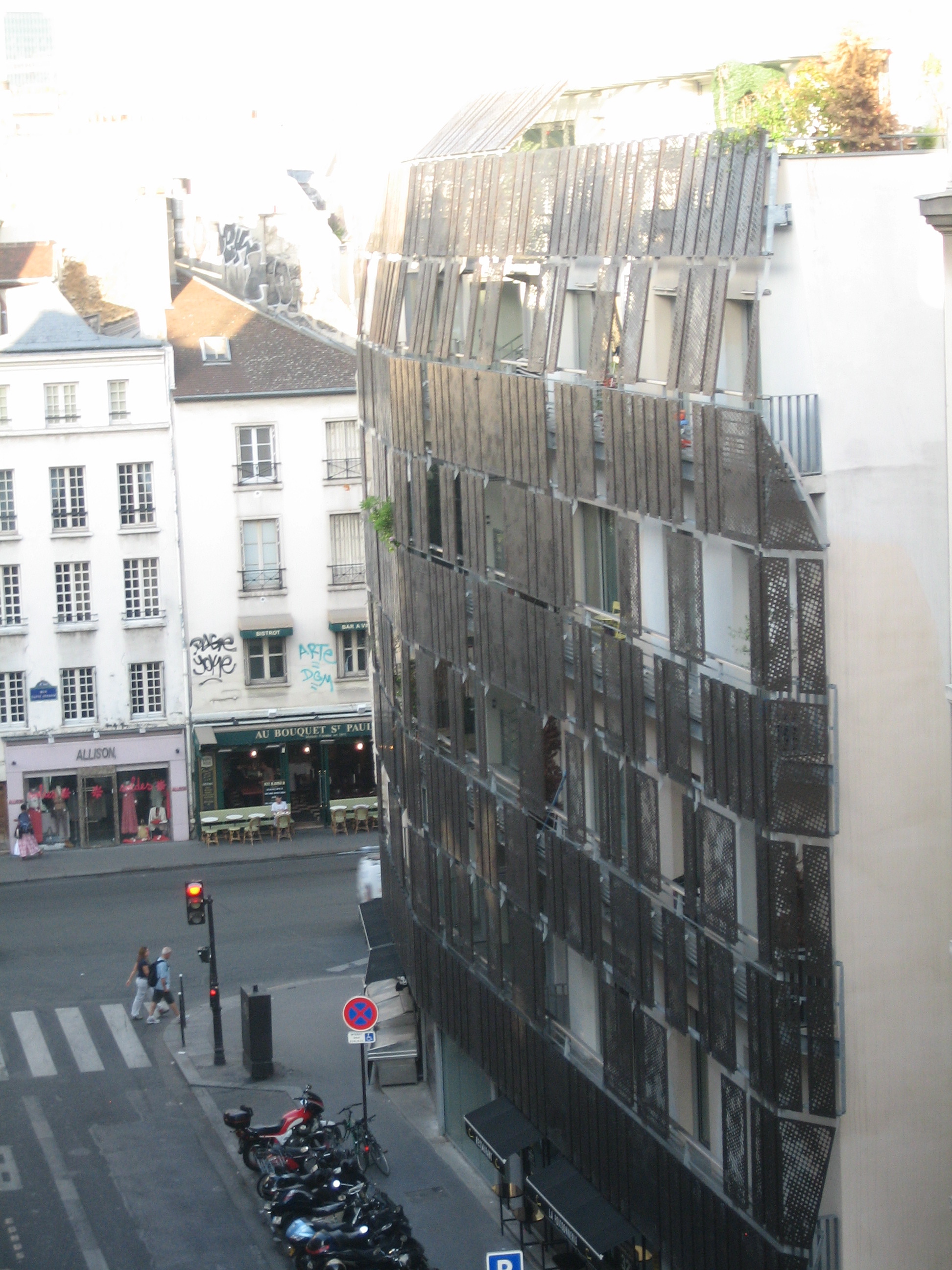
view from our hotel in the Marais: people-friendly streets and green facades
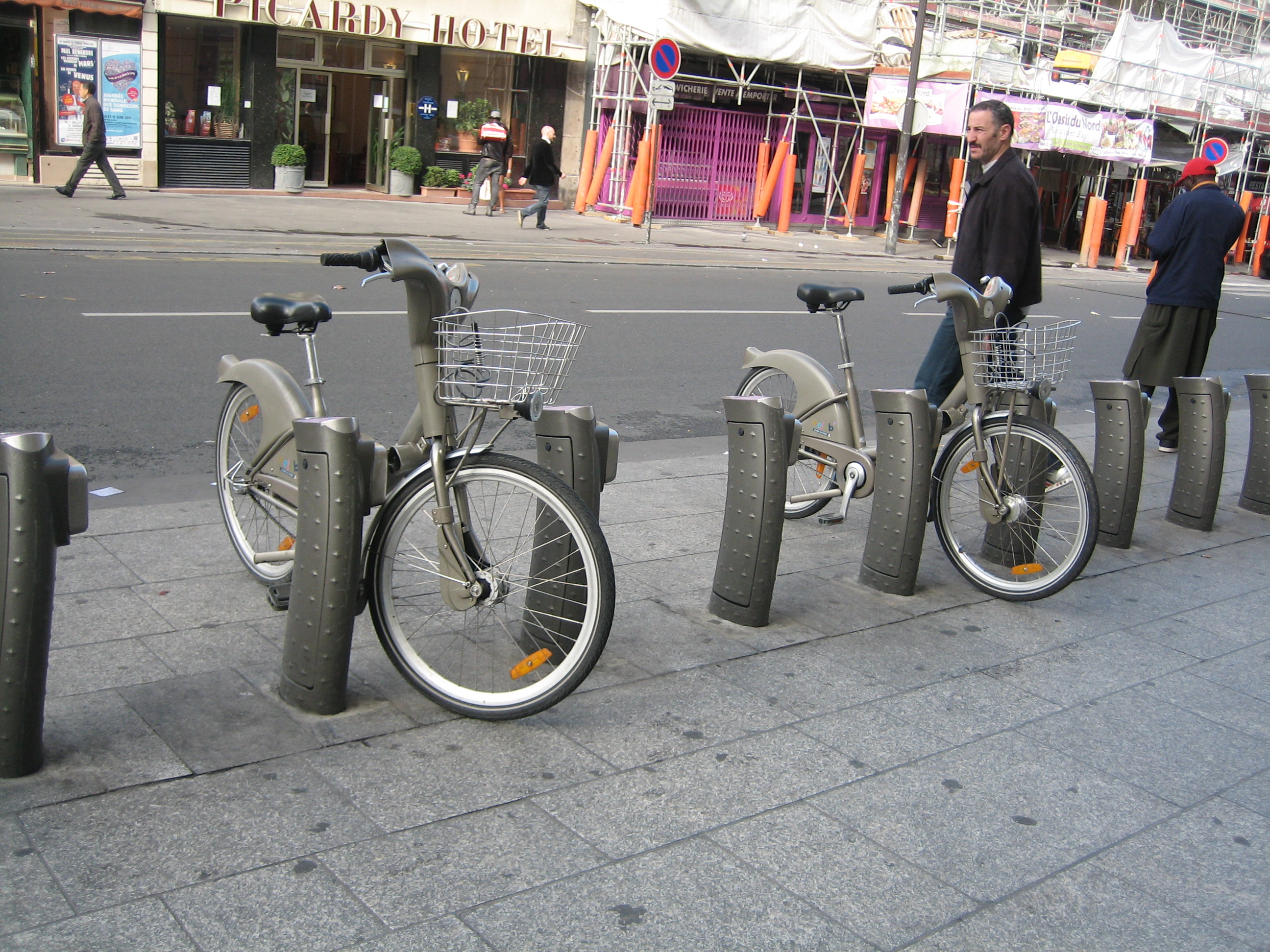
Parisian bike-sharing

City-sponsored urban garden exhibition (at the Hotel de Ville)
Profits from Planning
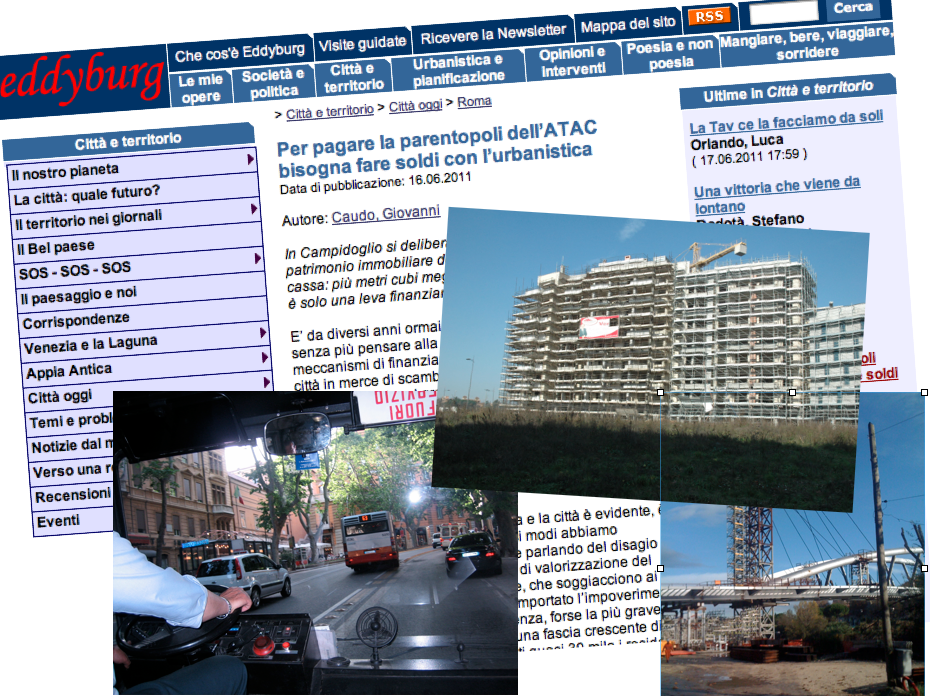
This is the first in what I hope to be a frequent feature in this blog; the translation into English of important critical commentary from the Italian planning, architecture and ecological sectors. Thanks to Web 2.0, social media and the like, words of wisdom travel quickly and travel far. It is my hope that through dissemination in the English-speaking world these observations will have a more far-reaching impact.
Article by Giovanni Caudo published in Italian 16.06.2011 at http://www.eddyburg.it/article/articleview/17143/0/39/.
To pay for its nepotism scandal Rome’s Public Transit Authority profits from urbanism
Deliberation on Rome’s Capitol Hill addresses the “value” of ATAC’s real estate holdings, to be sold to raise cash: the more the better. The city does not exist, planning serves only to leverage a better deal.
It has been for several years now that the planning practice is carried out no longer thinking of the city, of its needs and real problems. The mechanisms of “financialization” that have transformed the city into a commodity exchange in financial transactions are now well known by the public. We are all still living under the full the effects of a crisis that originated right there in those mechanisms. Perhaps it makes sense not to speak of urbanism at all. What we see are degraded practices which have lost any reference to urbs, to civitas and the like: they are just technically assisted real estate operations.
In Rome, the divorce between urbanism and the city is evident, in fact obvious. In recent years we have witnessed a number of ways of talking about the condition of the housing crisis and how the mechanisms of enhancement of existing residential fabric, which are subject to financial mechanisms, have led to the impoverishment of the former middle class. Perhaps the most serious consequence has been to deny to a growing population group the right to the city. In 2008 almost 30,000 residents left Romans to live in the municipalities of the province: from Orte out in all directions, with a growth of 14% over the previous year.
Urbanism “degraded” to economic and financial leverage has been carried out mainly by private interests with the need to leverage debt-based investment, so that huge gains can be made to be reinvested in the restructuring of enterprises, retraining, or mechanisms of capitalization (just think of Pirelli’s adventure with the Telecom Italia).
Today the City of Rome is behaving the same way, urban planning is to make money and “gambled” to save ATAC. The public transport company, overrun by the parentopoli scandal a few months ago, has a deficit of 319.1 million euros, rising debts and risks failure. So the administration decided to put in “sell” orders for the tram and bus deposits and all those properties which complement the public transport but are no longer required to perform the service. Significant assets, the volume and surface, which in many cases is located in central areas of the city. This enhancement was a thought that had already started under the Veltroni administration, the liquidation of the ATAC deposit at Via della Lega Lombards (an area just a few steps from Tiburtina station). A thought which is reflected in a specific provision of the existing plan, as approved in 2008, and paragraph 4 of Article 84 provides that in case of liquidation of these properties it is necessary to draw up a general program that identifies “the maximum usable surface area, regardless of the existing volume (m3) and subject to the limitations and conditions resulting from the application of discipline in article 94, paragraphs 9 and 10”. These limits set the maximum building area index “equal to 0.5 m2/m2, of which at least half is to be allocated to services of general interest or public spaces or local.”
The rule states three essential principles: no increase in volume, built-up area (SUL)equivalent to not more than 0.5 square meters / square meter of land and identification of functions to be inserted, taking care to look at the compatibility with the surroundings. Three principles which Mayor Alemanno’s council plans are not putting into practice. Thus, in the resolution to be approved in the General Plan for the liquidation of real estate it states that for ATAC the limits imposed by the planning code, the existing volume, the maximum area, the obligation to reserve at least half of new construction to public services “limits the potential revenues from the sale of the areas.” In short, in this way you can’t make money and you can’t save ATAC!
Does the mayor not wonder that in some areas the provision of services is not only necessary, but perhaps is not even enough to be able to make the existing city livable? In short, it’s money above all else! So with this premise, the “General Plan for the functional conversion of buildings not essential to local public transport” under discussion, and perhaps in approval by the City Council meeting in Rome June 16 (today) proposes a sequence of forced interpretations of the rules of the plan for the sole purpose of having the maximum possible volume in each area subject to exploitation. The end result (calculated by default) is that on about 130,500 square meters of land area covered by the enhancement, where, under the plan, you could construct approximately 65,000 square meters, half of which is to be given to services for the district, they want to build 141,500 m2 (more than twice) without any constraint for the services. For example, in the former San Paolo garage you can make 18,500 m2 net area (according to the plan there should be 5,000 m2), and a portion will also be residences for 240 inhabitants. The former Vittoria garage in the Prati district, will have a net built area of 18,500 m2, instead of about 8,000 m2 allowed by the regulating plan, and the examples could continue.
You could agree that the existing rules of the plan must be revised because they involve an excess of mechanical algorithms there where problems are complex and each area has a story in itself. You want to change the regulations? Do it, it is certainly not an uncritical defense of the existing rule that we want to support. But you can not change it in this manner, declaring for others, compliance with the plan (sic). This is a procedure that makes it weak and sets the plan up for subsequent disputes. If there is a difference with the earlier administration, it is perhaps precisely here, in the means. You probably would have arrived at the same results, but it would have been done with a little less of superficiality of approximation and inconsistency of technique.
A capital city can not address in this way conversion processes that are so important and decisive for the future fate of the city. It can not rely on such a low level of thought dominated by the single criterion of the commodification of the city. It must draw up a serious plan, detailed for each area, undergo a careful analysis of each area and its context being able to define not only the quantity but also the sustainability of the functions, quality of transformations that it hopes to achieve. In this way it gives rise to a high-level task that could be an example for all other initiatives, which in the coming years will be more and more, regarding the conversion and the transformation of the existing city.
Mr. Mayor, stop. If you want to restore ATAC this is the worst path to take: it will bury the company, squander its real estate and open the floodgates to years of litigation that will be paid at a huge price by the agency. Not to mention the negative impact on the city, but then this is no longer of relevance to the urban planning of the Capitol.
Giovanni Caudo
Reasons 5 through 7
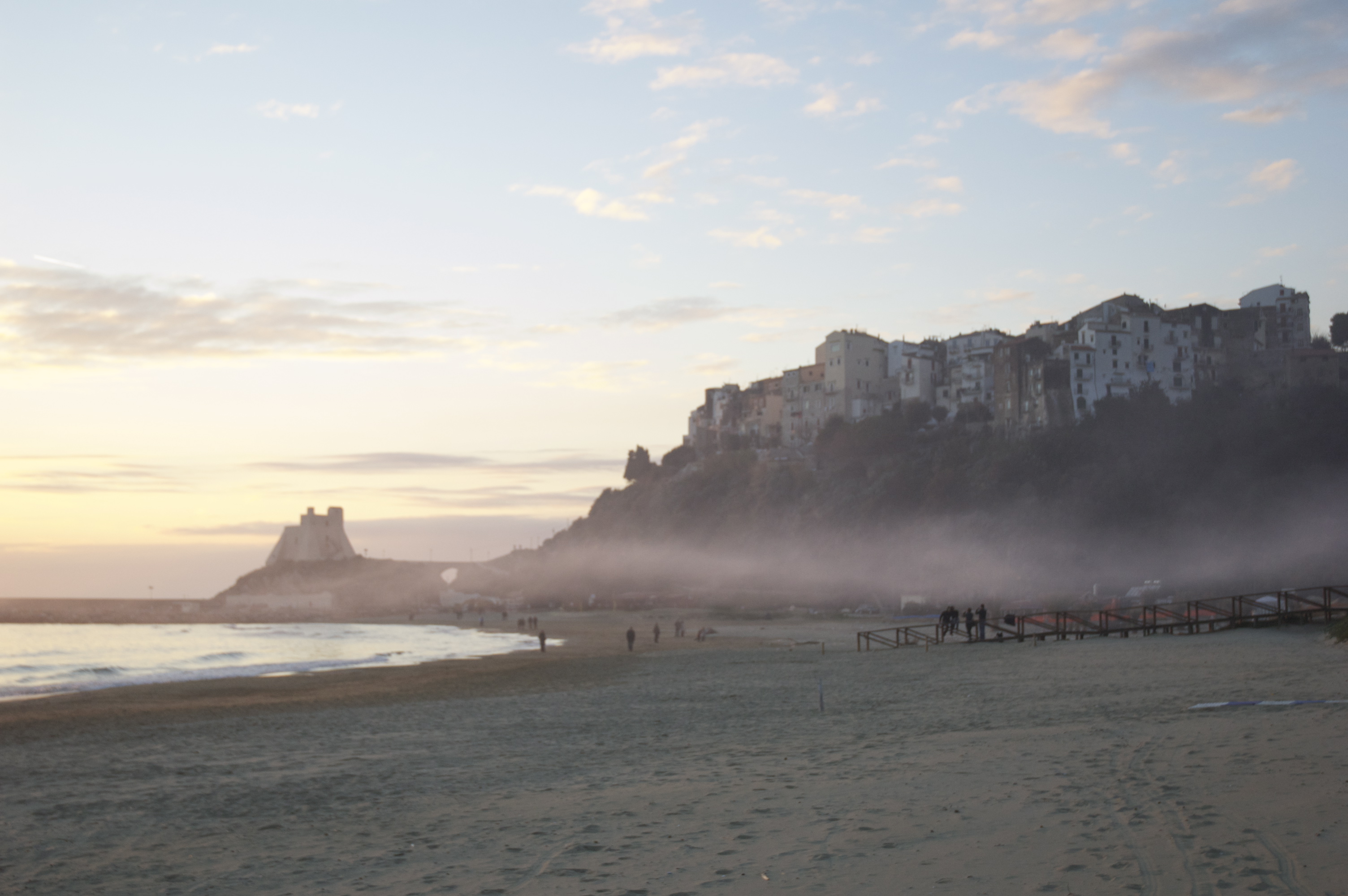
the magical coastal town of Sperlonga, just a train ride away
Here’s the next and final installation in my answers to the big question that people like my friend Fulvio Abbate always ask, “perche’ non torni a Boston?” (why don’t you go back to where you come from)? For parts 1-4 see previous posts.
Reason # 5. In Rome, frugality has yet to be completely replaced by waste. I come from a culture of abundance which has bred an economy based on scarcity. The more you have and the more you consume and discard, the higher your status. In Rome, by contrast, conspicuous waste earns little respect, and excess is often not of consumption but of less tangible things with less direct material impact. A bureaucratic procedure might take an excessively long time, but the outcome won’t be any lasting damage, just like an excruciatingly (for me) long Italian meal doesn’t mean eating more than at a fast-paced American one. Romans are famous for talking, a lot, before taking action but while action often has negative consequences (consumption of resources, emissions, toxicity, etc.) talk rarely does. This ties back into the discussion of quality in Reason 4: one great pair of shoes is often better than a dozen mediocre ones (which leave only a desire for me, further spurring a cycle of waste).
Reason # 6. Variety and difference can never be overrated. I live in a place where in this season I can leave home and be skiing in snow-peaked mountains or swimming at a sun-drenched beach or hiking in a forested national park or exploring the backstreets of small medieval hill-towns, all within a couple of hours. Without even leaving Rome I can bicycle through dnese historical alleys, through wide open parks to grand modern neighborhoods, the normal contrasts one sees in most cities amplified by design. In moments I can pass from the bustling asian markets of the Esquiline to the chic little streets of Monti, after weaving through the nuns and the prostitutes around Santa Maria Maggiore. romans are a minority, if not nearing extinctions, in one of Europe’s most multi-ethnic cities, and in my book this kind of diversity is fantastic. Cultural diversity, like bio-diversity, only makes the species more resilient.
Reason # 7. The public sphere has yet to be entirely swallowed by privatization. I can live a rich and varied life in Rome, only rarely turning to private services for my needs. My children go to good public schools, one of the great attractions of Italy currently under attack. When we need health care, it is well-provided publicly. I can get around the city and the country (really the entire European continent) on public buses, trams and trains. Even without paying for entry into Rome’s countless museums I never lack aesthetic and cultural stimulus in a city where every square, every church, every garden is rich in treasures.
In conclusion, I think Rome (and Italy in general) is at a tipping point, having started to copy some of the worst aspects of American culture, from our bad commercial television to our huge big box stores, from our obsession with money to our blind addiction to cars, from the shopping mall to urban sprawl. But luckily it’s still not too late for Romans to recognize what a good thing they stand to loose and change course. In fact, what is disappearing is the very quality that other developed nations are trying to achieve. It would be ironic indeed if Rome were to make the mistakes American cities made twenty years ago right at the time we are trying to learn smart urbanism from traditional Italian examples.
If you don’t like it…(part 2)
 This is the continuation of this previous post in which I attempt to answer the question “if you don’t like it in Italy why don’t you get the f*k out of here.” Stay tuned for parts 5 through 7.
Reason #2. Just like anywhere, there are a few really good people in Rome. Actually Rome attracts people drawn to the same things that drew me here all those years ago so, while still a minority, the people for whom I feel an affinity seem more abundant here. Certainly more than if I lived in Las Vegas or Dubai. It’s easy to see the jerks, there are so many of them in rome, the caffoni, the prepotenti, the maleducati (many of them in positions of political or economic power which makes them more visible and more dangerous), but when I look at my address book (or the results of this week’s elections in Milan and Naples) I realize that the nice guys are a growing majority. A majority I like to think I’m a part of. Sometimes Rome gets under my skin and makes me less than nice, but I do my best to think positive.
Reason #3. Things are still made and done well here. I guess the word is “quality”, for which there is often an obsession that defies concepts like practicality or efficiency with which I am more familiar. This is true in cinema, Italians being more apt to make a great film rather than a successful one, and even more famously in food and fashion. Sure there are many exceptions which must be resisted and exposed (friends like Katie Parla and Elizabeth Minchilli are doing a great job here with their attentive observation of Rome’s restaurants) , but better to fixate on quality than the lack thereof. A well-made pair of shoes, a finely crafted doorknob or handrail, a perfect plate of pasta…where else am I going to find such a concentration of good stuff?
Reason #4. Even the bad stuff is beautiful. Here I’m stepping into philosophical quicksand, I know, but it has to be said. There’s an aesthetic quality that enriches my world even in the things I find distasteful and despicable. Great design extends to motor vehicles, excessive luxury products, weapons, uniforms, and other things that play no positive role in our society. Religious art, especially that pertaining to particularly despotic times such as the Renaissance, is often really pretty good. I’m a connoisseur of Fascist architecture while being profoundly anti-Fascist. I can even appreciate the personal style of Italians for whom I have not respect otherwise. Let’s face it, many good people in other cultures–and I don’t want to single out Anglo-Saxons– are not so attractive, while every time I get off a plane in Rome, or even approach the check-in area of a Rome-bound flight, I am wowed by the style and charm that even the most obviously cut-throat, neo-liberal bourgeois bigots manage to exude. I don’t know if this is a good thing but it makes life pleasurable.
Stay tuned for parts 5 through 7.
Critical Mass Rome
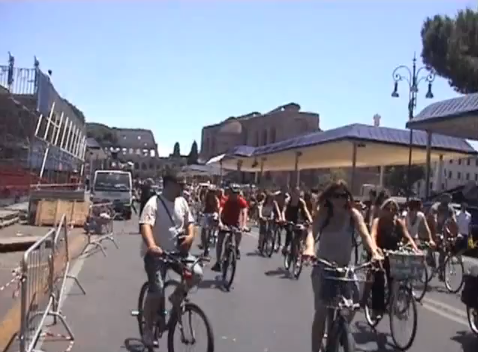
[Sorry about the poor quality of the above image; it’s a screen shot from video since I wasn’t taking stills. My full Critical Mass videos are at http://youtu.be/E-QsnHpAUwI]
I joined two of the three days of Critical Mass events in Rome this past weekend, as I have in the past, and for the most part I advocate this movement to promote sustainable mobility in cities around the world. Like many “every-day cyclists” I do have a few doubts about the efficacy of Critical Mass though.
Question: is it okay to block traffic by going through red lights? I personally prefer a form of militant legality, stopping when the light turns red (while cars who wanted to run the red curse me from behind), or stopping to let surprised pedestrians cross at the zebra stripes. I suppose this would break up the continuity of the mass, and allow lots of smelly cars to get in the middle of the group, defeating the purpose. But I think the driver watching the light turn green and bikes continue to pass probably doesn’t have too much sympathy for bikers. Some bikers in the Forums say that we suffer the consequences of this pent up anger in days to follow. I don’t know.
In Rome the vast majority of the observers, whether on the street, in apartment windows or behind the wheel of automobiles, seem amused and entertained. One comment I read today claimed that the traffic police hate cars as much as we do and are therefore great supporters of CM. I beg to differ; I saw the vigili do some pretty arrogant things the other day, including gesturing for a motorcyclist (not police) to speed through a light at double the speed limit just as it was changing. Not real human-friendly, never mind bike-friendly.
The great thing about Critical Mass is the experience of riding around Rome without a. breathing fumes, b. being deafened by engine noise and c. risking being hit by motor vehicles. Occasionally I’ve had this same experience when streets have been closed to traffic for special events or emergencies, but until Rome wakes up to the fact that car-free streets are better for everyone the only chance to briefly experience this bliss once a month or so is through militant biking. If that means ticking off a few drivers, so be it.
In anticipation of the objections of motorists who “have nothing against bikers but just want to get home” I’m always amazed how the consequences of cars can be so easily ignored. You just want to get home, but you’re doing so in a 2 ton device that kills about one person every hour in Italy, not even counting the health costs and economic costs. At best it just gets in the way, causing people on foot, in wheelchairs, with strollers to go out of their way to maneuver around you. Your trip home means burning a resource that took millions of years to form and which is scarce–your burning fuel means that my grandchildren won’t be able to. You’re also pumping carbon into the atmosphere contributing to global warming. You just want to get home but future generations may want to just have homes to go to.
I’m sorry but your commute has consequences that mine, by bicycle, doesn’t have. The time will come when critical mass doesn’t happen once a month, it will have been “reached” and motorists will feel pretty silly sitting in their cars in cities flowing with clean, silent, civilized two-wheelers. Until that day, I’ll keep up my daily militant legality and my monthly collective celebration of a clean alternative to cars.
Public Space
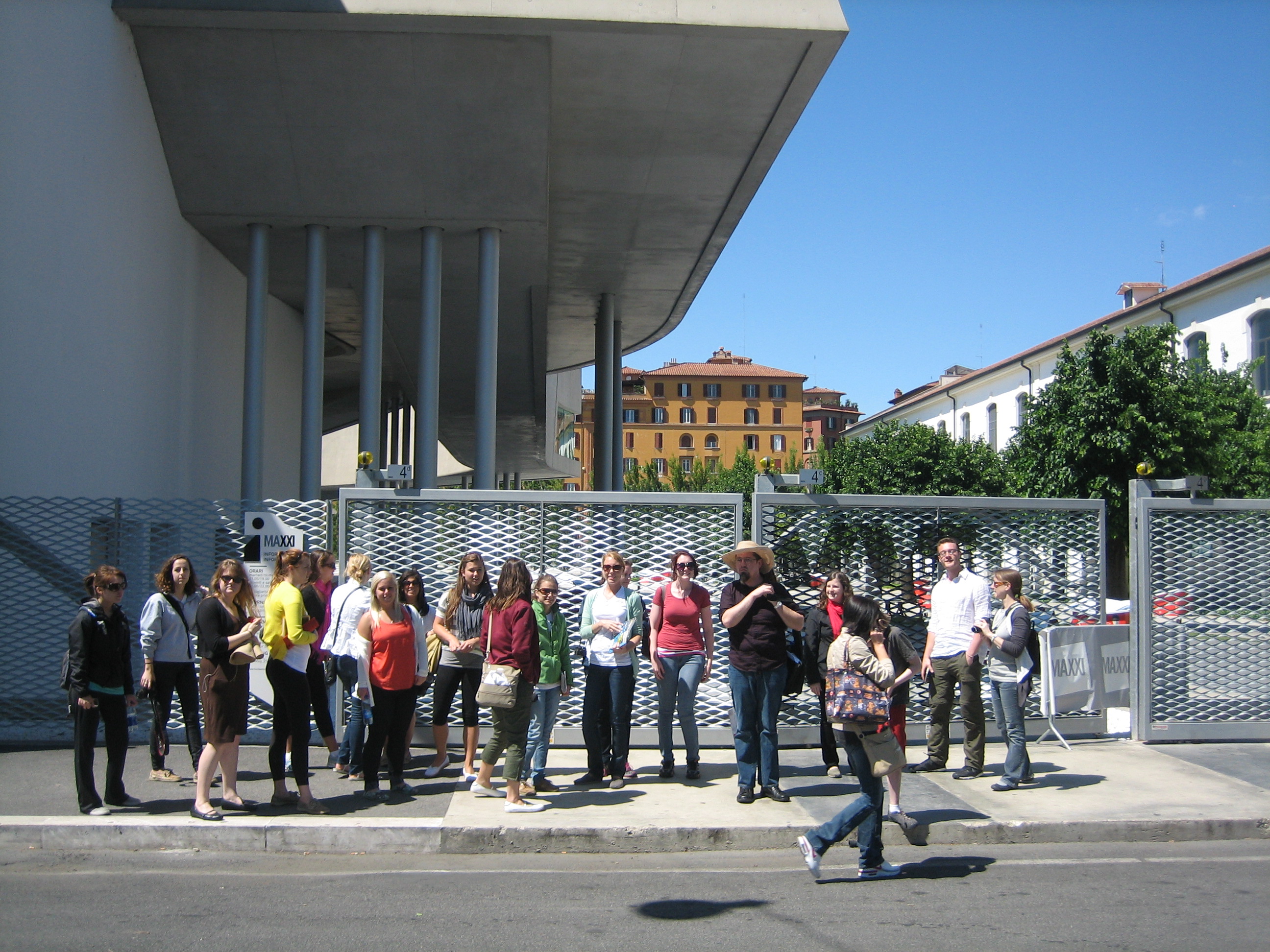
Zaha Hadid's MAXXI, a public space born gated and under the electronic eye.
Why can’t public spaces be public anymore? After a fascinating weekend of conferences at the Biennale for Public Space in Rome (sponsored by INU at the ex-slaughterhouse in Testaccio), today I accompanied a group from Miami University in Ohio around contemporary Rome noting the crisis of public space. Meier’s Church at Tor Tre Teste, walled and gated. Calatrava’s Sports Center construction site; visible from afar. Fuksas’ Nuvola. Off-limits as a construction site, of course, but who knows when it opens what access will be like. Libera’s Palazzo dei Congressi isn’t really gated (and in fact dates to before this current trend) but the rooftop garden, one of the best features, is strictly VIP. After all, EUR is not really a neighborhood but a corporation, EUR Spa (Inc.).
At the end of the day the most frustrating place was Zaha Hadid’s MAXXI. It’s fine for the museum to be closed on a Monday as most Italian museum’s are—recent budget cuts to culture make this understandable–but why does the PIAZZA have to be gated, closed to the public when the museum is closed? I was once told that this is because it contains art, to which I replied that Piazza Navona contains a couple of Bernini sculptures and it’s open 24/7. At least the nearby Parco della Musica is open on days when there is no music at the Auditorium; after all it is a public space.
The need for surveillance and control is a symptom of bigger problems in our cities, problems that can’t be addressed if we ignore the symptoms.
If you don’t like it here…

It is early May and I am sitting at my terrace table, in the shade but appreciating the perfect temperature, the fragrant breeze mixing lemon buds and jasmine. I complain a lot about Rome in this blog, but have to acknowledge that this place where I live is not so bad. Really.
I’ve frequently been asked “the question”, often by victims of my more tiresome rants. It usually takes the form “what the hell are you doing here? why don’t you go back to where you came from?” or something even less polite. These are not exactly questions to which there are rational answers, like “why did you choose Princeton?” I certainly am not in Rome for professional success or economic opportunity. I have no doubt that, had I stayed in the US, I would have a busy, lucrative architectural practice and/or a tenure track academic post. And while my family is now an Italian one, my marriage to a wonderful Italian woman was not the determining factor here. My move here has more to do with aura, with quality, with the poetics of urban life, with lots of un-namable phenomena which add up to something great. So in this and upcoming posts I will attempt the impossible, to enumerate my answers to “the question”. And in so doing, hopefully shed some light on why this “still sustainable city” could become again a model for ecological urbanism and not its antithesis.
Reason N. 1 There are no simple solutions in Rome.
Here the site for any project is already rich in context, not just history but presences, traces left by history. Every problem requires a discussion, an openness to opinions, a recognition of values and diversity. Often solutions seem irrational at first, a surrender to compromise, until over time they are shown to fit rather than dominate. The Theatre of Marcellus, begun by Caesar, completed under Augustus, transformed to a fortress, to a palazzo, to condominiums, but always enriched, never reduced to single idea or image. I am here for the Theatre of Marcellus and countless such places.
Cultural production, like biodiversity, has a tendency to get more sophisticated over time unless interfered with and in Rome this has been going on with peaks and valleys for almost 3,000 years. For Paolo Soleri “the complexification and miniaturization of the city enables radical conservation of land, energy and resources” and unlike “City-from-scratch” projects like Soleri’s own Arcosanti or Jacque Fresco’s Venus Project (both of which I actually appreciate), Rome has demonstrated its robustness. It is no longer in beta.
So the very complexity which for many is a negative trait, a hindrance to “progress”, is my reason n. 1 for loving this city.
 SUSTAINABLE ROME