A Secular Roman Spring
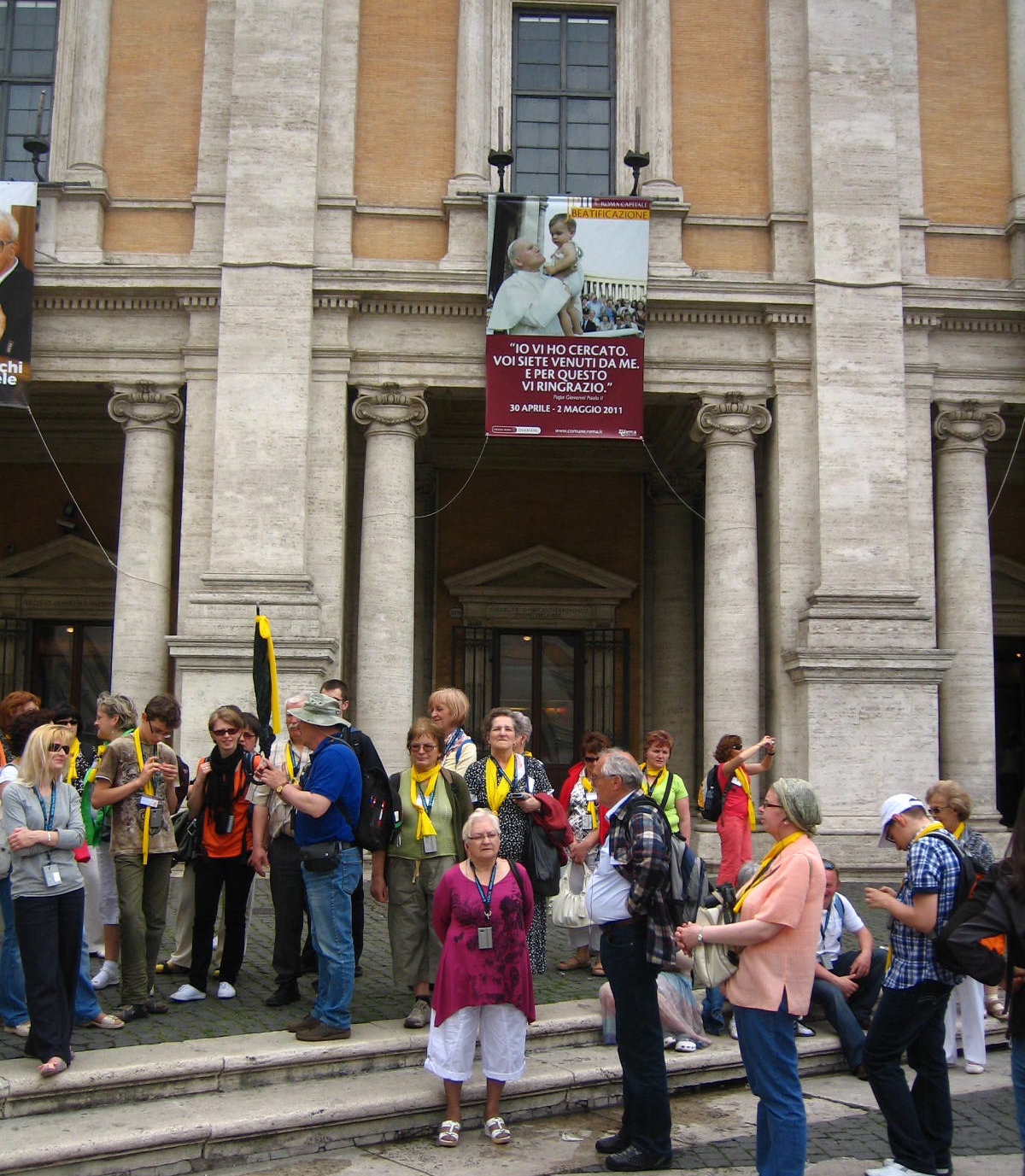
Pilgrims and Papal Poster on the Capitoline
It has indeed been a strange spring so far in Rome. First, back in March we had the Ides (15) of March, the Palazzo Massimo alle Colonne “miracle day” (16), the Rome Marathon (20) and the Spring Equinox (20), some of my favorite rites of Spring, all overshadowed by the celebrations of the 150th anniversary of the Unification of Italy on March 17th. Italian flags, usually only seen during World Cup season, sprouted everywhere. The Comune di Roma (a title which roughly means “municipality” and which is held by all cities and towns above a certain size) had the previous year essentially dissolved and changed its name to Roma Capitale, an entity with a unique status as the nation’s capital. Now the city was decked out to earn that title, at least symbolically.
April saw no let up in the festivities. April 21, Rome’s 2763rd birthday. April 22, the planet’s 41st Earth Day. April 24 Easter , April 25 Pasquetta (Lunedi’ degli Angeli). Sorry, Easter Monday just doesn’t say much, but this is a big holiday in Italy, famous for picnics in the countryside. April 25th is also St. Mark’s feast day in Venice. And April 25th the national holiday marking the defeat of Fascism by the partisans, one of the more important secular holidays in Rome, but this year the secular meaning was overshadowed by the religious pomp.
Not even a week later hundreds of thousands of religious pilgrims started to arrive in Rome for the festivities marking the beatification of Pope John Paul II (JPII was the event’s catchy logo). Only six years after his death, he was on the fast track to sainthood and Rome was again decked out in kiosks and porta-potties ready for a big event. Where a month earlier there had been speeches praising Garibaldi and the defeat of the Papacy by the non-clerical Italian state in 1861, there were now images of the deceased Pope. Outside my studio the night of April 30, hundreds of thousands of pilgrims held a candlelight vigil. The following day, May 1, they flocked to St. Peter’s square to hear the current Pope officiate at the beatification ceremony.
But May 1 is already a holiday, one of the most important in Europe, celebrating workers and labor. Pasquetta had seen people out post-Easter picnicking instead of commemorating the defeat of Fascism; now a week later the Pope was stealing the thunder of the working class. After the morning’s events at St. Peter’s started to wind down, the annual union-sponsored free concert outside St. John’s in the Lateran started to get underway. Commentary about the “two piazzas” was not lacking. There were logistical glitches in both; many pilgrims couldn’t get anywhere St. Peter’s and the sound system at St. John’s, at least when I was there, was on the blink leaving the crowd confused but amused. At the latter, there was a strong presence of campaigning to promote the rights of socially precarious workers, the right to publicly managed water (a referendum will be held in June to fight planned privatization of this precious resource) and to reaffirm Italy’s long-held commitment to reject nuclear energy in favor of safer renewable alternatives. The other referendum in June is a vote to prevent the Italian head of state from avoiding to stand trial in the case of criminal allegations, and there has been a concerted effort on the part of the government to sabotage the referendum campaigns to lower the risk that any of these (but in particular this last one) should pass. I stayed clear of the pilgrimage events so I don’t know if the referendum was publicized there as well, but the Vatican has not to my knowledge taken a stand on any of the issues (although Vatican citizens can vote in the referendum).
During an interview with CNN several months ago I was asked about the Vatican and my only comment was that there seems to be a parasitic relationship between Rome and the “state within the city”, but that it wasn’t always clear which was the parasite and which the host. This weekend, Rome has “played host” on a big scale, plastering the city with images of JPII, kitsch souvenirs, setting up kiosks and toilets and turning a blind eye to pilgrims sleeping in the streets. This latter phenomenon is ironic since the city had just undergone a campaign to evict Rom residents and bulldoze their camps the week before to clean up the city for the event, causing the Rom to seek asylum in the extra-territorial church of St. Paul’s Outside the Walls. Meanwhile, the battle continues for ten families who have lived for generations farming the land in the Aquafredda Park but are now facing eviction, by land’s “owner”, the Vatican.
It’s hard to live in Rome in view of Michelangelo’s cupola, breathing the fumes and risking death under the wheels of “Christian Rome” tour buses and Vatican-plated Mercedes everyday, and not feel a bit cynical.
Walking the Agro Romano
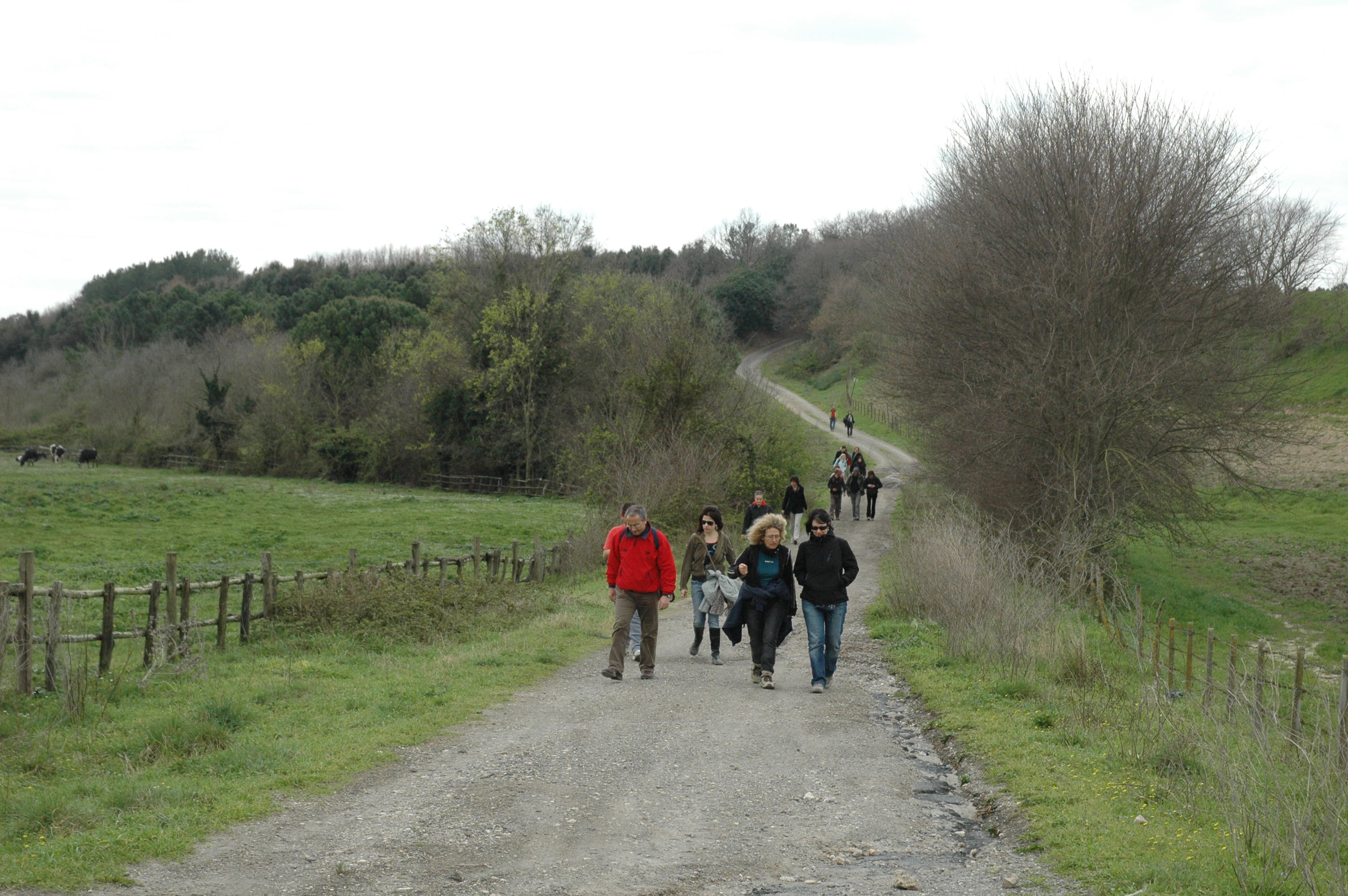
The farmland at Castel di Guido
Yesterday I took a walk in the country. But I also took a walk in Rome, since most of the 20 plus kilometers were within the city’s administrative limits. I was not alone but in the company of 27 enthusiastic walkers under the banner “primavera romana” (Roman spring) whose goal is to experience the city by walking its roadways and pathways, especially those less travelled (at least on foot) by normal people.
I had heard about these outings in the past, encountered mentions on the web or seen them in the various newsletters I get, but the logistics, to date, had never worked to join in. Yesterday when I opened my mail, read a message from Giulia “surfing on your blog I thought you could be interested…” I saw my opportunity. And so I grabbed some things I thought I might need, walked down to the station on my street, and hopped the next train to St. Peter’s (one stop away, just outside the walls of the Vatican) where I caught another train heading north toward Civitavecchia. Of the several appointments announced on the website one was at Aurelia station for the departure of the train I was already on and it wasn’t hard to ID the group as it boarded: hiking boots, adventurous attitude, clearly for most not the first such outing. I introduced myself and before we knew it we were at our stop: Maccarese-Fregene.
If there can be said to be leaders of this initiative and these walks, it would be Lorenzo and Giulia, active in the group Stalker/Osservatore Nomade, a sort of architectural research team founded in the mid 90s. They had mapped out a route to coincide with meetings with local stakeholders, particularly in the area of Castel di Guido where one of two city-owned working farms still persists. This was our first destination and Lorenzo led the way.
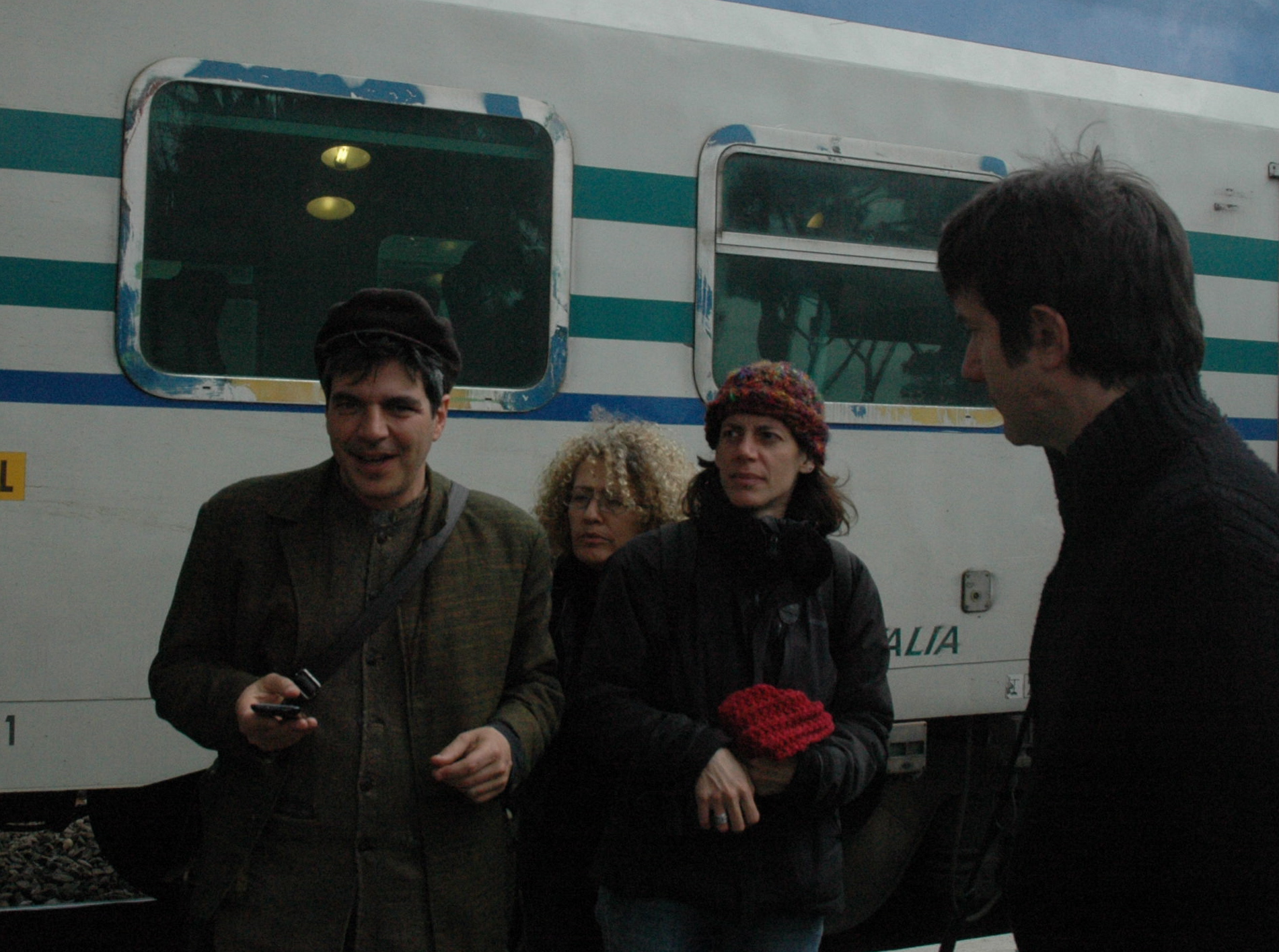
Thanks to the Italian train system, we have arrived at Maccarese-Fregene
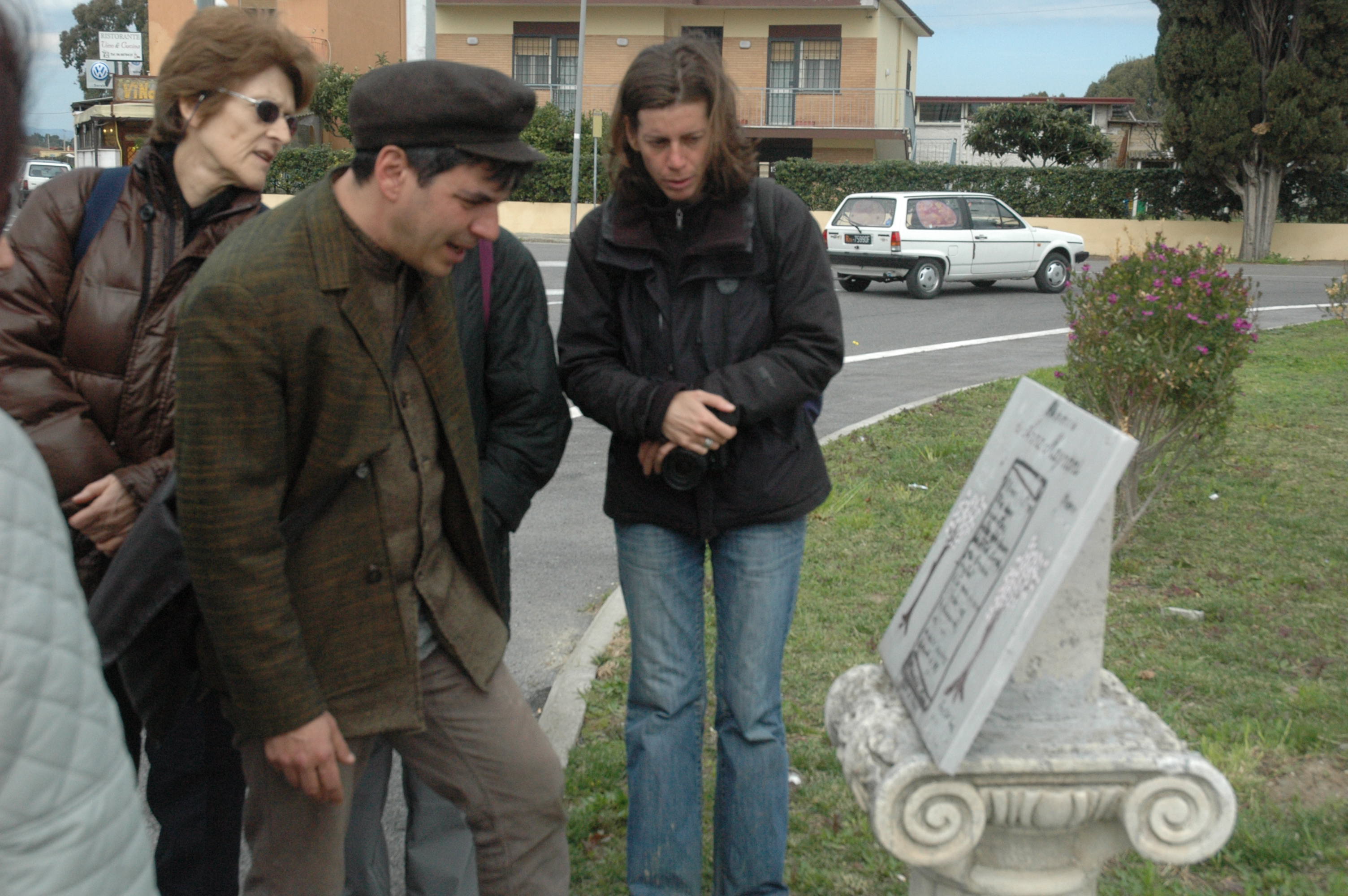
Lorenzo reads a plaque dedicated to Italian actress Anna Magnani in 2000
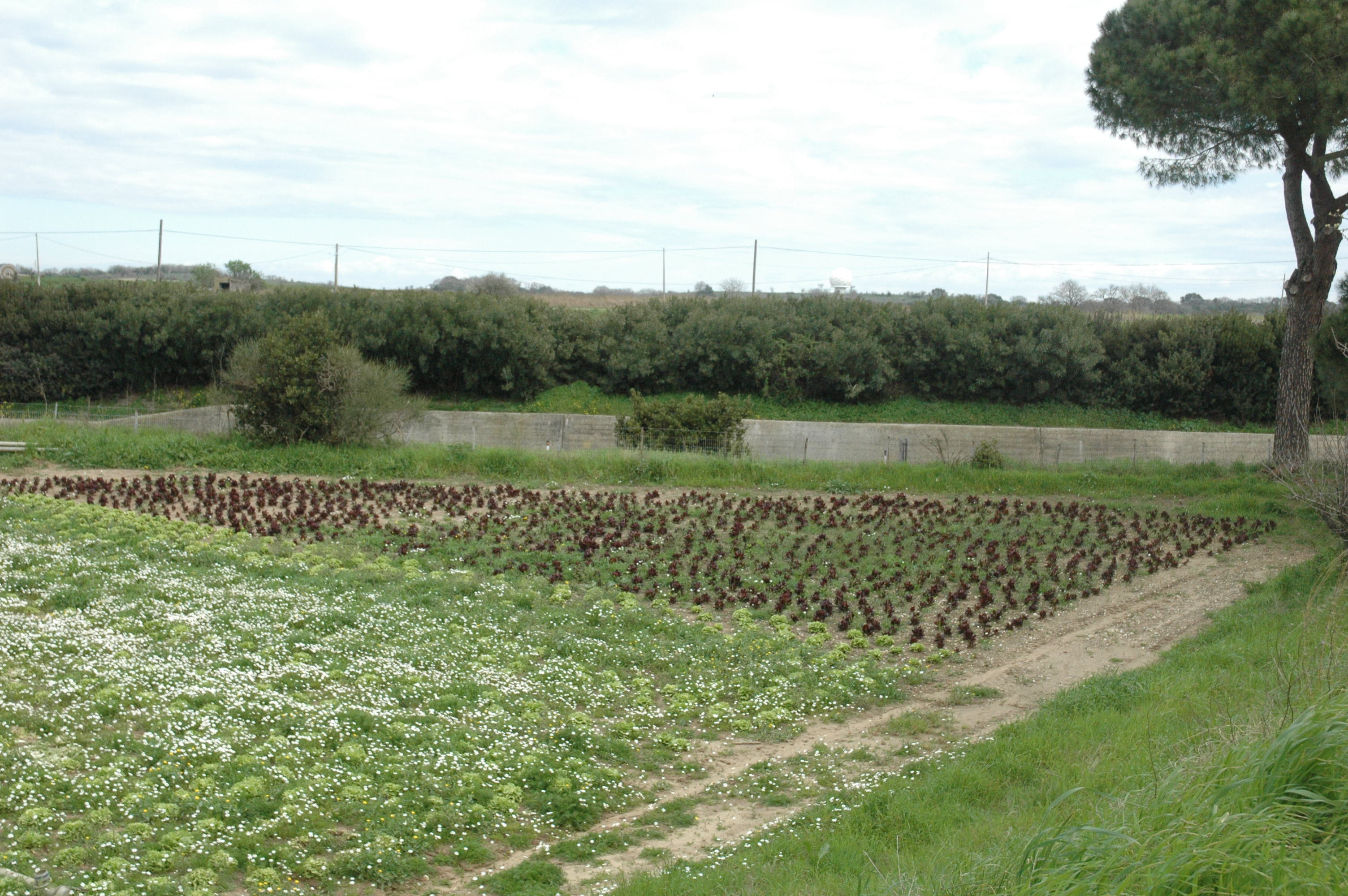
When you fly in to Rome's airport look down; fields of artichokes, radicchio, and more help feed the capital
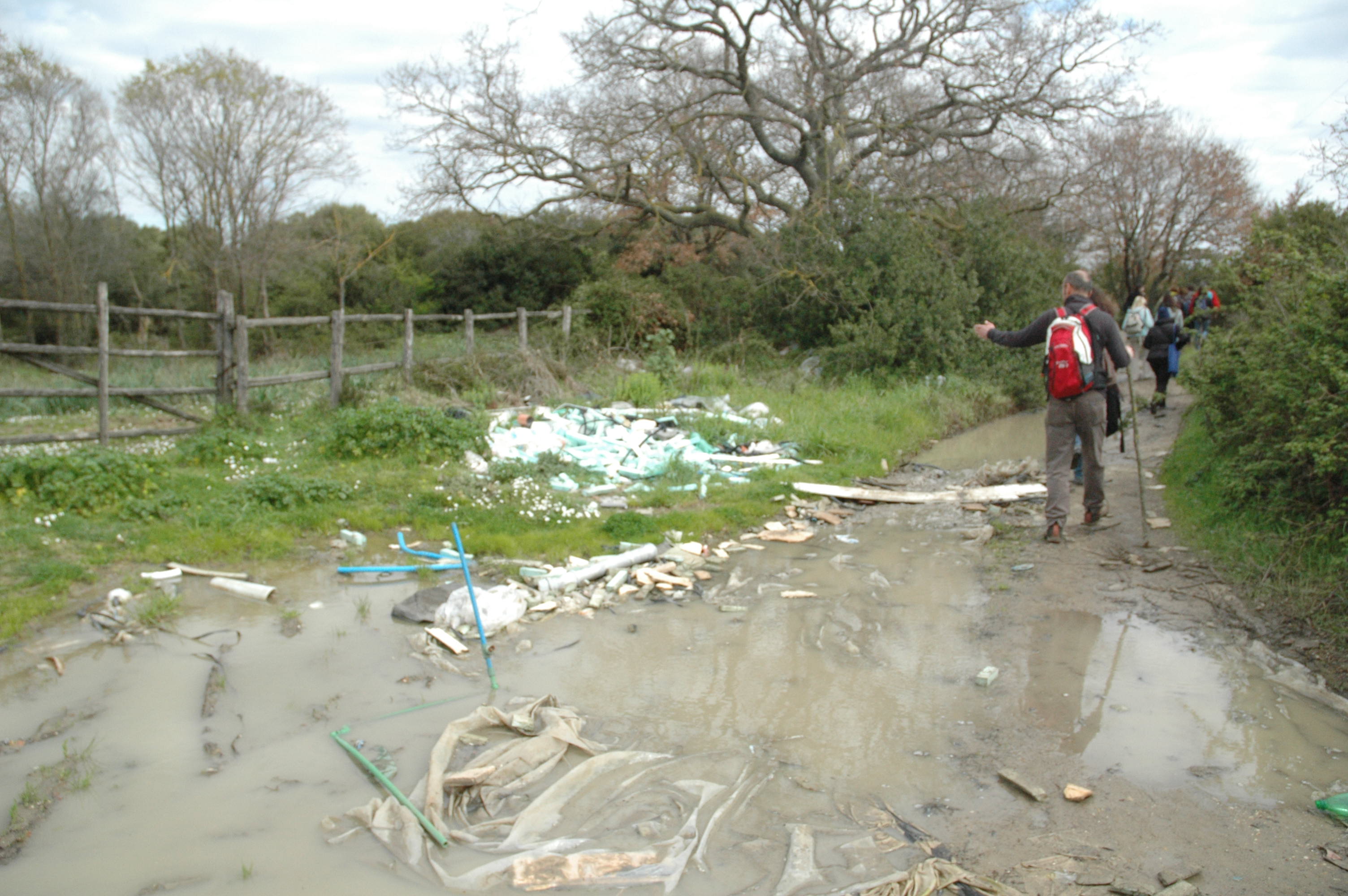
Why is it that where there is a nature reserve there some jerk always dumps waste? Maybe because the nearby Malagrotta dump is full (see previous post)
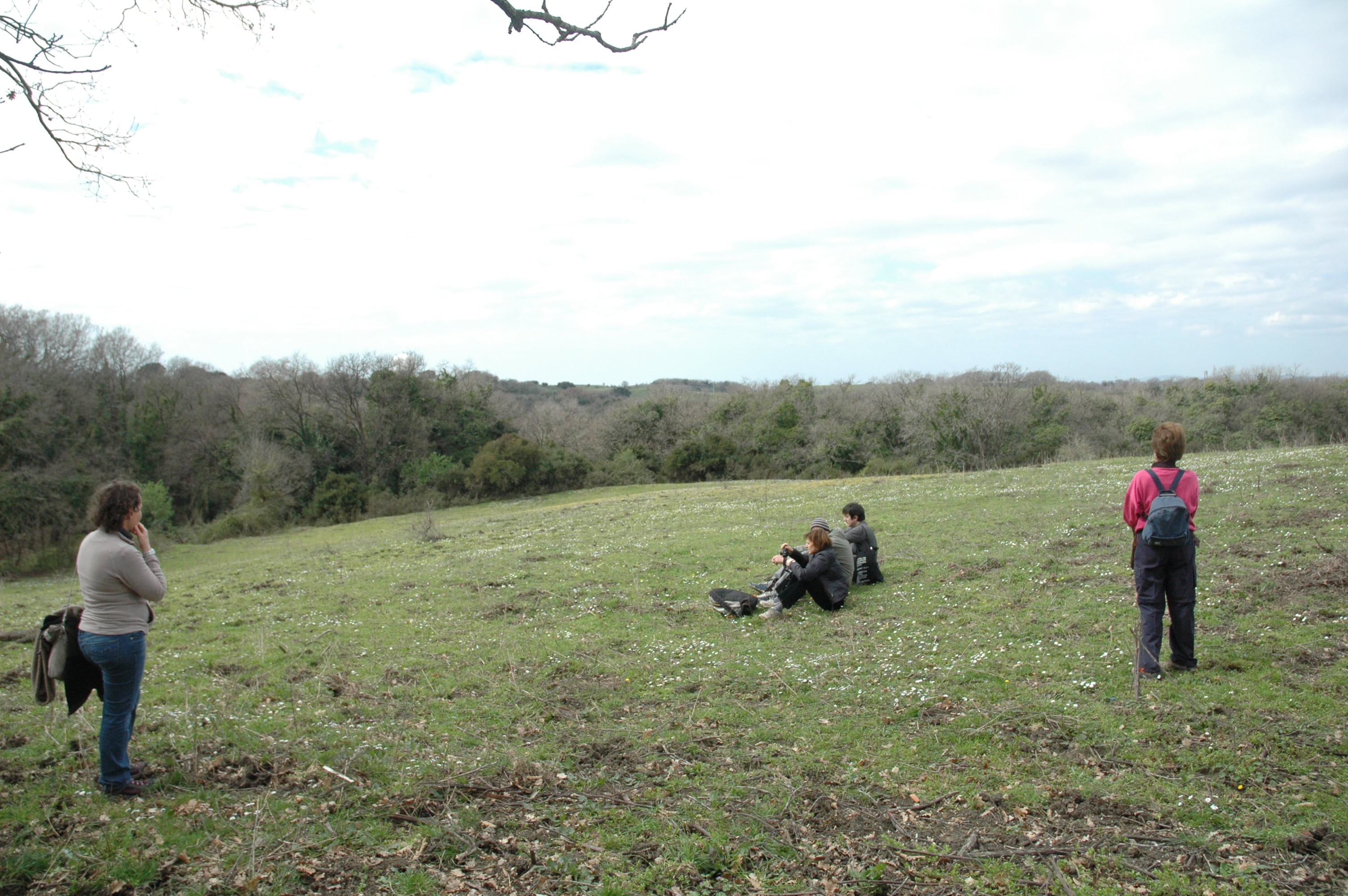
Taking a break in Rome's countryside
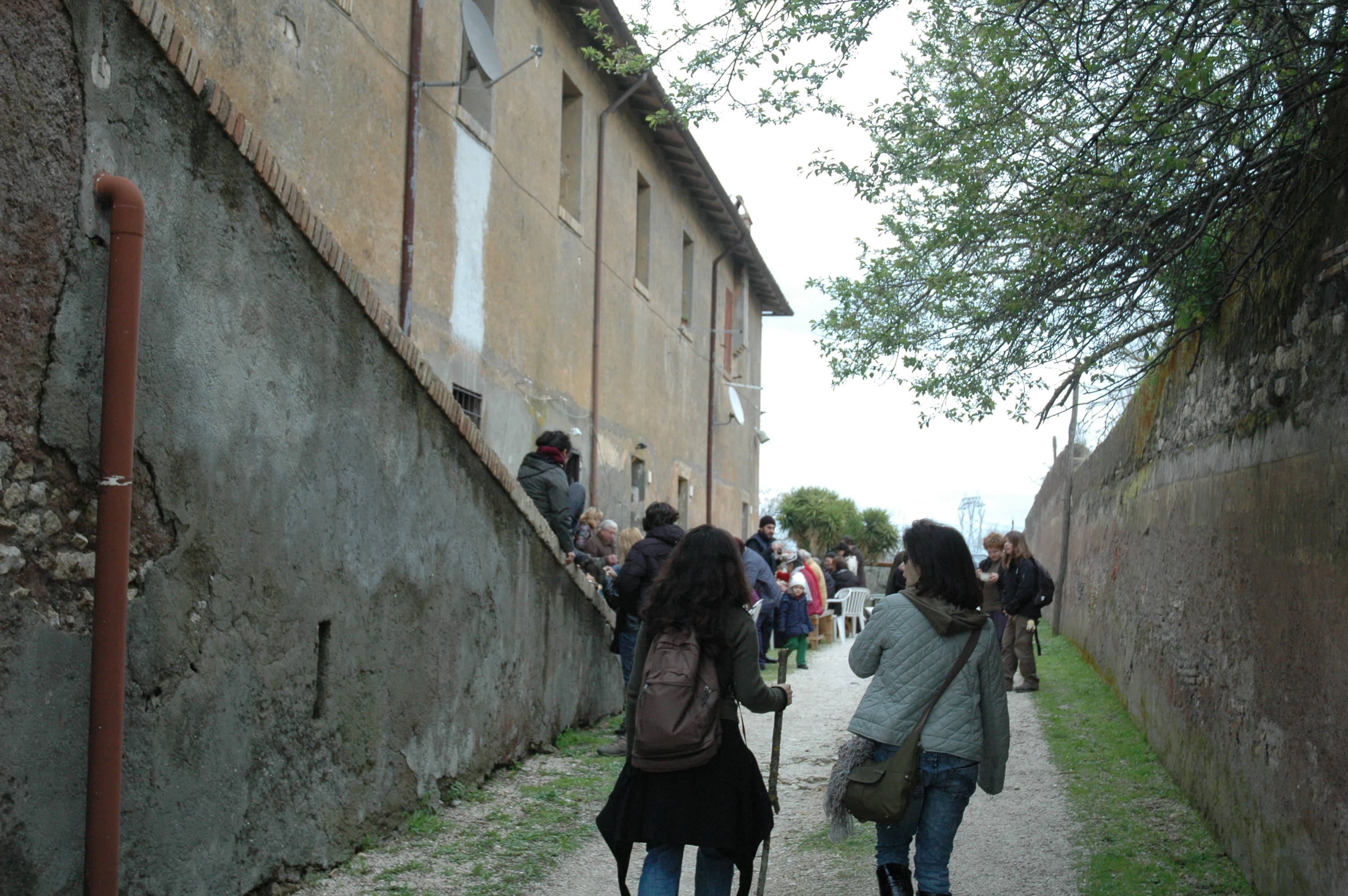
Arriving at Castel di Guido for lunch
Castel di Guido is comprised of several thousand hectares of farmland surrounding a “borgata agricola”, a farming village which still boasts a public school, a day-care center, a public health clinic, a community center, a museum of rural culture and more. Founded by the church-run Santo Spirito hospital to provide food for patients, it became Italian after the unification of Italy 150 years ago and is today faced with the threat of development. Instead of producing revenue for the city the property is actually costing Rome money to maintain, an absurdity which can only be blamed on ineffective management and confused priorities which see in land the promise of economic profit before food. The farm staff has been reduced to a fraction of what it was even 50 years ago but they still produce and sell the results in Rome at the weekend farmers market in Testaccio. We lunched on lentils and soup, local salamis and cheeses and good red wine (a deal at 6 euro per person contribution). We heard from some of the current and former farmworkers who are keeping alive the oral history of the farm. We viewed a video produced by the local associations with interviews and images of the women from the farm. The photos below do better justice to the encounter.
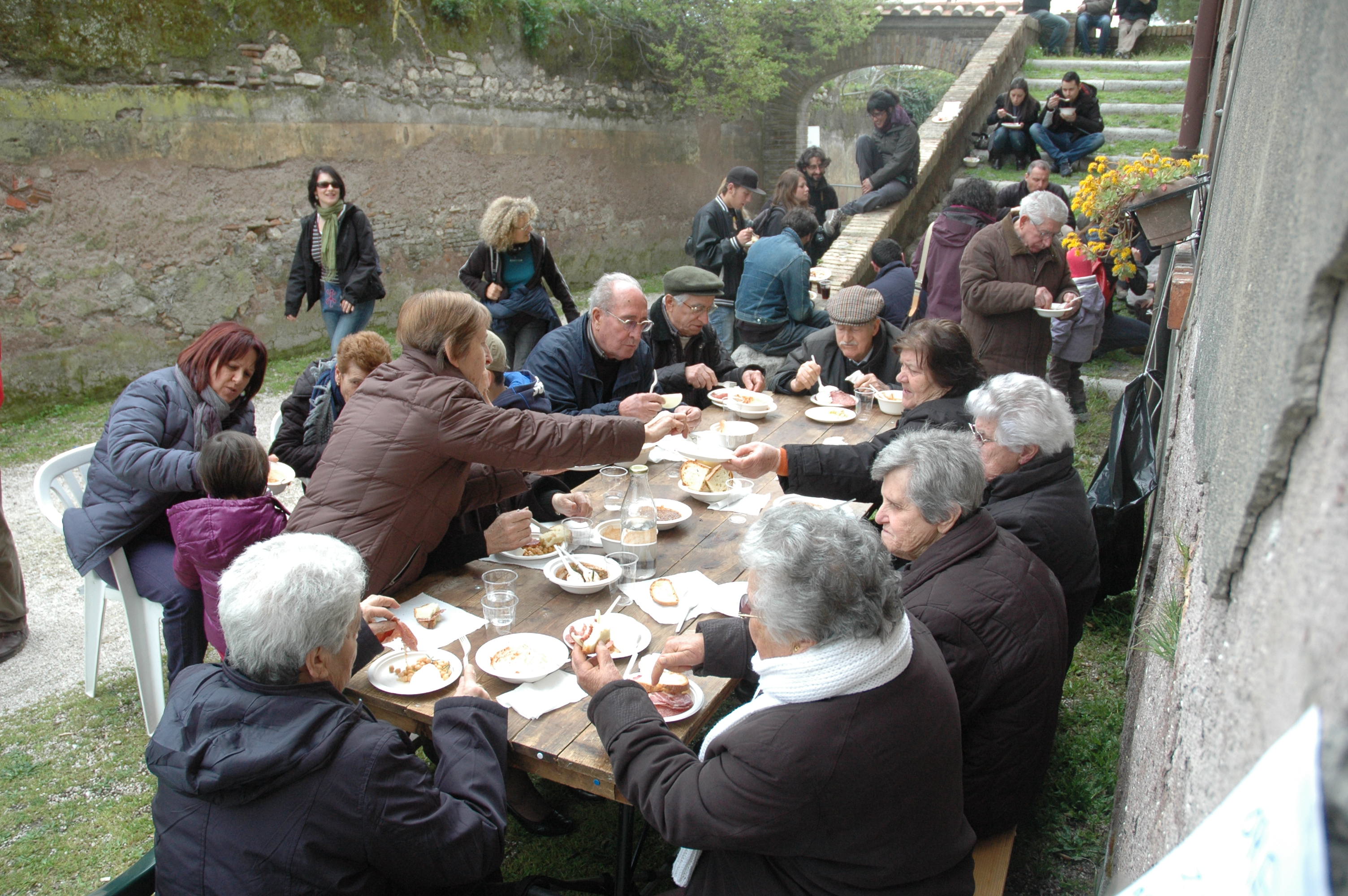
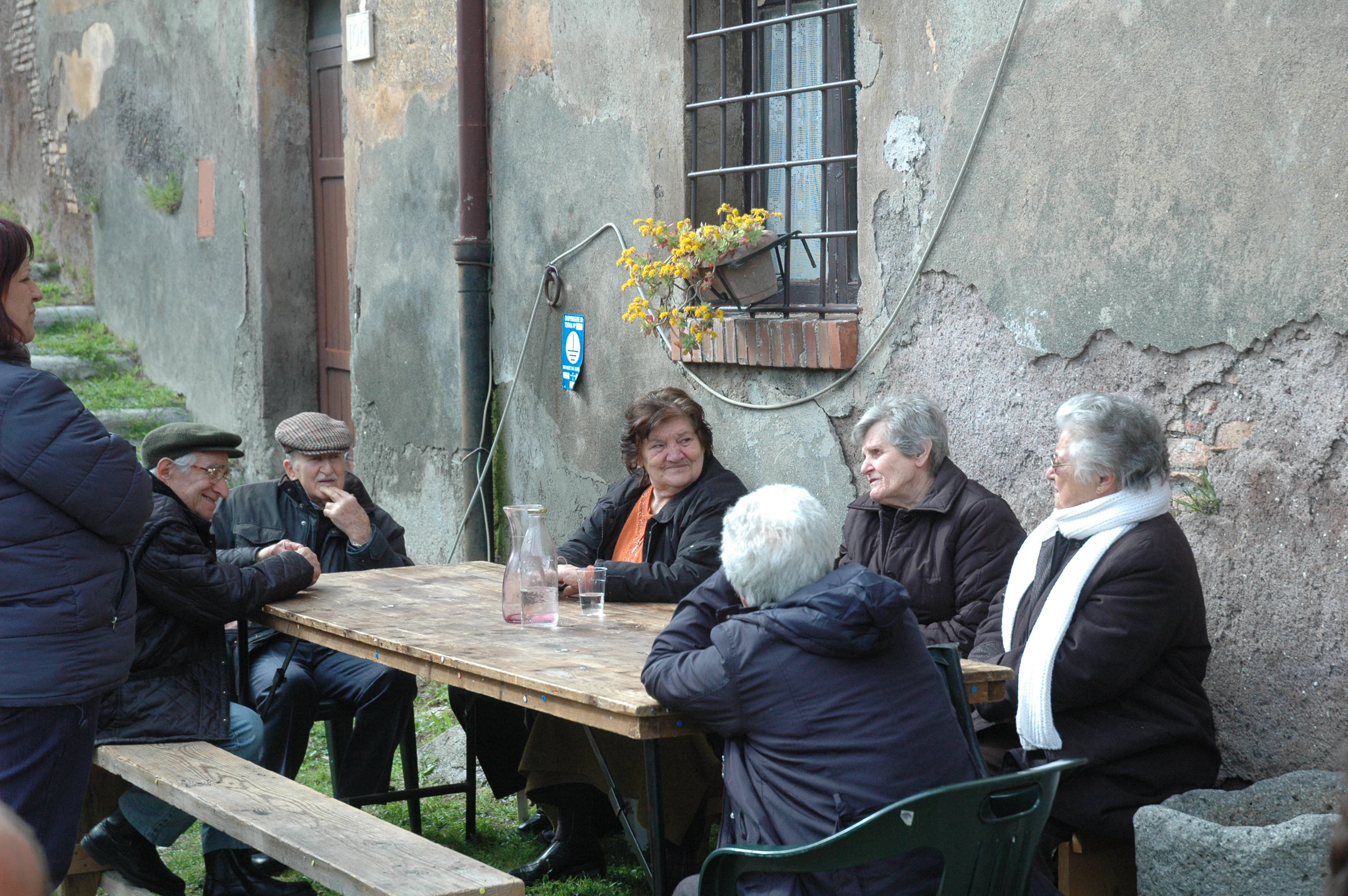
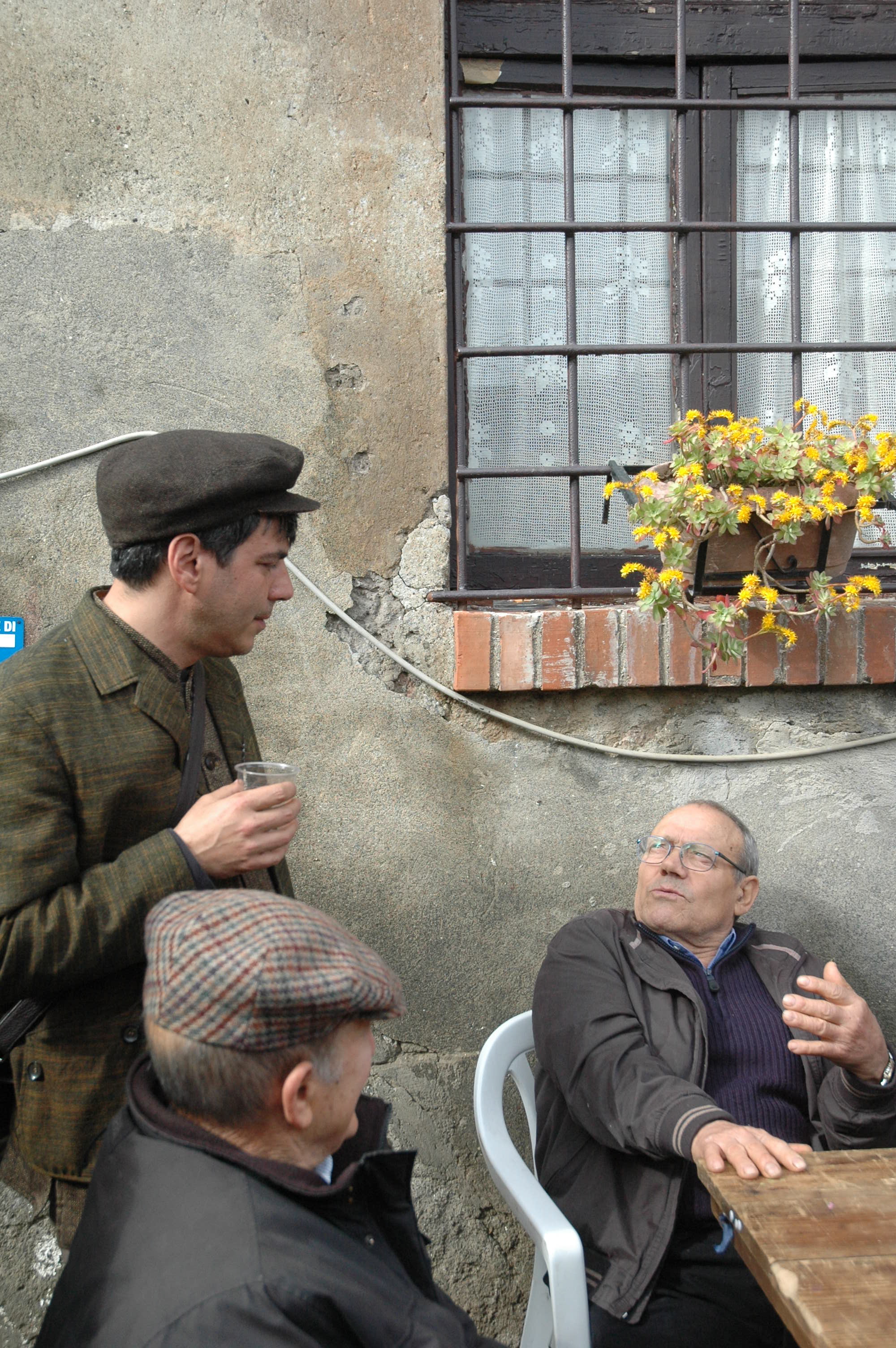
Lorenzo leads the discussion with the former farmers
After lunch the walk took a different course, in single file along roads made for cars, not people, zig-zagging around fenced properties, revising plans on the fly as the logistics of limited Sunday train schedules and the slow speed of trekking required. At one point we found ourselves at a truckstop, probably the only pedestrians ever to have ventured there. Night fell and we were still pretty far from the train station where we were to have continued the itinerary (but were now merely hoping to find a lift back to “Rome”). And it was getting cold. I was glad to have packed my battery-charger so my phone’s gps was still working, and my bike light to provide a small safety beacon as cars zipped past us in the dark. But the mood was far from grim or desperate and, in fact, eventually we found our way back into the city. Will I do it again? You bet. I think I’ve finally found a group of urban observers even crazier than me.
Malagrotta: Rome at the Edge of a Waste Apocalypse

Malagrotta Dump (image courtesy of http://ecoitaliasolidale.bloog.it)
The city of Rome has been dealing with its waste for thousands of years in a variety of forms. Sometimes throwing it in the river (one of the legendary versions of the origins of Tiber island). Sometimes piling it in landfills such as Monte Testaccio, a 30 meter-high pile of pottery shards. And sometimes finding creative (but equally destructive) new uses for old materials as practiced by the Cosmati artists who transformed marble slabs into mosaic tiles in the late middle ages. For the past decade, however, waste management in Rome has meant one place and one man: Malagrotta, the property of Manlio Cerroni. Every day five thousand tons of trash show up at what is Europe’s largest landfill, some converted to energy through incineration or gasification, but the rest piled up as landfill. And since 2008 this landfill has been, well, full. The proposed solution, a new dump site north of Rome at Allumiere, was shot down this week, leaving the question open. The problem isn’t finding another landfill site but reducing, and eventually eliminating, the waste produced. The Lazio region as a whole produces over 3 million tons of waste a year, with less than 20% recycled. Compare this to the Germany’s 70% rate. The process is marred at every step: inadequate measures for separating waste in the home, at the curb, ineffective control at the processing plant leading to potentially usable recycled materials being sent to landfill anyway. The lessons of Naples, where trash piled uncollected on the streets tarnished decades of hard-earned improvements in the city’s public image, seem to go unheeded in the Italian capital.
Improving transit in Rome

Why can't the Tiber serve the city's transit needs?
Recently I was interviewed in my studio for a CNN show called “Future Cities“; the first episode just aired addressing the challenges of public transit in Rome. Much of the program, including the Mayor’s interview, repeats the old story about how Rome has a very limited underground metro system due to the presence of archaeology which makes construction slow and expensive. More interestingly, Engineer Antonio Tamburrino, one of the participants of the 1972 Club of Rome with whom I have been discussing urban sustainability of late, instead presents an innovative project to pedestrianize the historical center and surround it with a ring of surface light-rail, a smart alternative to heavy underground trains (which are last century’s technology). Since the only clip they used from my own interview was a short, rather silly soundbite, I want to dedicate a blogpost in which to share my more complete views on this important issue.
It has become a cliché to say that Rome is structurally not well-adaptable to transit because of its archaeological layers or to bicycling because of its hills. But it is not cultural heritage or topography that stand in the way of a more livable city. In truth, the single greatest menace to the city of Rome and the one for which the solutions are the most obvious and yet the most elusive, is automotive traffic. Cars clog the streets and pollute the air, not to mention inflicting a startling human cost,: an average of two pedestrians die in Italy each day, mortalities from accidents are about one an hour, not even counting the health costs and economic damages. We hear a lot about the Traffic Emergency, but when we look at the details the solutions are often the creation of parking structures, the widening of streets, drafting of new laws, etc.
I’m convinced that the simplest solution lies in simply enforcing the existing laws regarding motor vehicles. Despite a relatively high 50km/h speed limit throughout the city (London has lowered its to 30), cars can be clocked at double this on Via Fori Imperiali near the Colosseum where a young cyclist was killed two years ago. Despite parking restrictions typical of most European cities, autos can be seen everywhere in violation and rarely fined.
This has been long accepted as sign of Italy’s famous flexibility with regard to the law, turning a blind eye to minor violations, but urban residents are starting to get fed up. I work with a number of pedestrian advocacy groups and public space planners and, thanks especially to the web and to blogs like my own, initiatives to fight the automotive addiction are growing. Fed up with the lack of enforcement of parking laws we have started distributing our own symbolic citizen’s fines, attempting to sensitive drivers to the fact that their personal convenience comes at the price of the rights and safety of hundreds of pedestrians and cyclists, children and elderly, people who are consuming no fossil fuels and producing no emissions.
Our goal is to shift the balance back to a mix of public transit and walking/cycling. Rome’s public transit network, in particular its buses and light rail, is potentially one of Europe’s best, were in not for the congestion of private vehicles and inconsistent management. I’m convinced that given a choice of a clean, efficient transit system and pleasant safe streets for walking and cycling, counterbalanced by costly and rigorously enforced parking restrictions, most Romans will eventually overcome their automotive addiction.
- Re-design the ATAC bus routes rationally, with public participation and the use of web 2.0 technology. At present, there are routes that run almost empty (the 125 on the Janiculum for example) and others where the buses are consistently packed. I have an idea for an application which would allow users to propose bus routes using Google Maps data and social networking protocols to optimize routes. I am convinced this kind of participatory design is the future.
- Eliminate the capolinee (bus terminus) from the city center and draft believable bus route schedules. In redesigning routes, ensure that the buses are always moving smoothly according to a rigorous schedule, not sitting idly occupying public space. This is possible in most European cities; there is no valid reason that it cannot be so in Rome.
- Give transit universal precedence over private automobiles, just as is done with emergency vehicles. Drivers that don’t get out of the way of buses are fined. In addition, program traffic lights to give transit green lights when approaching.
- Reintroduce trams on the Lungotevere, Corso Vittorio, Via Nazionale and Corso Rinascimento. Clearly this must be part of a comprehensive transit plan, but it shouldn’t be put off. Case studies from other cities from Zurich to Portland show that trams more than buses demonstrate the permanence which encourages people to make the switch to transit, bringing positive change to the neighborhoods where they pass and the city as a whole. A tram along both sides of the Lungotevere, in conjunction with the creation of a protected bike path (instead of the shared sidewalk cyclists are told to use today) would give people a clear and clean option to move through the city and by narrowing the road discourage rather than incentivate private automotive traffic.
- Reintroduce navigation on the Tiber; this was already done several years back. The concession arrangement which allowed a private company to operate tourist cruises in exchange for providing a public transit services was inexplicably suspended and now only the tour boats are running. For my son to get from his high school to the rowing club where he goes after school takes three buses which zig-zag across the city but could be done by one straight ferry trip up the Tiber (or one tram or bike ride along the Lungotevere)!
Stati Generali: the next ten years in Rome
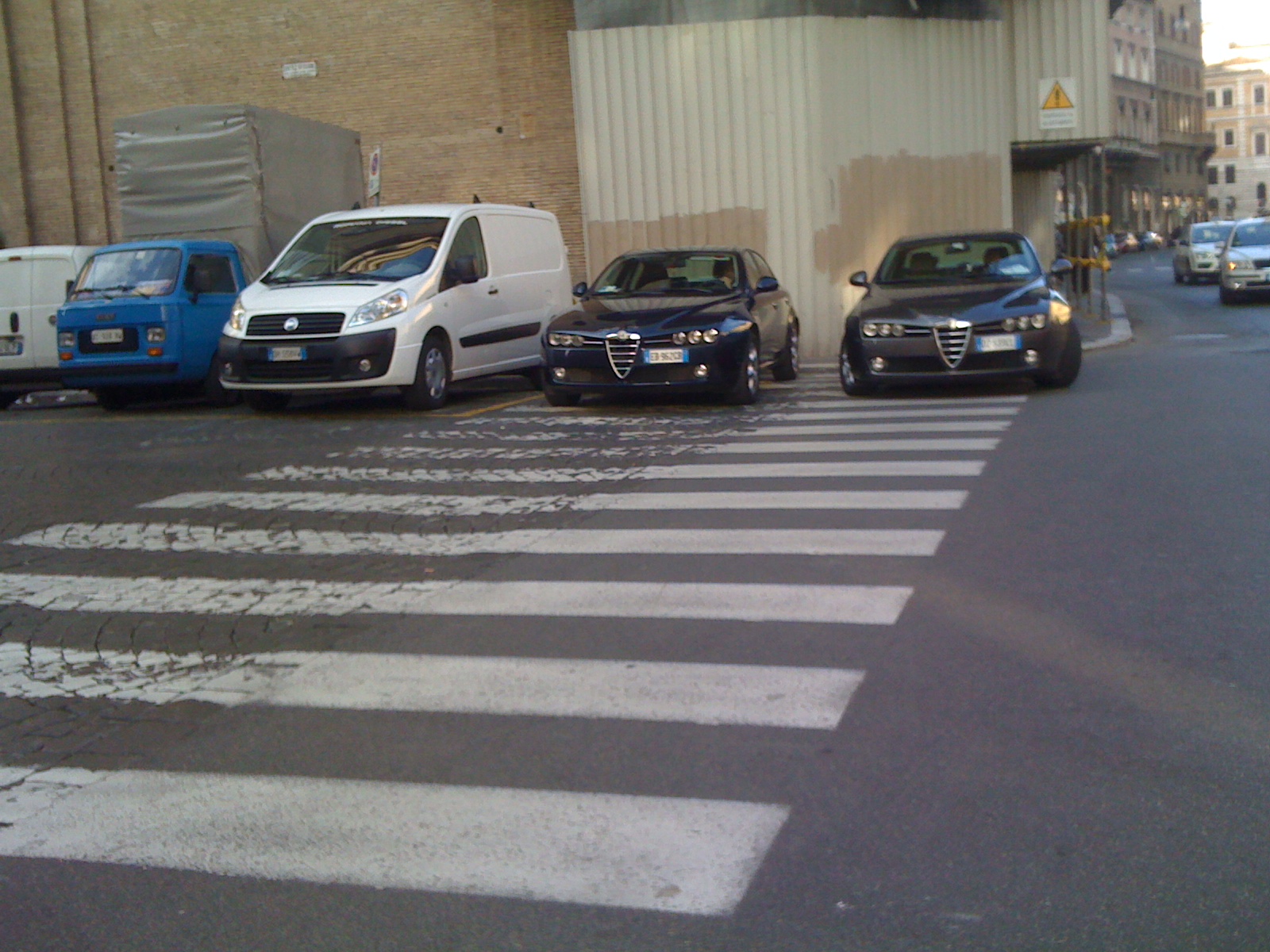
I hear talk of pedestrian zones and I see government cars on crosswalks
Earlier this week I stopped by Adalberto Libera’s congress hall in EUR, this time not just to admire the fantastic rationalist architecture but to check out the exhibit of objectives and plans for the Millennium Project and hear some discussion about the future of Rome. The theme “Let’s build the new capital together” was catchy and the area headings such as “Rome, city of environmental sustainability” or “Rome, city of global competition” were certainly admirable.
However, the actual contents were for the most part disappointing. Without going into all of the panels, videos and models on display, there was an abundance of catchphrases and a dearth of hard evidence of effective change: “strategies, renewable energy, sustainable mobility, smart grids, e-mobility, sharing, solidarity” all sound great. And yet the projects presented were vague, recycled, disconnected from one another. Mysteriously the city of music and youth at Tor Vergata was disconnected from the Rem Koolhaas city of youth at Ostiense or the Renzo Piano’s Park of Music at Flaminio. The panel on bikesharing looked great but those of us who try to use it know that it is little more than greenwashing, with few bikes available, poorly maintained, unreliable and unsafe. The flythrough video of Piano’s proposal for new connections between the Auditorium. Villa Glori, and the new bridge over the Tiber was beautiful, especially for the total absence of motorized traffic. Unrealistic. Today the Auditorium parking garage is usually empty but the sidewalks in the neighborhood blocked with parked cars.
The video of the Tor Bella Monica project Leon Krier showed at the end of his bizarre but compelling talk showed a city in the best cutting edge graphic rendering technology, a cross between Pixar and Disney. It looked like Salzburg or Heidelberg, again without hardly a car in site (well, one foreign sports car eerily turns a corner at one point and magically disappears). Krier even confessed that the renderings were made in China, a frightening example of our globalized economy where fake versions of past urban forms are now produced and marketed regardless of local identity or realities (although, hey, you can’t not like nice urban spaces designed for people when the alternative is scary non-urban non-spaces designed for vehicles)
Troubling also was the uniformity of participants at this meeting. If it was about building the new capital together, where were the working class residents, the teachers, the children? The crowd was a sea of men in blue suits and security forces. As an architect I can sense real-estate developers a mile away and my sensors were jumping. I wondered if I had mis-interpreted the new “capital” in the exhibit’s title, not the urban kind but the financial kind.
Outside police vans blocked pedestrian crossings with their engines running; so much for a sustainable pedestrian friendly city. Inside at the bar coffee was served in plastic cups and the bartender laughed when I asked if there was a recycling strategy. The conferences were mediated by two television-style hosts who were expert in carrying out their task of facilitating snappy sound-bites and catchphrases, keeping the pace upbeat and happy, avoiding anything that might seem like debate.
It is certainly better that these events take place than the alternative, silence or pure cynicism. They should be observed closely, attended, critiqued, and above all actively participated. The interests at stake in the bid for the 2020 Olympics are both the personal wealth of a handful of individuals and the collective well-being of future generations of Romans and visitors.
Bridging the Tiber
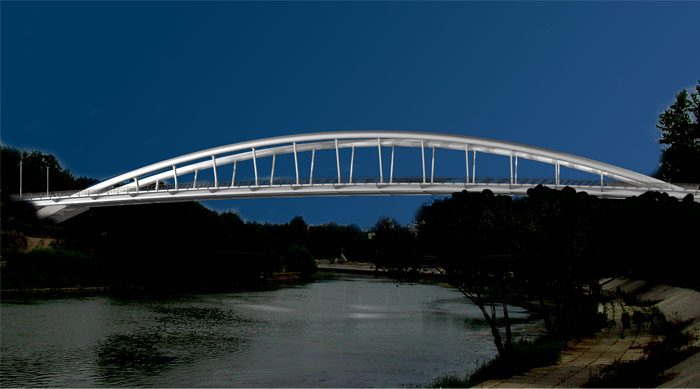
Ponte della Musica (image thanks to Roma Pedala)
Attempting to plan a route for my son to get from school to rowing lessons on the Tiber, I became interested in the progress of the two new bridges under construction across the Tiber. One bridge, the Ponte della Musica, would shorten his route significantly, filling a gap between bridges in the Flaminio neighborhood. It would mean the difference between taking a reasonable bus ride and a safe, pleasant walk, and an impossibly long bus ride with a change to a tram and subsequent delays, at which point shuttling him by car becomes the more probable choice.
Two bridges were commissioned by a competition launched in 2000 by Francesco Rutelli as part of the requalification plans for the Flaminio and Marconi/Ostiense neighborhoods, one to the north and one to the south of the city center.
The Ponte della Musica in north, designed by London-based firm Buro Happold in collaboration with Powell-Williams Architects, spans the Tiber at the point between the Lungotevere Maresciallo Cadorna to the west and the Lungotevere Flaminio to the east, linking the sports area at Foro Italico with the Flaminio area which now boasts several important cultural venues, Renzo Piano’s Auditorium (thus the bridge’s name) and Zaha Hadid’s MAXXI Museum. Originally designed as a pedestrian/cycling bridge, the project was later expanded to allow the passage of a tram and public transportation, with inevitable delay in construction and cost overruns. One hopes it doesn’t also mean that it simply becomes another funnel for traffic, unsafe and unfit for bikers and pedestrians.
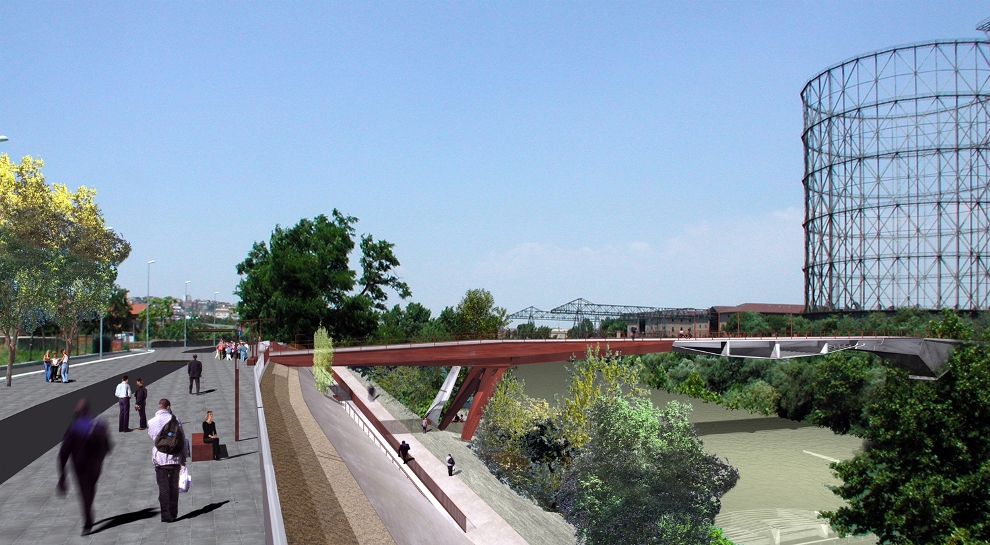
To the south, connecting the two former industrial areas of Ostiense and Marconi, the Ponte della Scienza will link the Gazometer in Ostiense with Lungotevere dei Papareschi where the Teatro India located in the former Mira Lanza soap factories, and the nearby Gambero Rosso gastronomic center, will soon be joined by university buildings and other cultural destinations. Designed by APsT Architettura, the local firm of Gianluca Andreoletti, this bridge didn’t begin construction until 2008, only to be held up by archaeological investigations in 2010. At present it is under construction but I have been unable to find any believable prediction of its completion date. This is a question of particular importance to those of us who use the bike path along the river’s edge which has been interrupted by the construction site for over a year now.
These two projects are a great sign that Rome can become more livable for its users, residents and visitors alike, and not just more profitable for the automotive-petroleum-construction lobby. It is a small step in the right direction.
Graffiti: prioritizing the battle for civic respect
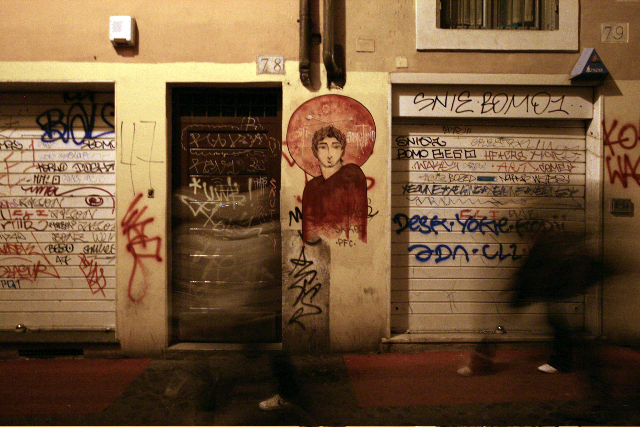
EikOn Projekt posting, photo by Jessica Stewart
The boundaries and bridges that divide and connect well-meaning community activist groups often focus on the problem of urban graffiti. Groups like “riprendiamociRoma” here in Rome vehemently battle billboards and graffiti alike, unifying them under the banner “urban degradation.” Their most recent tirade, on their blog is against the daily newspaper Repubblica for its discussion of the work of street-artists Omino71 e Mr.Klevra for the l’EikON Projekt 2011. Affixed to city walls with glue, these painted/printed posters are inspired by Byzantine ecclesiastic iconography. If and when removed, yes, they will leave traces behind on the already graffiti covered walls.
The debate is a valid one and should be brought out into the open, voiced in the context of the range of difficulties faced by a city like Rome. Questions must be asked including, but not only, whose property are building walls in the city? What media are available for expression? What are the predominant messages conveyed in the daily life of the city? Who pays the price of urban deterioration?
Critics may object to a discussion of the markings of graffiti writers as works of art so let’s keep it neutral, calling it “street painting and posting”. In the context of a legally provided wall, such as those many schools and community centers have made available, or in art galleries, this same work can certainly be described as art, so the dispute is not about the work itself, but its context. Painting and posting on a public or private wall without consent is a violation of property rights, without doubt. Which is exactly what makes it interesting as a cultural phenomenon, that it calls into question our preconceptions about property and the “acceptable venues” for expression. The right to express has long been linked directly to money; the more one has, the more visibility can be purchased. The ownership of urban buildings and their potentially graffiti covered walls is made possible by money, the barrage of advertising legally or illegally displayed throughout our cities is made possible by money, the goods displayed, the cars which saturate our city streets, the clothes worn by passersby, are all expressions made possible by money. Money not only buys more volume, be it a building or a car, but it also can buy immunity from prosecution as seen in the case of the billboard racket in Rome.
But now, for the first time in history, we are starting to see media which allow widespread expression with meager means. Of course, I’m talking about the internet but even before its advent “street painting and posting” foreshadowed this phenomenon.
Ancient Rome left ample examples of scrawled messages, from bathroom humor to political slogans, on the walls of Pompeii and elsewhere. But it was in late 18th century Rome, under the oppressive Papal and Napoleonic governments, that “pasquinades” started to appear, witty, anonymous critiques hung around the necks of statues or posted by fountains. As graffiti took off as a part of the multi-disciplinary hip-hop phenomenon, focused on New York in the early 80s, it provided powerless youth a quick path to recognition, a path which bypassed the system (of studios, agents, galleries, compromises) and went straight to the viewer in the street. The aesthetic was also picked up by the less powerless, by privileged people who might navigate conventional paths to visibility but preferred to challenge those channels as a critique of the system. And then, of course, like every cultural trend, graffiti became commoditized.
The cityscape today offers a vast array of stimuli for all senses, and sometimes those that are appealing to some are appalling to others. As in any system, there is something to be said for diversity, for multiple voices being healthier than a few loud ones, especially in Italy where media is notoriously centralized in very few (well, two) hands. Those that cringe at graffiti, especially when defended as art, are of course welcome to engage in campaigns in the name of civic decorum, but might first look and reflect and prioritize. Today’s graffiti will fade and merge in time with all of the other markings that make up the time-worn palimpsest of Rome. With rare exceptions, it doesn’t prompt action, unlike the billboards which, legal or illegal, usually pressure the viewer to buy, to consume and eventually to discard. Unlike the automobiles which clog the streets of Rome, graffiti doesn’t block my path, it doesn’t pollute my air, and it doesn’t kill or maim. Its critics might take a deep breath, smile and be glad for some “painting and posting” that doesn’t just promote the agenda of a multi-national corporation.
Bicycles vs. Motor Vehicles, Rome claims another victim
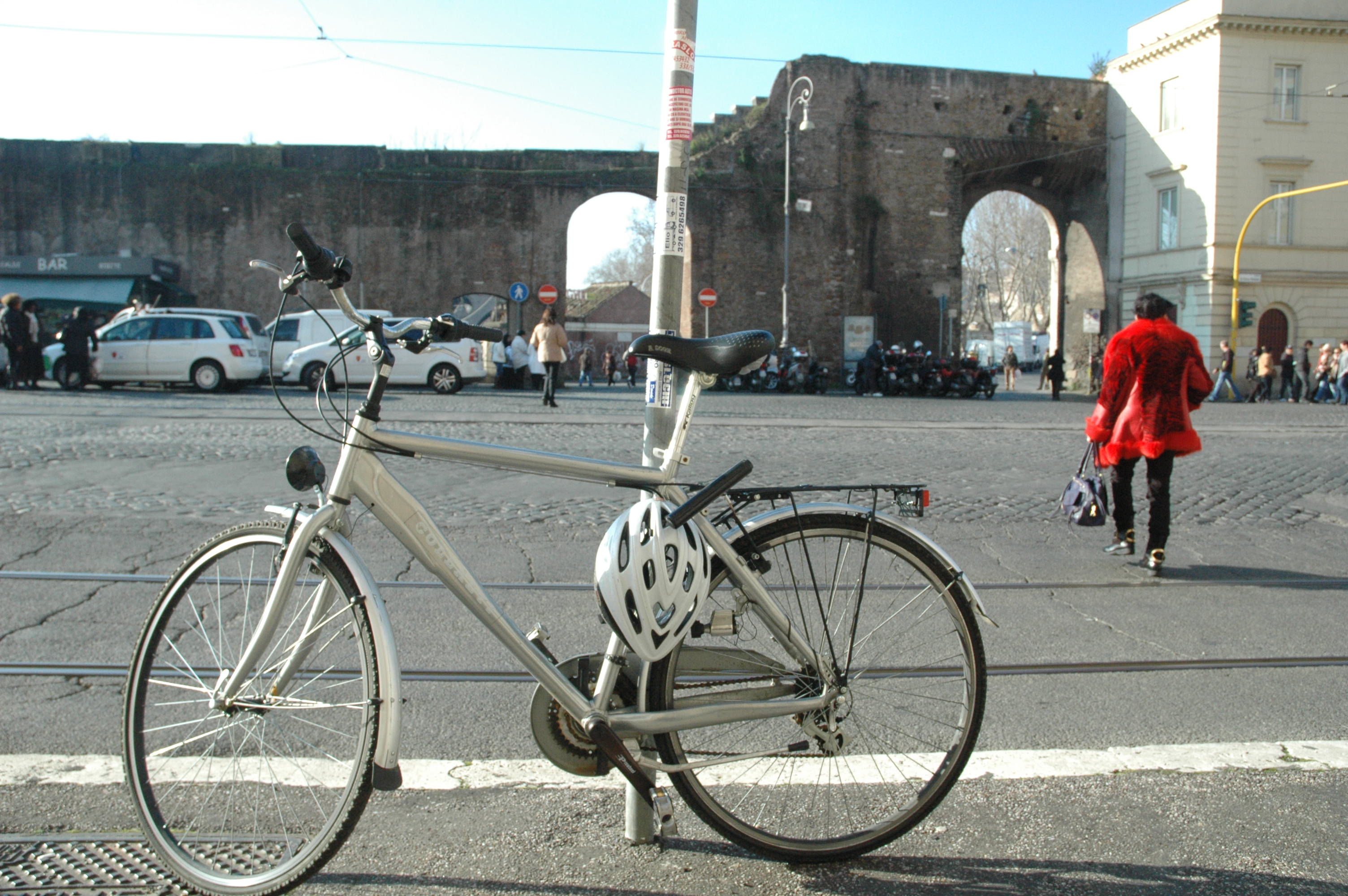
Yesterday the streets of Rome claimed another victim, a 70-year-old woman run down by a truck on a normal urban road while bicycling. The city’s bike advocacy groups, traffic safety activists and civic-minded citizens have called for accountability on the part of government officials who have for too long sat back and watched blatant violations of traffic laws ignored. Visitors to Rome may be amused to see the chaos, feeling a thrill of adventure after surviving a street-crossing, and leave thinking that somehow the system works. I myself used to subscribe to this theory of self-organizing chaos. But for hundreds of victims of traffic fatalities (Rome has one of the worst statistical records in Rome) there is nothing to philosophize about; the streets of Rome are deadly.
Solutions require some fairly simple steps:
1. apply the laws that already exist. Speed limits are 50 kph throughout the city and 30 kph in many streets, and although average speeds are far lower due to frequent traffic jams, it is common to clock cars going at 80 or 90, but extremely rare for them to be stopped and fined. Similarly, double-parked cars and vehicles parked at intersections all block visibility and force cyclists into the traffic.
2. lower the speed limit to 30 kph throughout the city. Though still weaponized, motor-vehicles travelling at this speed are far less likely to kill or maim.
3. increase bike paths, as every civilized city has been doing for years. Rome has made timid progress but could do much more, at a fraction of the cost of other transit related projects. If a bike path had been included on Via dei Fori Imperiali, Eva Bohdalova would not have been killed there in 2009.
4. given the present-day situation and its disastrous consequences, those responsible should step down, giving way to administrators who are willing to take these politically difficult steps to save lives and make Rome once again livable for people, not just profitable for the petro-auto lobby.
Links:
Rebuilding l’Aquila
in background, church of San Bernardino in the "red zone" of l'Aquila
Yesterday I went to l’Aquila for the Building Maker workshop sponsored by Google and organized by Barnaby Gunning Architects as part of the project “Come Facciamo“. About 20 people, mostly it seemed architects or engineers in their “career years”, dedicated their time on a grey, snowy Sunday morning to come out and hear instructions about a tool which provides hope and visibility for a city which has seen several waves of devastation, from speculation and corruption in the late 20th century, to the tragedy of the 2009 earthquake, to the speculation and corruption of the post-earthquake “reconstruction” (not to mention the G8 fiasco).
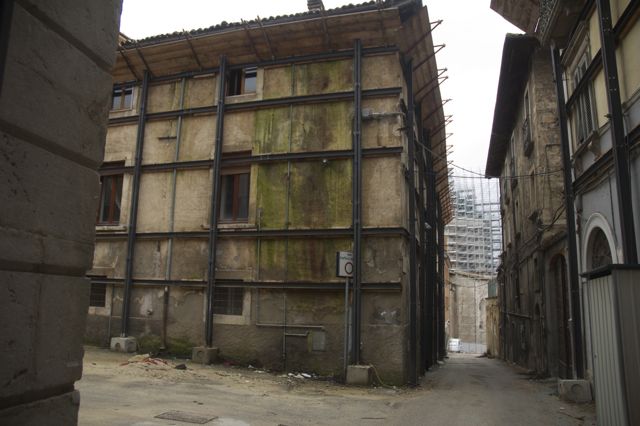
Today, the historical center of l’Aquila is a ghost town, buildings structurally reinforced but boarded up and empty of life. Walking through the town yesterday, the echo of my camera shutter resounded eerily in the silent streets. The only other sound were the broadcasts of soccer games coming from the military checkpoints where soldiers control who enters the “red zone”. This is not a city but a shell of a city that was.
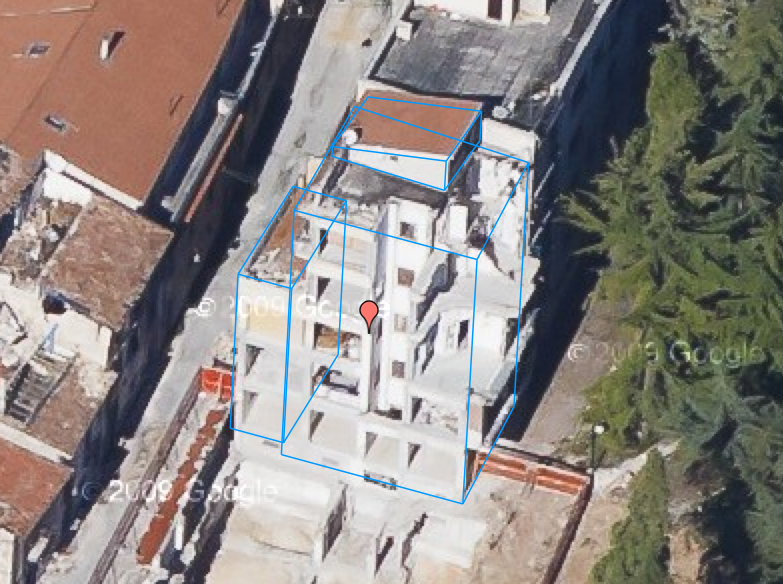
The workshop focused on several related software tools offered free by Google: 1. Building Maker, for creating 3D models of buildings based on aerial photographs, 2. SketchUp, a 3D modeling program and 3. Google Earth, the virtual earth on which photos, models and a wide range of geographic data can be situated. Representatives from Google (both Italian and American) were present to explain the software, working through the creation of a model on screen and then circulating among the participants as they struggled to model buildings chosen from a list of coordinates provided.
The site I chose randomly from the list was not easy, not just for its form but especially for its current state. The earthquake destroyed a large section of the building, which led to questions about where our models were to represent the city as it was or as it is. I had an interesting discussion about this with Nicole Drobeck of Google, a 3D data specialist who was very helpful in explaining to me (in English!) the workings of the program, but the conclusion was, well, inconclusive. I learned that the Google streetview car had been through l’Aquila just days before the earthquake and that the satellite date currently on Google Earth is pre-earthquake, so we can document what the city was, but the detailed aerial imagery which Building Maker uses were gathered after the disaster, when Google sent a plane out of the way for a rare, specific city documentation of l’Aquila. The project provides a tool for inserting proposals for reconstruction but also an objective, real-time document of the slow state of reconstruction which contrasts with the narrative of success stories often heard.
I didn’t get too far on my model before I had to pack up to return to Rome, and later as I opened it again (pulling it down of the virtual shelf in the 3D warehouse) for the first time I asked myself about the story of this block. It was simply too bizarre to be working on photos and vectors and planes when the object of the study was a place with its history, its aura, its stories and its tragedies. Thanks again to Google, it was easy to pull up news articles to learn that Via Campo di Fossa n. 6 was a site which until the 1970s the city of l’Aquila had wisely avoided constructing and when the master plan of 1979 did allow construction it happened fast, with too few controls. And that on 6 April 2009 half the building collapsed on itself, killing 27 occupants.
While no virtual reconstruction can change this history, hopefully it can serve to tell the story as completely, simultaneously both concretely and transparently as possible.
Formula One Races and EUR
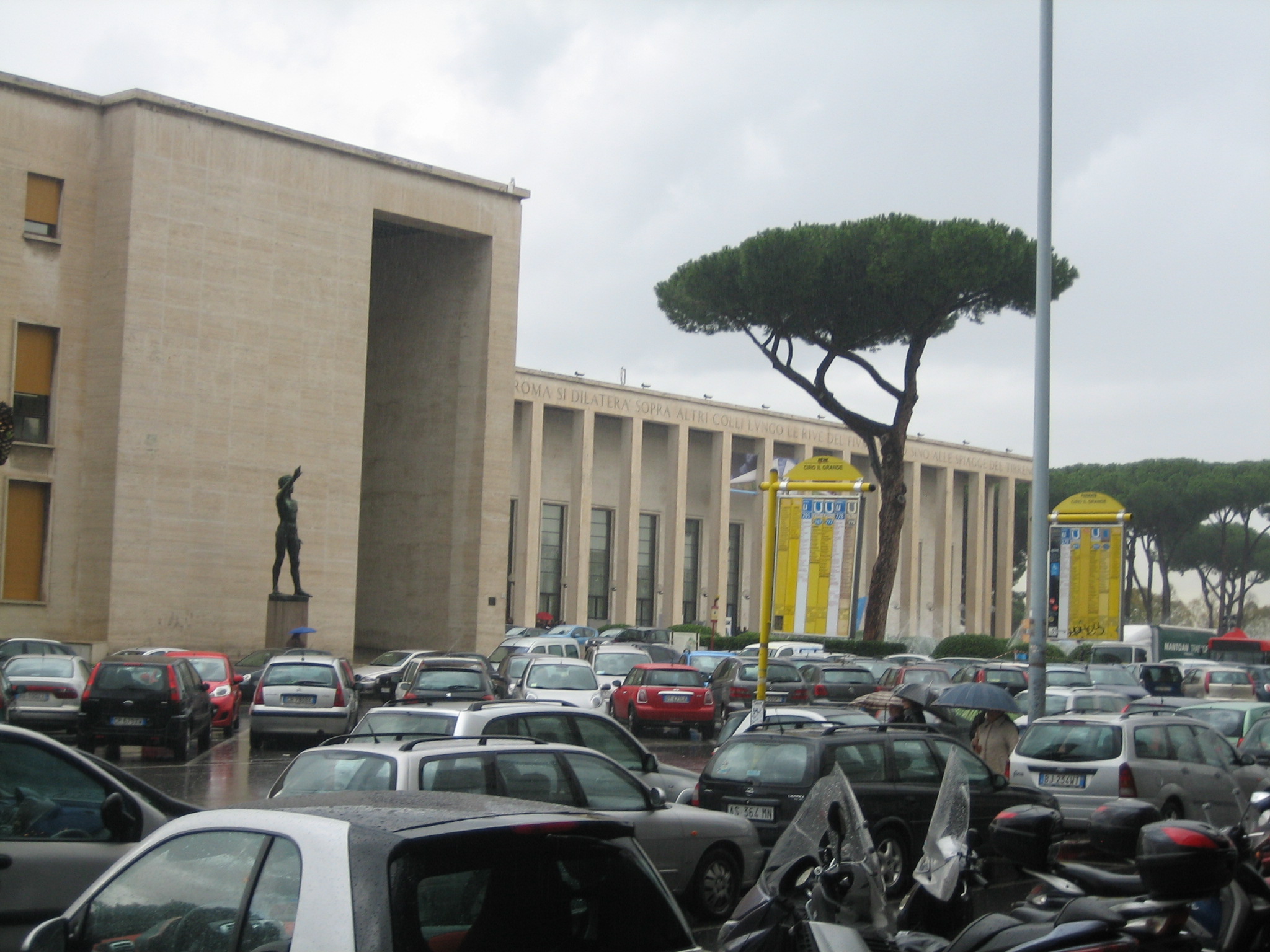
- The Third Rome Rises out of a sea of cars
 SUSTAINABLE ROME