Ten extreme 2011 resolutions to make Rome a greener city
As usual this year I’m going to keep my private resolutions private but publish my “what if” resolutions for the city of Rome. I’ll confess this is a reworking of a post from last year (my apologies for long-time readers). The issues facing Rome don’t change too much from year to year, for better or for worse.
- Ban all cars and petroleum-fueled vehicles from the historical center except for ambulances, hybrid taxis and delivery trucks (during specific times only). Learn from Venice, restricting access to certain streets entirely as is done already in some of the Ghetto streets like Via Reginella while streets like Corso Vittorio and Via Arenula remain thoroughfares for buses and taxes which drop their passengers at important nodes where they proceed on foot into the narrow pedestrian streets. Result: more uninhibited pedestrian activity throughout the historical center will enhance the local economy, encourage tourists to stay longer and spend more, reduce health and safety risks, free up space now occupied by cars for other productive activities. Residents who insist on owning cars (a “privilege” residents of cities from New York to Amsterdam do without quite happily) pay to keep them stored in structures at the edge of the center, convenient to exits to the city so that cars can be used for excursions to the country, the only remaining role suitable for private automobiles. These car-storage structures, akin to Venice’s appropriately named Piazzale Roma, might be planned in underutilized sites such as the air-space over (or ground under) train tracks, former military barracks, and government buildings deemed expendable by optimization projects.
- Raise the cost of parking throughout Rome to reflect the true environmental costs of autos and the true value of real estate. If sub-standard housing in central Rome rents for € 50/square meter/month then a 10 m2 parking spot should go for no less than €500/month or €2/hour. But add in the cost of infrastructure that allows for cars to function, road construction and maintenance, the health and safety costs from pollution and accidents and the military costs of ensuring access to fuel, not to mention the cost of dismantling and disposing of vehicles at the end of their cycle, parking should jump to prohibitive rates. Result: the relative advantage of private automobile use disappears and more money becomes available to improve transit, biking and pedestrian facilities.
- Implement strict guaranteed schedules for all public transit in the city. This has long been possible for trains and it has been my experience that the trains in Italy run on time (thanks to dedicated train professionals, not any nostalgic Mussolini dictatorships). If bus schedules are fine-tuned to satisfy real needs and drivers are held to timely departures, there should be no risk of waiting interminably only to see two or more of the same bus number arrive simultaneously, a common occurrence in Rome today.
- Ban automobile advertising as has been done for other harmful products like cigarettes. Given the damage done by cars to our cities, our health, and most importantly our future, it is criminal to promote an image of automobiles as anything but the weapons of mass destruction that they are.
- Install bike racks in all public squares and condominium courtyards. This may seem like a very small project compared to the pedestrianizing of Rome, but bicycles are one of the miracles of modern society and could go a long way to solving our personal transportation needs if they were allowed to exist in Rome as they are in other cities. Other bike related solutions such as allowing bikes on public transit and creating bike lanes are also desirable but less urgent than simply providing bike parking. Bike sharing as it exists now in Rome has little more than symbolic value; in fact its strongest practical achievement is the freeing of a few square meters of urban space here and there (where the bikes are parked) from the eyesore of car parking.
- Decriminalize the installation of solar panels. At present the city of Rome has no clear policy regarding the installation of solar thermal and/or photovoltaic panels on buildings, or better the policy might be clear but the officials don’t understand it. The result is that attempts to incorporate renewable energy into building renovations have been met with accusations of illegal construction. The laws and economic incentives should be simplified, publicized and enforced to encourage well-designed and site-sensitive installation of solar (and wind and geothermal) technology in new and existing buildings. Result: Rome could reduce its fossil fuel consumption and related greenhouse gas emissions dramatically.
- Commission sustainability evaluations and upgrades of all government-owned properties: introduce energy conservation measures, insulation, renewable energy, space-use optimization projects. As capital of Italy Rome has a huge amount of state real-estate and often the worst track record in terms of energy consumption. By investing in improvements the government could fund research, help jump-start the green economy, and set a good example for private citizens. Hey, the Vatican has already done better, installing Italy’s largest PV array on the roof of Nervi’s auditorium.
- Set a target for 99% recycling of Rome’s trash by year’s end, providing reliable local solutions for composting organic waste, discarding without destroying reusable products, recycling paper, plastic, and metals in facilities managed and manned by local labor. My architecture students from Cal Poly last Fall were tasked with the design of a facility to collect, dismantle, process, recycle and reuse discarded electronics and other items; the results were not necessarily an optimal industrial system but in most cases a vibrant public space gravitating around something other than religious, political or corporate functions. Such places, nerve centers for the efficient use of material and human resources, could be inserted into the marginal spaces left over by the growth of the metropolis. The notion of waste can be removed from Rome’s vocabulary. Result: greater employment, need for less new resources, reduction in pollution, more compelling public gathering spaces, elimination of waste transportation, more meaningful products.
- Rigorously enforce existing anti-littering laws, including pooper scooper requirements. Rome’s street cleaning force is amazing, but they fight a losing battle against a population of Romans and tourists (who justify their behavior with a defeatist “when in Rome, do as the Romans”) who drop trash wherever and whenever, leaving the city a depressing eyesore until the AMA crew comes along. Fight illegal billboards and other forms of graffiti as well. The city needs education, starting with school children, to instill the understanding that everything has its place and the place of a soda can is in a particular receptacle, not the ground.
- Redesign city surfaces and reintroduce green coverage to absorb and filter runoff water and prevent flooding and erosion. Rome’s problem is too much, not too little water. Conservation of water only makes sense in the context of a regional plan to send water to dry areas such as Puglia; in the short term Rome needs to prevent runoff water from increasingly dramatic storms from inundating the city and washing away soil and paving. The solution lies in grading, maintenance of the drainage system, and most importantly the design of permeable surface, either green or porous paving–Rome’s San Pietrini cobblestones are one of the city’s greatest contributions to humanity. Results: less water in the streets, more water in the ground, more resilient greenscapes.
These ten resolutions are incomplete and just a start, but collectively the result of their implementation would be the Rome I like to dream of. It is the Rome we have known for centuries, a richly layered palimpsest of cultural memory, actively evolving in the present and into the future but liberated from the damage of the petroleum economy.
Venice in Rome
 Just back from blissful car-free stay in Venice, now on a bus stuck in traffic in Rome, observing how dis-functional this city is. Most of the cars don’t need to be there; they contain a single, healthy, adult passenger who could easily walk, bike, take transit or any combination of the above. They are driving because of the VICIOUS CIRCLE effect; too many cars and too little planning has resulted in a malfunctioning transit system which leads more and more people, out of despair and disrespect to choose to drive. The choice is made easier by the fact that parking is virtually free, illegal parkers rarely being prosecuted. This not only slows down public transit further as buses with difficulty get past double parked cars, but it makes the pedestrian experience an unpleasant one. Romans must choose between 1. walking on dirty sidewalks blocked frequently by scooters and at least at every intersection by illegally parked cars, 2. biking in smog-filled, dangerous streets with few safe places to lock a bike 3. spending hours of frustration waiting for or on public transit which doesn’t run on schedule or 4. get in a car or scooter, use the drive time to chat on the phone, read the paper or email in slow traffic, in any case negotiate traffic faster than a public bus, park anywhere close to one’s destination for free. As it stands the practical choice is obvious, but what sad results for a city with such great potential.
In Venice I noted that the only motorized vehicles one sees (boats) are used for delivery, emergency or taxis. A bureaucrat in Venice doesn’t drive a boat to work, a shopkeeper doesn’t double-park a boat outside her shop, even smartly dressed lawyers hop a vaporetto and walk to their final destination without sacrificing status or social standing. The density of people is astounding as is the variety of use; children playing, people stopping to chat, merchants selling wares, business people moving quickly to destinations, all coexist. Water or not, the situation in Rome should be these same; few private vehicles clogging the arteries, leaving space for efficient buses and trams, pleasant public space for pedestrians and bikers, safety for children and the elderly, and a better future for the planet.
Venice cannot be held up as an example of the ideal city; its population has dropped drastically in recent decades and clearly there are reasons beside the reckless real-estate policies which encouraged the exodus. Yet on a purely experiential level, three days spent in a humane urban environment have reminded me that we can do much better than what we settle for here in Rome.

Saving the Agro Romano
The Roman Countryside
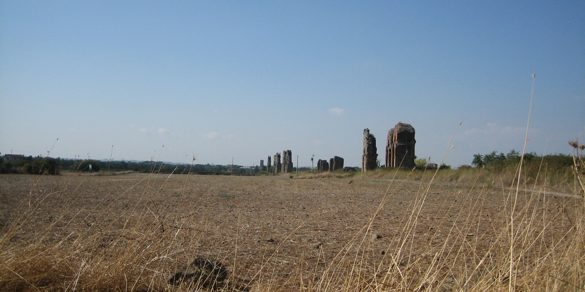
When it comes to total green area (82,000 hectares or about 275 square meters per capita, 68% of total area of the city) Rome takes the prize. This title of “Greenest European Capital” is deceptive though, deriving more from the fact that the boundary of the city was drawn far out in the hinterland in anticipation of future expansion, thus including within the urban area vast tracts of farmland, land of great ecological value but limited investment value. Sadly, in this very moment when we appreciate the importance of biodiversity, of local food production, of green zones as essential to human inhabitation, the green “capitol” of Italy’s green capital is disappearing like rain forests in Brazil. An more local though more anachronistic analogy that comes to mind is the destruction of antiquities in Renaissance Rome, usually carried out by exactly those humanist patrons who claimed a renewed enthusiasm for antiquities; in a similar manner the speculative growth currently consuming the “campagna romana” is often promoted as “green” (see box below).
According to Lorenzo Romito of Stalker, the long but now accelerating process of destruction of the Roman countryside dates back to the establishment of Roma Capitale in 1870 (Rome as capital of Italy, but capital also in the sense of “wealth in the form of money or other assets”), the result of a long battle fought in the name of “republican” ideals against clerical and noble special interests. In 1870, the royalist and capitalist interests prevailed and the breach in the walls of Rome opened on September 20 let into the city a wave of speculative development which would deface and deform the fabric which had taken two millennia to evolve and seen some of the most sophisticated urban designs, from the proto-modern metropolis of the Roman Empire to the dynamically dispersed city of the Baroque Era. In the place of an either an idea or a design for the city, master plans were enacted and subsequently ignored, easily bypassed by variants and loopholes. Neither was a grass-roots, bottom-up urbanization as often takes place in the developing world possible; where such spontaneous urbanization of unused “blight” areas by the city’s sub-proletariat, a truly Roman phenomenon recognized by Pasolini among others, has taken place the forces of speculation have been quick to suppress any real city-forming tendency in the name of urban renewal. Year after year, with increasing frequency under the city’s former “progressive” left-wing mayor (progress=modernization of real estate speculation) and the city’s current “conservative mayor (conserving the interests of Rome’s rich and powerful), large tracts of rural land guilty of falling within the city limits are (excuse the rhetoric) sacrificed on the altar to cement and automobiles.
A truly green future for Rome will not be based on new “green” real-estate speculation or new “green” parking structures for new “green” automobiles. It must, as a bare minimum, demand, as does London, that any new development be transit oriented but far better would be a moratorium on the sub-urban conversion of rural land. Then the process of urbanization in the true sense–smart, cradle-to-cradle, resource-based, pedestrian-oriented, bottom-up, zero-emissions, eternally-contemporary city-making, can carry on.
Links: Primavera Romana, group working toward goals of sensible, ecological evolution of Rome.http://primaveraromana.wordpress.com/
A Small Town in Abruzzo
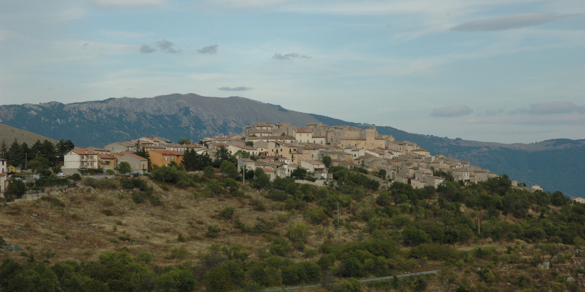
This blog entry is an abbreviated version of the text of the catalog Il Progetto “Borgo Abruzzo” a Castelvecchio Calvisio which was just published by EXÒRMA EDIZIONI in Rome.
Arriving in Abruzzo for the first time with a group of American architecture students, leaving behind the intensive blocks of the hinterland of Rome, the occasional factory or abandoned farmhouse, and ascending into the mountains to the tiny town of Castelvecchio Calvisio, I prepared myself for the questions. Why did they build here? Why did they stop? Where is everyone? What happens here now? Why is this town important?
It is not just the uncontaminated countryside and clean air that draws the students, though after a month in the heart of Rome it is certainly welcome. After all, they come from a land of national parks and abundant green space. And our destination is not a single monument or work of art; we are not on a pilgrimage to see remote masterpieces. What strikes us are the towns themselves, Carapelle, Calascio, Santo Stefano di Sessanio, Castel del Monte, and Castelvecchio itself, compact and well-defined, recognizable as considered though not necessarily planned human artifacts. We come from places developed in the 20th century when, thanks to the automobile and cheap fuel, proximity was superseded by connectivity as an advantage, when physical limits became a liability and surplus surpassed coherence as an organizing paradigm. Now that the “petroleum interval” is coming to an end, compact urban settlements like Castelvecchio Calvisio start to once again look like smart solutions. (Connectivity is great when, as with the internet, its environmental impact is negligible; it is a different story when to physically move ourselves, our products and our food over huge distances we destroy our carbon reserves)
Although the workshop presented in this catalog was framed in the context of response to the 2009 earthquake (and inspired by similar efforts to rebuild New Orleans more sustainably after Hurricane Katrina) my own involvement in Castelvecchio predated the earthquake. In 2007 my archaeologist friend and colleague Dora Cirone called me, saying “you have to see this town.” From her description I envisioned a kind of modern day Pompeii, a town abandoned but still intact. During my first visit I peeked into rooms open and still furnished but clearly not inhabited in years. Yet the cause of the sudden evacuation was not a natural calamity or industrial disaster. Economic and social shifts had drawn people to larger urban centers, attracted by tertiary sector jobs, modern housing, and perhaps most importantly the perceived convenience of automotive-scaled development. Ironically, as the world has become more “urban”, urbanized areas have become less concentrated and compact towns and historical centers of cities like Rome have seen their population plunge.
Castelvecchio Calvisio is unique amongst medieval towns for its particular urban morphology, characterized by its tortoise-shell outline and un-medieval orthogonal grid. Yet it is also part of a regional system of towns, in turn part of an inter-regional economic system built around the transhumance routes to Puglia and wool-trade connections with Tuscany. In medieval urban planning, it is the exception that confirms the rule.
From the start, Dora and I saw the opportunity for scholars from multiple disciplines to learn from the area’s rich history. Archaeologists might investigate and document human settlements, which date back to Roman times at least in the plains. Architects and urbanists would learn from the vernacular building types and urban patterns. Ecologists could probe the relationship of human settlements to the natural environment. Economists, anthropologists, sociologists and others would find a wealth of material to study. However, we are convinced that these towns should not be reduced to laboratories or museums. While cultural or environmental tourism may play a key role in arresting the decline of the area, a resurgence of local economies based on agriculture, commerce and services is necessary to ensure that these towns thrive.
There are ever more reasons today for people to move to (or move back to) these small centers, especially if they are redeveloped effectively to ensure low-impact connectivity with the world through high-speed data networks and ecological public transit links and a minimum of quality local services. A writer, a financial consultant, even a designer can now access the same data from a remote village as they can from a downtown office building. The resources that must, by definition, be local are those used daily: healthy food, clean air, reliable energy, secure shelter, and usable public places, all of which can be provided by a functional compact town. By contrast, today’s growing metropolitan areas, built in relation to the automobile, are having increasing difficulty satisfying these basic needs sustainably.
In October 2009, together with architect Cinzia Abbate, I accompanied seventeen students from the California Polytechnic State University’s Rome Program in Architecture for a three-day workshop in Abruzzo. Using public transportation, we travelled first to l’Aquila where we were accompanied through the “zona rossa” by Prof. Giorgio Cota and representatives of the fire department and civil protection agency. For the students, having grown up in California, the experience of earthquakes was not new but the extent of the damage was for them unprecedented. Even more striking than the damage, though, was the experience of disrupted daily life, the silence, the absence of cars and shops and people. Later that day, arriving at Castelvecchio Calvisio, the silence was no longer such a shock. I had to explain to the students that aside from some visible collapses and much rubble the town hadn’t really changed since before the earthquake; its abandonment had begun long before for different reasons.
Over the next 24 hours we met with local residents, the mayor of the town Dionisio Ciuffini, welcomed the students, architect Giuseppe Santoro led them on a fascinating walking seminar through the borgo, engineer Silvia Galeotta presented them her thesis project, and they were fed abundantly by the town’s trattoria, bakery and grocery store. The workshop began intentionally with no preconceptions and no concrete brief but by the end of the first day of discussions, through a participatory process involving students, faculty and local residents, four themes emerged and teams formed to address them:
- 1.Mapping and promoting cultural itineraries
- 2.Urban voids
- 3.The south edge (stables)
- 4.An outdoor space for events
On the afternoon of day two the students began working with speed and enthusiasm, brainstorming over pappardelle, lamb and Montepulciano d’Abruzzo and then elaborating their ideas digitally well into the night. The following morning each team projected its images and presented its ideas to a hall packed by the mayor and staff, local residents and students from IPSIASAR in l’Aquila. As requested, the work was not proposed as “solutions” but as “ideas”, and each group finished their presentation with questions to the Abruzzo students, seeking to further their local knowledge and test their hypotheses with real users. The work published here is thus the outcome of short, concentrated efforts of a handful of students but also, to a small degree at least, of input and feedback of a community. Though these students have returned home they have all expressed their desire to return (with family and friends) to the town they have grown to love.
Country Living
I count myself among the fortunate inhabitants of Earth, not so much for what I own as for the diverse experiences I have. Most often, these are thanks to the generosity and creativity of others, friends and family especially. I like to think I return the generosity as much as I can, offering an experience of my world to those who share their world with me.
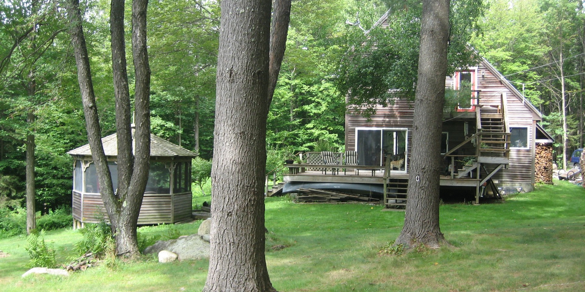
I am writing now from the heart of the Berkshire forest where my family and I are guests at the home of my cousin in the hills of West Cummington, Massachusetts. If my own world is in Rome is urban, chaotic, compact, compressed, this world is rural, expansive and peaceful. My uncle purchased land here half a century ago and, in addition to putting a large portion into preservation trust, he left parcels for each of his children, three of whom designed and built their own homes. We are at the home of Hal and Barbara which stands as a testament to self-design, to the extraneous nature of the Architect in the creation of personal dwelling.
At risk of diverging from my intended theme for this post, I have to sing my praise for this house to which, to my knowledge, no professional architect laid hand. Like Shaker design (which we saw in nearby Hancock Village) or a boat or a well-written computer application, this house has everything but wastes nothing. It just seems right. It sits in the forest like it fits, a tall box with a steep roof against the snow and thick insulated wood walls and thermal windows against the cold. The views from inside out are controlled with the eye of someone who was willing to spend time on the site before designing and make changes along the way, something architects rarely have the luxury of doing. The spatial and visual connections within, from the upper floor corridor down to the double height kitchen, from the upper deck to the lower deck which wrap around an existing apple tree, provide variety without excess. As on a sailboat, everything as a space and every space has a function. The house fits the land and the lifestyle of the inhabitants like a glove. I truly believe that the only way to really achieve this is for the designer to be his/her own client and camp out on the site for a while before making the first decisions. Where does this leave professional designers? I think there is a huge unmet potential for designers to make building systems and products, to come up with solutions that can be adopted by lay-people and applied creatively to unique conditions. Prefabricated building systems offer a challenge for architects to extend their reach from the single client to whole communities without increasing their workload. Just as my cousin buys efficient windows and excellent appliances (he doesn’t try to build his own coffee-maker), others might be able to buy quality building components to customize and assemble into homes that fit.
Returning to the concept of rural living, though, I’ve decided it’s not for me and shouldn’t be for most people; if it were, Earth could not support the population it holds with difficulty now and I don’t see an ethical way to reduce this. No, I think this kind of rural living, even when treading as lightly as Hal and Barbara do, can only be sustained when it is a rare event, a marginal phenomenon. While I’ve seen no better example of what Melvin Webber called “community without propinquity” –I am connected to the web, watching films downloaded from Netflix, and can drive up the road to the hip, eco-friendly Creamery for organic eggs and herbal tea and conversation, we are still looking at a vast amount of land supporting a small community of humans. Looked at differently, as a small group of humans tending a large area of land helps justify the situation, but the bottom line is that in a post-petroleum world it will be very difficult to support such dispersion.
Between the extremes of the urban life which is my normal reality and the bucolic dream I am experiencing now lies the reality of most people dwelling in a world which is urbanized but not urban or which is green but not rural. That is what the planet truly cannot afford.
It would be great if most people lived in sustainable cities, places which may not even exist at present but which people around the world are working hard to envision and create (myself included) but had an opportunity now and then to experience true country living, to decompress and walk in the forest. And, vice-versa, for those rural residents to come to the cities for a while, discover the joy of walking out ones door into the chaotic whirlwind of human culture. Thanks, Hal and Barbara, for an eye-opening rural experience. Our Terracina tower is awaiting you whenever you can get away from the forest.
Reuse in Rome

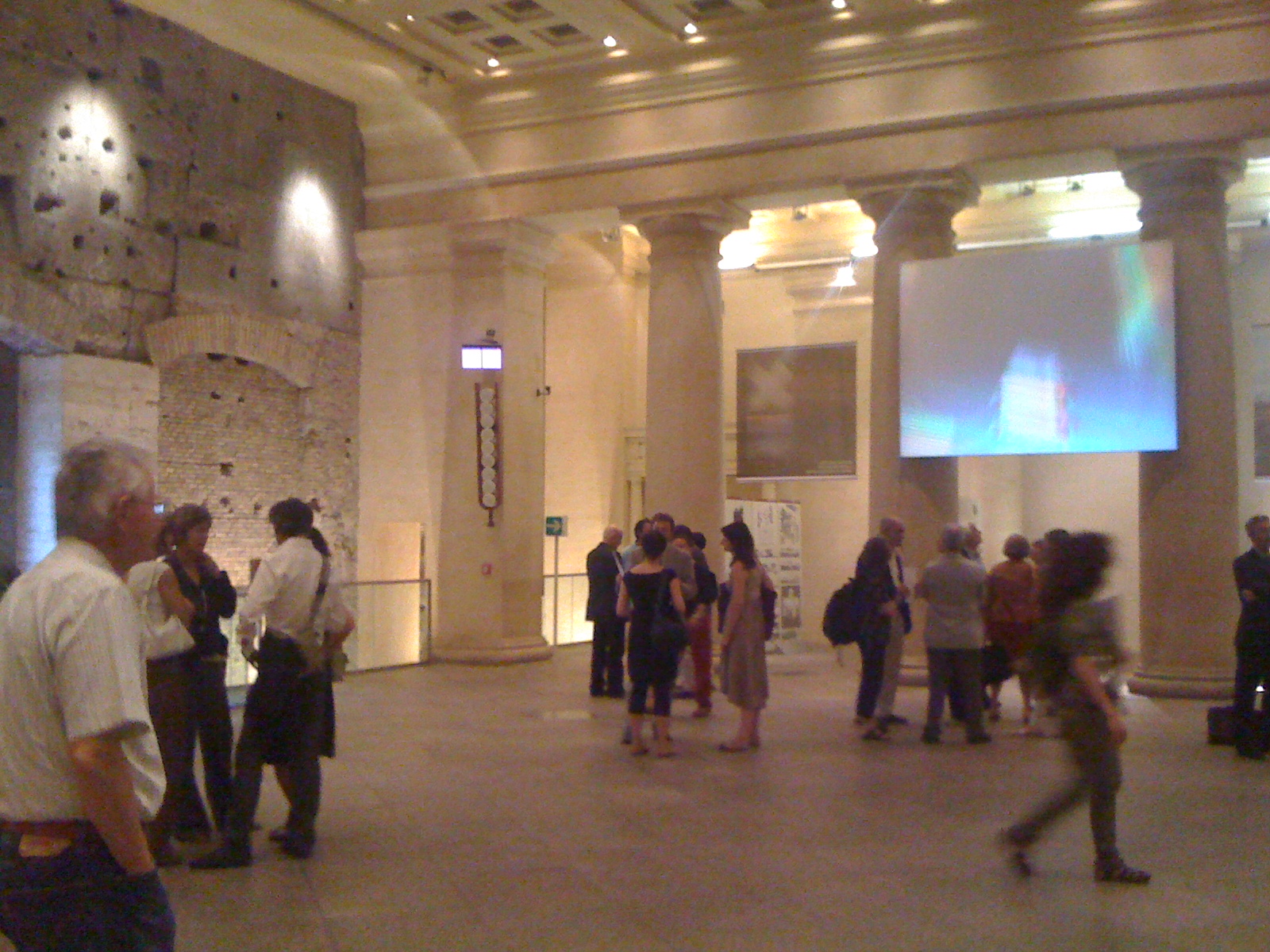
This week, as part of the Festa dell’Architettura, the work of nine university programs (members of AACUPI) and an equal number of architects from the various foreign academies has been on display in an exhibit entitled Foreign Architects Rome (FAR) at the Temple of Hadrian. The site is prestigious, to say the least, standing as a monument to the deified emperor responsible for the Pantheon just down the street. Originally built in about 140 by Hadrian’s adopted son and successor, Antoninus Pius, the building has served in recent decades as the site of Napoleon’s offices, the city of Rome’s stock exchange, and currently the chamber of commerce exhibition center.
Its street address in Piazza di Pietra tells another story, one of material reuse. Pietra (stone) was the material available to be quarried from the eroding temple, most likely to be burnt for quicklime in the lime kilns. Appropriately, material reuse was the subject of our students’ principle design project, on display along with analysis, urban studies and history projects and a panel dedicated to the Abruzzo revitalization workshop.
The premise of the project was that cities produce waste and consume materials and energy, but this is not necessarily “by nature”. A well-functioning city in which inherent synergies and efficiencies are maximized by design can reduce this “waste” to close to zero. Products which today become broken or obsolete are discarded when they could be repaired, reused, regenerated or as a last resort see their component materials recycled. Traditionally such activities have often been marginalized, performed by outcasts in blighted parts of cities. Rome, however, has a tradition of productive workshops in its historical center, now being rapidly forced out of existence by global economics. In an emergent green economy this work will become more appreciated and more central to a mixed use urban ecology.
The project called for the transformation of the site of the former papal arsenal at Porta Portese into a sort of “Village of Alternative Consumerism”, an urban resource center or a center for material reuse. This is a place where people can bring things to fix or hack, where you can drop off a broken washing machine knowing it will be treated as resource, not waste, and the way in which it is collected needs to look like sophisticated resource storage (rather than a mess). Students worked on systems for archiving, displaying and storing materials and parts but also on the development of a new kind of public space, a gathering space based not purely on consumption but on productive relationships. A kind of Hub of resources. Given the complexity of both site and program, the results were indeed impressive.
In putting together the exhibit I opted to show a little of each student’s work rather than selecting specific projects: the result was admittedly a bit chaotic but I think an accurate reflection of Rome and its material culture. Quotes were used to express the issues being addressed and their glo-cal urgency. Hopefully visitors will get a sense that the attention of the international architectural world is not just about the historical monuments and cultural traditions of Rome, but also about the complex urban systems that make any city an effective ecological habitat.

Roma Citta’ Futura
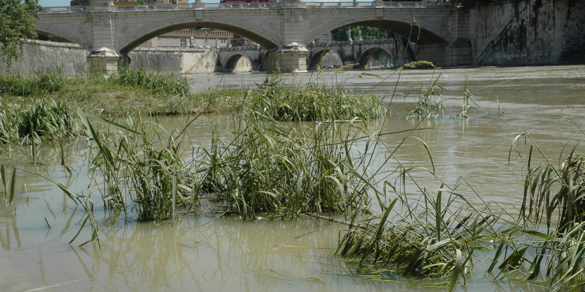 While I was sitting in a conference about Margaret Fuller on the Tiber Island this morning, I drafted seven points for getting Rome back on track for a sustainable future. I didn’t start out with the magic number seven, but in the city of seven hills, seven kings, it works out well. It is a work in progress but I intend for these to be the backbone of my upcoming book on Rome.
1.Stitching damaged fabric.
- •requalify blighted areas through design
- •inject life into underutilized buildings
- •create public space where it is lacking
- •make private space work where it is dysfunctional
- •seek synergies and closed-loop adjacencies
2.Internalize and distribute energy
- •recognize the energy efficiency of Rome’s buildings and increase it where possible
- •in new construction, quantify and regulate embodied energy
- •require and fund installation of renewable energy sources on public buildings: PV, solar thermal, wind, geothermal, etc.
- •facilitate installation of renewable energy sources on private buildings: PV, solar thermal, wind, geothermal, etc.
- •exploit adjacencies for cogeneration
3.Minimize private automobile use
- •seek to invert record of worst per capita auto use in Europe
- •vastly improve public transit, especially BRT, through strictly enforced bus lanes, precise and extended schedules, creative PR to restore image of public transit
- •privilege bikes through real bike sharing, ubiquitous bike parking, extended bike paths and, above all, the removal of private autos from most streets
- •Declare historical center zona 30 or car-free
- •Zero tolerance for traffic and parking violations
- •Moratorium on new parking areas
- •Reduce “macchine blu” to bare minimum, following examples of British leader David Cameron who walks to work. No public employees should use a car unless their job requires travel to areas inaccessible to public transit, bike or walking. Furthermore, when for security reasons “macchine blu” and escorts are requested, maximum transparency is necessary so citizens can see what it is costing and decide if it’s worth it.
4.Ban waste
- •create urban re-use centers and subsidize vintage commerce
- •streamline recycling and make it work (also enforcing waste separation with force of law)
- •penalize packaging, promote bulk sale and re-usable containers by pricing waste out of the market
- •create neighborhood compost centers and gasification plants
- •encourage urban agriculture, including courtyard animals such as pigs, as a productive use for organic waste
5.Re-forest and farm
- •facilitate design and permitting for green roofs and urban gardens
- •provide land for urban farms
- •incentivate courtyard animal breeding
- •penalize long-distance produce by fuel taxes and fees
6.Send water where it is needed
- •Though Rome has abundant clean water, other parts of Italy don’t; conserve water in Rome and pipe it to Puglia, etc.
- •Re-invent cisterns to store water from rainy season for dry season
- •De-pave where possible to prevent rapid run-off
- •Create complex loops to purify and use grey and black water
7.Reinvent community
- •design public spaces and facilities
- •enforce full transparency of information for citizens
- •promote education, oral histories, local culture
- •promote sustainable tourism, using local authenticity to attract global interest
Roma Ciclabile or ?
 I was at the Campidoglio yesterday for the presentation of Rome’s “Piano Quadro della Ciclabilita’”, the plan to promote and support bicycling as an alternative to motorized transport. I went with hopes of seeing tangible proposals that would allow the city to catch up with many of its northern sisters where biking is the preferred mode of transit for many.
May 13 was also international “Bike to Work day”, although I saw little evidence of this. My own comute from home to studio is a ten-minute ride; if I were to take a car and park it illegally it would take at least 20 minutes, longer still if I were to look for legal parking. Yesterday I saw, as always, at least about 150 cars blocking streets, double-parked, parked on sidewalks, on crosswalks, forcing bikers and pedestrians to weave through traffic. Yet when I arrived at the Campidoglio and locked my bicycle to a pole (no bike-racks for the municipal offices and Capitoline museums) I was immediately approached by police instructing me (with much appreciated irony) to park elsewhere. “This space is reserved for the mayor; I didn’t realize he was biking to work today.” Useless to explain that Alemanno not biking to work on Bike to Work Day when he is that same day also presenting a plan to promote cycling, is hugely hypocritical and astoundingly bad PR.
The Piano Quadro della Ciclabilita’ presentation was little more than an opportunity for politicians to make claims of environmental sensitivity. Much of what was said about the advantages of urban cycling, the problems of street safety (Rome has one of the worst mortality rates in Europe from accidents) and the opportunities for the green economy was perfectly valid, but also gratuitous when the administration’s responsibility is to solve the problems, not point them out. The cyclists in the audience were visibly and understandably angered at being instrumentalized by politicians, ready for photo opportunities “participating” with “citizen groups”. As always, the conference began late, the headlining Environmental Alderman Fabio de Lillo announcing he would arrive later, no sign of the Mayor, and after two hours it was clear that the debate with associations would be cut short or eliminated entirely. I had to leave, frustrated at having heard nothing concrete.
What did I expect? Nothing more. What could I have hoped for? Quite simply, firm commitment to improve the city of Rome for cyclists and pedestrians (and thus for everyone):
- Commitment to enforce traffic laws, fining and removing from circulation cars parked illegally, documenting speeding violations, telephone use, etc. etc. including violations by state officials (my collection of documentation of Rome’s police committing such infractions is exhaustive). This alone would make the streets of Rome significantly safer without the cost and delay of creating bike paths. And it doesn’t require approving any legislation; just enforcing the legislation already on the books. Yes, it’s absurd we have to even mention this, but in Rome enforcing the laws is at best an optional.
- Creation of Zone 30 throughout the historical center and in specific streets around Rome. Statistically, the mortality rate would drop dramatically. Strange that Maurizio Coppo, head of the national street safety council didn’t even mention the concept, common throughout Europe, as a solution.
- Creation of bike racks throughout the city (such as outside the city offices, schools, commercial areas, etc.) The claims made by the city about accomplishments in this area are laughable to say the least.
- A city law allowing bike parking in condominium courtyards; this had been mentioned in the press but seems to have dropped out of the law as proposed.
- Clear intermodal transit exchange rules allowing bikes on the Metro and trains all the time, everyday, with improvements to service to make this effectively possible.
- Creation of a bike-sharing program. The one that is constantly held up as a symbol of Rome’s green credentials is nothing more than another bike rental agency, not nearly as efficient as dozens that have existed for years.
- And if they want to extend bike paths, that’s fine too, but show us the money!
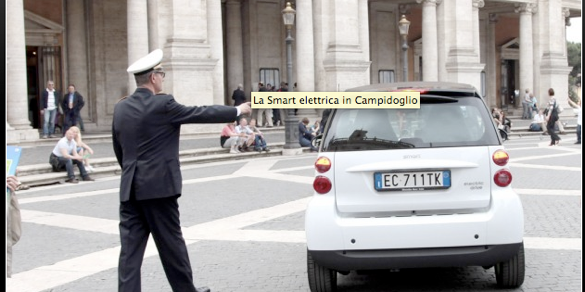
As I left the conference and went to retrieve my bike, locked to a fence out of the way on the edge of the Capitoline hill I pass another “event”, the inauguration of the Smart (brand) electric car. There it was, parked in all its glory in the pedestrian zone of Michelangelo’s Campidoglio square, where hours earlier I was told to remove my bicycle. This may be as close to the green economy as Rome can get, still holding on to the myth of the car as the only respectable form of transportation, now under the alibi of “zero emissions” (and the electricity is produced by what 100% renewable source, scusi?) . This is where the Mayor was, not at the presentation of the cycle plan but at the presentation of another lethal weapon ready to enter Rome’s traffic jam.


At National Bike Day in Rome, you could pedal a fixed bike and use the power generated to run a toy CAR!
Update from Rome
 Springtime in Rome always brings excitement and hope for the city, optimism can’t help but prevail amidst the flowering trees, jubilant tourists and warmer weather. Except when the flowering trees have been cut down and not replaced, the tourists are irate about waiting a half-hour for a bus only to find it too crowded to enter, and it’s been cold and rainy almost every day since November! In the midst of the wonderful chaos of a Roman spring, rather than write a single blog entry, here is a list of tweeter like comments on the goings on around town.
- Follow up on Progetto Millennium. On Tuesday, May 18, 2010 at 9:00am at the Salone della Cultura del Palazzo dei Congressi will be held the “Stati Generali” meeting, presenting over a hundred projects for the city of Rome. http://www.statigeneraliroma.it is the site for more information, though only in Italian. The link to submit your own proposals for Rome, very enticing, is currently not working.
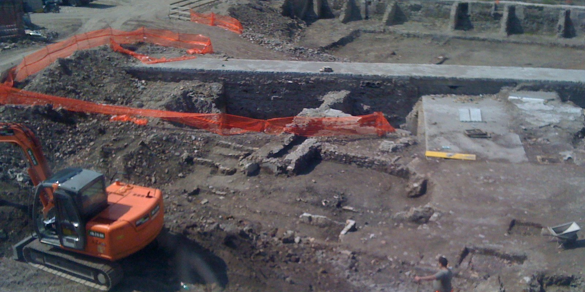
- Status check on the excavation for the Multi-level parking Structure at Piazza della Moretta, Via Giulia (see 15 March blog). Photo above is of the excavation in progress, being carried out with no “safety coordinator”, no safety plan for the adjacent high school, no no hard-hats or other required safety measures, and above all no public debate about the idiocy of dedicating valuable, sensitive land along the Tiber river in the historical center of Rome to the storage of automobiles. At least they are uncovering some interesting pre-Mussolini foundations and appear to have an archeologist present to keep an eye on things.
- Art Shows. On a brighter note I’ve seen a number of interesting shows recently, contemporary art at the Gagosian gallery (Richard Serra paintings) and the French Academy (I Mutanti, a show of five artists very creatively installed in the Villa Medici halls, stairs and gardens), and a fascinating exhibit of photographs byStephen Shores at the little museum on Piazza Sant’Egidio in Trastevere. Shores’ photographs of everyday American scenes from the 70s are haunting and beautiful but impressed me most because of the sporadic presence of automobiles (the models I remember from childhood). The are big and colorful but not so numerous, reminiscent of a time when cars in cities still seemed like an exciting novelty and not a destructive infestation. In the same building, appropriately, are displayed the watercolors of Roesler Franz showing typical street scenes of 19th century Rome, still pretty recognizable today. Two of my life’s backdrops in one show!

- Bike Day. Tomorrow is National Day of the Bicycle in Italy, sponsored by the Ministry of the Environment. I’m sorry to be so cynical, but dedicating a Sunday in May to bicycles is a way of saying “bikes are for recreation, for children, to pay lip service to environmental concerns and pretend to care”. Bikes are a viable form of urban transportation and along with transit and walking they should be stimulated through incentives, not symbolic gestures. Bike paths, bike parking, tax breaks for bikers, prosecution of auto drivers who exceed speed limits and put bikers at risk—these would be more tangible solutions.
- Architecture Exhibit. Coming up in early June (1-7) at the Temple of Hadrian in Piazza della Pietra will be an exhibit of Foreign Architects in Rome, featuring work from the academies and university programs belonging to AACUPI. I will be exhibiting work of the Fall 2009 Cal Poly Rome Program I coordinated, specifically their projects for a center for the green economy sited at the Papal Arsenal near Porta Portese. The challenge was to create a vibrant urban place in which urban synergies and efficiencies are maximized by design to reduce “waste” to less than zero, turning it into “resource”. Call it an urban resource center or a center for material reuse–anything but a “junkyard”.
- Food. My newest neighbor in Via di San Teodoro where I have my studio: the weekly “Coldiretti” farmer’s market. Good food, directly from the producers, for reasonable prices. From raw milk to walnut bread, fresh ricotta to seasonal greens. Best of all, you get to taste everything. I haven’t had to enter a supermarket in weeks.
Progetto Millennium
 Last week an important conference was held at the Auditorium in Rome: Progetto Millennium. Rome 2010-2020, New Models for Urban Transformation. A panel of experts from the fields of architecture and urban design were invited to discuss the problems, challenges and opportunities facing Rome in the next decade. While there is much to criticize in the policies of the current administration, the work that came out of this conference is extremely valuable in launching a serious discussion of serious issues and for that we should all be grateful.
In the upcoming entries I will be analyzing some of the specific policies being proposed or at least promised by Major Alemanno and his staff. Today I want to post the list of questions which were posed by Rete Romana Mutuo Soccorso to the invited participants. My translation from the Italian is fairly loose (I wrote it quickly to get the questions to the participants on time) but if you want to see the original Italian I will post it here.PM_italian.pdf. The questions are clearly quite polemical and pretty loaded but they seem to have achieved the goal of encouraging discussion. Amazingly the city has promised to post the transcripts of the conference on its website open to comments in a public forum.
TEXT of the 10 QUESTIONS
To the participants of the Progetto Millenium Conference Richard Burdett; Santiago Calatrava; Peter Calthorpe; Paolo Colarossi; Stefano Cordeschi; Roberto D’Agostino; Livio De Santoli; Bruno Dolcetta; Massimiliano Fuksas; Zaha Hadid; Leon Krier; Richard Meier; Renzo Piano; Paolo Portoghesi; Amedeo Schiattarella;
It is truly an extraordinary occasion to have as guests here in Rome such important figures from the world architectural scene. In fact, it is thanks to your familiarity with other world capitals that we are taking the liberty of posing ten brief questions which, should you see fit, you might answer on the occasion of the upcoming conference.
We are presenting these questions in written format because the conference has provided no forum for participation of citizen representatives such as our Rete Romana di Mutuo Soccorso, a coordinated network involving 80 neighborhood committees from the historical center to the hinterlands of Rome.
It is with this very issue of participation which we would like to begin, thanking you in advance for the responses you can provide.
- 1.In the rest of the civilized world, are the voices of citizens ignored as they are in Rome? Article 1 of the “Code of citizen participation in urban transformation”, in vigor in Rome since 2006, states “The city of Rome recognizes in popular participation a fundamental method for the formation of decision-making regarding urban transformation and the promotion of social inclusion.” Is it acceptable that the Mayor of Rome has totally excluded Rome’s citizens from the program of this important conference?
- Do beautiful works of architecture make for a beautiful city? For decades an approach to urban transformation has reigned in Rome which sees projects not in the context of a general framework such as the master plan but as individual works juxtaposed, often incoherently, against one another. Through the efforts of various valid architects beautiful works of architecture have been produced; but if they are disconnected from an urban design can they delineate a beautiful city?
- Is it also true in Europe that public works are financed by selling off public assets? Here major public works receive their financing by ceding to private organizations land in the Roman countryside and public buildings, modifying their functional restrictions in contradiction with the master plan. Based on your understanding of other cities in civilized Europe, do you agree with this senseless policy which impoverishes the city for all?
- Is public housing still built in the world’s other cities? In the past twenty years Rome has seen only a handful of public dwellings constructed. The rest of the huge building production has been carried out by private enterprise. The lack of affordable housing for a significant sector of the population is causing a major exodus of inhabitants and an ongoing “cementificiation” of the Roman countryside, resulting in empty and unsold homes. In other cities are policies of public housing pursued? Is affordable housing constructed?
- In what other capital city in the world are there 800 automobiles per 1000 inhabitants? Not even counting two-wheeled or commercial vehicles, Rome counts 800 autos per 1000 inhabitants. In your experience are there any other cities in the world with such a devastating ratio? Given that the Strategic Mobility Plan of the current administration provides for a mere 2% reduction of private transportation in favor of public transit over the next ten years, do you see this as an ambitious goal?
- Do metropolitan railway lines exist in other parts of the world? In Rome, workplaces are ever more concentrated in the central areas while residents move to the distant periphery and beyond the city limits. In the last fifteen years over 100,000 families have been forced out of the center and spend an average of 3 or 4 hours a day in transit. Given this, and the difficulties of working in a terrain rich in archaeology, do you think it should be higher priority to construct the central sections of the Metro C and D lines or rather to dedicate resources to the construction of connections to the more densely inhabited peripheral areas?
- Elsewhere in Europe are historical public spaces destroyed and public schools dislodged to construct parking structures? The major public works projects in the historical center have consisted in the construction of multi-level underground parking structures which risk altering forever the face of the city. In recent years the marvelous terraces of the Pincian hill narrowly averted the risk of such a garage. In Piazza Cavour one of the most beautiful 19th century gardens was destroyed to make way for parking. Recently construction has begun to excavate parking under one of Rome’s historical classical schools, the Liceo Virgilio on Via Giulia! In civilized Europe do you destroy the historical memory of the city to build underground garages?
- Are other cities’ historical centers regulated or is there everywhere a liberalization of the proliferation of fast food places? The heart of Renaissance and Baroque Rome is carpeted with restaurants, pubs, trinket shops, many with the financial backing of organized crime. Recently the city administration has passed regulations which substantially liberalize even further this senseless proliferation of low-quality commerce. In the other beautiful cities you visit, have they too given up on any form of control and civil behavior?
- In Europe do they also condemn the peripheral neighborhoods to languish in favor of shopping centers and amusement parks? The huge periphery of Rome and the Roman countryside are littered with more than thirty shopping centers, among the largest in Europe and plans are underway to add two huge stadiums and several enormous amusement parks. The association of merchants in Rome, Confcommercio, has denounced the closure in just two years of over 5,000 neighborhood shops. Do you believe that the urban desert which has been imposed on us is fruitful for the sustainability and livability of our city?
- Is Dubai more beautiful than Rome? One of the projects most dear to Mayor Alemanno is the creation of five artificial islands off the coast of Ostia to construct new buildings. After the bankruptcy of the giant real estate venture in the Emirates involving the creation of artificial islands, is there still sense in pursuing this unsustainable and social vacuous urban model?


 SUSTAINABLE ROME