Via Giulia: a Renaissance jewel in need of a rebirth
 Some years ago I had my office on Piazza Farnese and would often walk or bike along Via Giulia on my way to work, fueling my frustration with the invasion of cars along what was designed as a grand but quiet pedestrian boulevard. Today my frustration returns as my son’s high school fights to resist further automotive incursions in the guise of a new private parking garage on property currently used by the school. In fairness, the outdoor space in question is only partly used by the school, as it should be, for recreation but is otherwise a parking lot for teachers’ cars and students’ scooters. It should be redesigned as pedestrian space. It should not be given over to the car mafia.
Via Giulia was laid out by Pope Julius II in the early 16th century, his intention being to create a straight route to the Vatican, and to clear a location that had evolved over the centuries as haphazardly built hovels for grand noble palaces and an even grander papal courthouse. The aspirations were not the most respectable and the enormous scale of Bramante’s very “Roman” project resulted in only the travertine foundation and a few first blocks of the building’s base being erected, blocks which have earned the nickname “the sofas of Via Giulia”. Walking past the hundreds of cars illegally parked along the Renaissance street, I’ve always thought that the scale and presumption of these blocks resembled more their automotive companions. The courthouse, when finally built after the unification of Italy but on a different site across the river, was in the end even more preposterous. Via Giulia didn’t entirely lose out on its quest for justice. The city’s old prison, installed just across the river in a monastery built in the 17th century, proves that cities are places of strange adjacencies. And just down the street from the Virgilio high school in a similarly fascist-era building is the headquarters of the Anti-Mafia, a building where men in dark sunglasses descend from polished Alfa-Romeo’s day and night. I don’t know exactly what goes on there, but the estimated value the Italian government must spend on these cars is in the millions. This is Via Giulia.
The street is within the ZTL, the limited traffic zone, off limits to all but residents and those who have earned or bought the access sticker. Parking is forbidden along the entire street, with tow-away zone signs clearly visible amongst the parked cars. I used to call the police to request action; the usual response was feigned surprise “oh really, well we’ll send someone over right away”. Then I gave up. But now that there are actually plans for constructing a multi-level parking garage its developers and their apologists imply that the problem will be solved, that now the cars can get off the streets. These are the same lobbyists that point to the graffiti, not the cars, as the real evidence of barbarism (although as far as I know no one has ever been run down and killed by graffiti). I would like to think that if the plans for this garage (passed in secrecy and not available for public viewing) do reach completion, the millions in profit do go to the school and the community, including to pay the traffic police well enough that they dare to actually ticket the cars blatantly scoffing the no parking signs. But after 17 years in Rome, my expectations are less optimistic. I would rather see the cars left to fend for themselves and every square meter of open space preserved for people and green.
Monday, March 15, 2010
The Least Green Campus
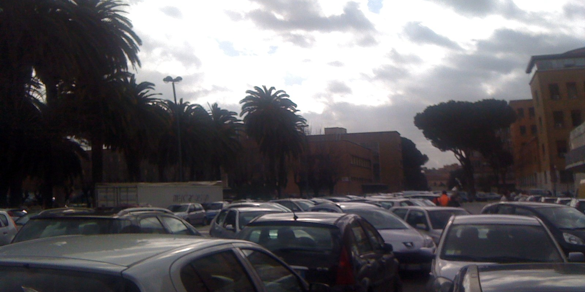
Last week I had to go to the University of Rome’s central campus to pick up my university degrees (the new one I recently earned from the Architecture school there plus my original Princeton and Harvard certificates which they had kept on file, folded and rubber-stamped in the dusty basements of bureaucracy!). Having been privileged (yes, that’s definitely the right word) to study in some idyllic campuses, my point of reference is biased, but even so I can’t imagine a worse environment for university education than this “campus” (etymological note: from Latin campus ‘field’) .
The buildings are not all bad, despite the heavy fascist-era monumentality. Planned in the 1930s to replace the Renaissance buildings near Piazza Navona, there are some great works by Gio’ Ponti and Giuseppe Pagano amongst others. The problem, as so often is the case, is the automobile, not anticipated by Mussolini’s architect Piacentini.
Aghast at the sea of cars pictured above, I asked a security guard who seemed to be directing traffic what the policy was on who was allowed to circulate and park beyond the imposing campus gates and he vaguely responded “faculty, employees, people with a temporary pass, …. pretty much anybody”.
There is practically no defended pedestrian space left within the campus. Sidewalks are blocked by cars and scooters, just a patch of muddy grass here and there remain humane. My romantic memories of strolling across campus with friends, discussing Camus and the Clash, wouldn’t fly here where maintaining a conversation while dodging Vespas and hurdling bumpers would be difficult.
I’ll be the first to admit there’s some hypocrisy in the pastoral campus behind the gates of a post-industrial world–I spent much of my university career escaping the ivory towers to the gritty realism of the city–but in this case the university is mirroring the worst aspects of the 21st century city. There is no role for cars to play on a university campus, period. Students, faculty and employees in a city served by widespread public transit should use it. Housing should be made more abundant near the campus and those that live nearby can walk or bike. Parking should be available for those who truly need it at a reasonable price, which means a high price, subsidized for the disabled alone. Faculty who occasionally need to arrive by car to carry equipment or other heavy items could do so with a temporary pass for loading as we do on American campuses and if necessary pay to park at market rates (which in the center of a capital city should be no less than €5/hour).
The problem is that in Italy more than in any other country many car-owners consider unhindered use of the car as a privilege far greater than fresh air and a pleasant environment. The day they open their eyes to see it as more annoyance than convenience, more embarrassing than impressive, they may start to prefer a green, pedestrian campus to an ocean of sheet metal as a suitable field for study.
Frugal Architecture
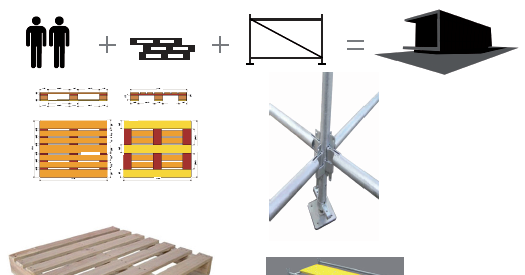
This past week I participated in the conference and workshop “Towards a Frugal Architecture”, sponsored by theFondazione Bruno Zevi, AACUPI (the Association of North American University Programs in Italy) and La Sapienza Valle Giulia School of Architecture, and organized among others by my colleague Cinzia Abbate. It was a fantastic opportunity to discuss important issues of our times with designers and thinkers from around the world, from Africa to Alabama, from the beaches of Indonesia to the favelas of Rio. The conference presentations, held at Rome’s Center for Alternative Economies (Città dell’Altra Economia) touched on local experiences and global issues, spanning nicely theory and practice. Nina Maritz of Namibia set the tone with a set of “anti-rules” in the tradition of Bruno Zevi: “listen to the land”, “Mum knows best”, “Form follows function” (using all the senses), “waste not want not”, “necessity is the mother of invention”, “the whole is greater than the sum of its parts”, “variety is the spice of life”, etc. Her message that a frugal approach doesn’t necessarily lead to frugal expression was well-stated: “just because it’s sustainable, doesn’t mean it has to be shabby, cheap and nasty”. Brazilian architect and planner Jorge M. Jàuregui spoke about his projects to introduce form to the informal city. An architect from the firm of Santiago Cirugeda then gave a very interesting talk about the sometimes illegal, subversive, temporary projects carried out in the margins of Seville. Giorgio Goffi showed some beautiful, inexpensive buildings in and around Brescia. Sarah Wigglesworth gave an extremely articulate talk about economics and ecology, describing frugality as the careful management of all resources, essentially living within the means of the planet. She pointed out that in an economy of abundance that has been reached in the developed world need has often been replaced by desire creating a status-driven economy. She advocated working against the grain, which requires understanding that “the grain” is involves land value, scarcity of resources, local skills, etc. Sarah accompanied the various projects of her firm with versions of frugality: modularity, recycled materials, found materials, flexibility/adaptability, lack of specificity, repetition, self-build, stretching the brief, etc. Eko Pravoto spoke of the search for a new balance when making architecture in a globalized world, pointing out that in his native Indonesia labor-intensive practices help put local manpower to work and save money while producing incredibly artistic, personalized constructions such as weaving and timber framing. The last and most dynamic presentation was by Danny Wicke of Rural Studio. Danny recounted his hands-on experience in providing for the housing needs in the poor, rural Hale County area of Alabama, showing a number of houses produced by students and volunteers from financing phase to ongoing maintenance and modification. Although there was no time for immediate debate, the conversations that continued over dinner and the next several days were enlightening.
The other part of the event was a workshop in which thirty students from American universities (including Northeastern University where I am currently teaching design studio) teamed up with an equal number of Italian students from the University of Rome for a day-long charrette designing temporary shelter for victims of the April earthquake in l’Aquila. In parallel another group of Northeastern and Rome students worked at the Academic Initiatives Abroad facilities at Piazza Cinque Scole, an event dubbed the “Frugal Fringe”. The students, who had all attended the previous day’s talks, were inspired to work with frugal and innovative building technologies to create structures which could be built quickly and cheaply but grouped to create communities and personalized to help repair the psychological trauma of the tragic event. There was no precise site and, other than projecting the photos I took when visiting l’Aquila with my students last fall to get a sense of the scale of the disaster, little discussion of the local reality was possible in the short time allotted.
After about ten hours of intensive brainstorming, sketching, digital modeling and much impressive linguistic barrier-hurdling (made easier by today’s lingua franca, Google SketchUp), the teams submitted their ideas. On Saturday morning, at the University of Rome Architecture Department, a discussion about the works took place with most of the conference participants, followed by a buffet generously offered by Portia Prebys and AACUPI. The results were impressive given the short timeframe, but criticism pointed to the too passive acceptance of the quantitative requirements of the brief as opposed to critical discourse about the larger picture, from the needs of the local economy to the possibilities for collective organization.
I noticed several approaches: a. those that encouraged participation, sometimes in the form of self-build, assuming that users know better what they want but need tools and information, an approach which sets up architects as managers and micro-economical advisors. b. projects which considered aggregation, emphasizing community, here taking on the role of sociologist or urbanist. c. projects which were more proactive, positing the architectural profession as technical experts, capable of drawing construction details, resolving structural, energy and water needs, and in short creatively envisioning possible buildings. This last approach was the most common, indicating that this generation of young architects is by no means retreating from the core tasks of the profession.

While the proposals often took the notion of “frugal” too literally as meaning “cheap” rather than “fruitful” as the word’s etymology would suggest, and the complexity of the construction techniques in some cases would over-ride any savings from the use of salvaged or recycled materials, there were some solid ideas worth pursuing further. Several used shipping pallets, filled with insulating material (I was hoping to see the idea of personal possessions such as books and clothing stored with double function of personalization and thermal insulation). Others used sandbags (perhaps filled with building cement-quality sand to be used in the construction of permanent housing at a future date?). There were a number of gabion wall proposals, wire mesh filled with rubble from the earthquake damage and local stone, a notion that Danny Wicke in particular found impractical due to the back-breaking labor required but which was defended when local unemployed labor could be used. Panel systems and even containers, prefabricated and shipped to the site, provided for more rapid assembly although it was pointed out (by one of the fringe critics from Northeastern, Lauren Abrahams) that even pre-fab is fabricated somewhere and perhaps the local economy could benefit from such industry and save shipping costs).
Hopefully the projects (and some of the ideas discussed) will find a venue for further consideration, whether in the form of an exhibit, a publication, or both.
Ten Commandments for a Bike-able Rome
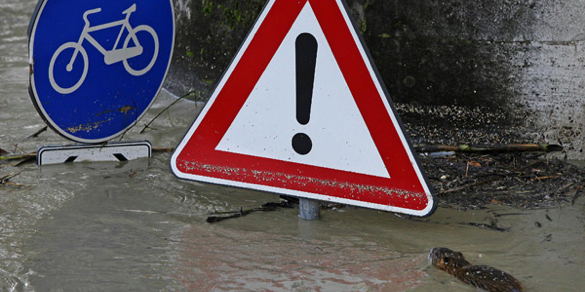 This month I’ve decided to upload the English-language translation I made of the “CicloDecalogo”, a document presented last fall to the city of Rome by a committee of urban biking activists here. I will include at the end a list of links to various organizations active in this important endeavor.
2. REDUCTION OF SPEED: Zone 30 in the historical center, in the limited traffic zone and on internal residential streets. A rigorous 50 km limit elsewhere. Only at speeds below 50 km / h can one survive being run over by a car. Apart from the deep human wounds, every accident carries an unacceptable social cost, which should induce the City to protect its most vulnerable citizens, no ifs, ands or buts. Despite the shameful media campaigns to discredit them, speed traps and video cameras are a useful deterrent. There are still too few and they alone are not enough; urgent solutions are needed that make it necessary to slow down. Speed bumps near many sensitive locations, in the many sensitive locations (schools, parks, hospitals, churches are protected in this way throughout the world without succumbing to the alibi of “emergency vehicle access”
Increased pedestrian crossings (installed without problems in many municipalities) to highlight the crossing and to slow vehicles even when no pedestrians or bicycles are visible.
Frequent preventive controls, followed by penalties, not in a war between people making different transit choices but as a necessary means to prevent deaths and accidents. Law enforcement should be carried out, without arrogance, by people who expect others to behave civilly, respecting common rules of safe behavior. Those guilty of offenses are not only drivers under the influence of alcohol or drugs, but those who speed in the middle of neighborhoods, those who run red lights or intimidate pedestrians by speeding up at crosswalks, an increasingly common phenomenon that must be prosecuted without further delay.
Immediate closing of the Olympic Pool parking lot built over the “Ciclovia della Musica “ bike path, returning this illegally occupied property to the rightful owner, the City and to the cyclists who used it;With a little maintenance and a small but continuous investment, the Tiber bike path could achieve the dreams and hopes nurtured over the years. The use of the river banks for parking and transit of cars and scooters is unacceptable and the Estate Romana festival should be moved to the left bank to avoid blocking the bikepath from May to October, the very most favorable months for biking; the Palmiro Togliatti bike path is left unfinished and poorly executive; no serious corrections have been made to the make-shift solutions, leading to the abandonment of “the useless bike path” which potentially provides a strategic link-Aniene Nomentana-Tiburtina-Casilina-Cinecittà-Aqueducts — Appius-Colombo-EUR-Center-Tiber. The solution for Collatina and railway station cannot be postponed further.WORK MUST BE FINALLY BEGUN OR RESTARTED FOR BIKE PATHS THAT HAVE BEEN PLANNED AND APPROVED
- Viale Marconi Laurentina junction with the Tiber bike path and connection to RomaTre;
- Via Nomentana, now even more valid due to the bike sharing station in Villa Torlonia
- Testaccio;
- Aurelian Walls, strategic ring road, already semi-finished thanks to the pomerium
- Andrea Doria;
- Prolonging Tiber Mezzocammino – Mare on the left bank towards Ostia and the sea. This would restore brilliance to the Tiber South area that, while dramatic, has little mobility use.
With a gesture of great political value and unanimously approved sensitivity, the dedication of a new and easily implemented bike route Colosseo/CircoMassimo/P.za Venezia/Fori/Colosseo should be dedicated to Eva Bohdhalova (killed by a taxi while biking home from work this year). Similarly, the Tevere Tor di Valle should be dedicated to Luigi Moriccioli.
A study by Cycling England www.cyclingengland.org.uk showed that if a cyclist goes to work 3 days a week for a year this results in savings for the community of 600 pounds, in 30 years equivalent to 10,000 pounds. A single cyclist, a true investment in good policy.BICIPLAN Thousands of simple, concrete, economic ideas have been verified and compiled with passion by local communities and are ready to be implemented. An explanation is called for as to the incomprehensible lack of progress on this initiative.
4. ZTL and PEDESTRIAN ZONES. The limited traffic zone and pedestrian areas of the world’s most beautiful and fragile historical center should again become serious, lasting and inescapable instruments. The uncertain policies and and delays have in fact resulted in the invasion and development of beautiful Baroque squares and picturesque Renaissance spaces, reduced to scrap-metal storage or banal shortcuts for the privileged and undisciplined. Today automobiles even deface Piazza Navona.
5. BAN THE CAR FROM THE CITY CENTER. Rome should be car-free at least at its core, and those few necessary cars should be slowed by a strictly-enforced Zone 30. The economic and public relations return from such a policy would be immediate; Rome would become once again livable and enjoyable, free from dangerous and oppressive hysterics, for tourists, children, elderly and. .. cyclists from all over the world!
Also, clear laws and signage should permit bikes to travel against one-way limitations on the streets with very little traffic.
6. GREEN STREETS AND INTERCHANGE PARKING LOTS. Municipal governments should coordinate their efforts to manage traffic arteries, identifying car-free commercial and residential areas (Green Roads) as it has wisely launched in some districts. Together with the Province and the Region Rome should not invest in new neighborhoods and streets that flow into the city without having first providing points of exchange with the public transport. The goal is to make car use in the city less desirable than other forms of transport through a committed and continuous policy of incentives and disincentives. This has no longer been true for some time and Romans are now convinced that it is better to waste 11 days in traffic than to take public transportation which is not adequately protected by bus lanes.
7. BIKE TRANSPORT ON PUBLIC TRANSPORT should be introduced and increased boldly and quickly where it is already possible, increasing the allowed days and time slots (Metro, Tram and Jumbobus) and providing for the foreseeable future on the rail line C and B1. On new metros and trams, an appropriate bike storage space (internal or external – there exist many examples from abroad) would allow an easy, fast and secure intermodal transportation of bikes included in the Metrebus ticket price.
8. BIKE STORAGE SHEDS AND RACKS everywhere, as a loud and clear call for the use of bicycles. Pleasant and low-cost additions can be made to public buildings, schools, cinemas, theaters, libraries and stations / bus terminus, possibly in safe environments, exploiting those already under surveillance. High rack models allow the most secure anchorage of the frame. Large companies should be invited to install them, using them as a hinderance to the criminal assault of more or less illegal billboards which with impunity have been degrading the city, and also to prevent the disorderly illegal parking. In Milan every subway station has its storage area for bikes and motorbikes.
9. BIKE SHARING should meet standards at least of Milan, if not in Paris, with many more stations and bikes and, above all, the usual first half hour free so as to be truly convenient and in synergy with the public transport and spread even around Rome with great direct and indirect benefits for all.
10. BUILDING CODES to allow bikes in condominiums. This is not to ask for subsidies to install install bike racks, but to adopt a regulation that allows them to be installed in common areas without having to re-approve the rules of the condominium. Rome is full of buildings with courtyards, both in the Center, where even the most prestigious have been ruined by auto parking, and in suburbs where disgraceful building projects have robbed the last remaining childrens’ playspaces, but it is still not possible to install a trivial but persuasive bike-rack.
The full Italian text is at http://cicloappuntamenti.forumfree.it/ . Below are some other links to bike-related organizations in Rome; please comment with ones I have certainly missed.
http://romapedala.splinder.com/
http://www.biciroma.it/index.php
http://ciclofficinamacchiarossa.noblogs.org/
The Elephant in the Rome
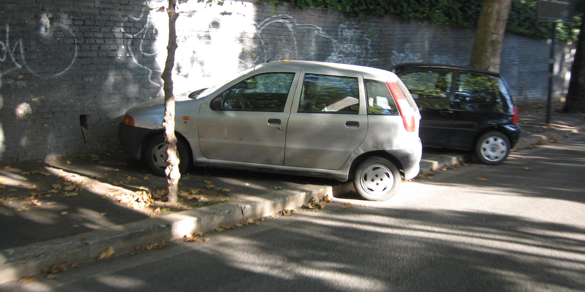 I can’t help returning again and again to Rome’s cultural addiction to automobiles, it’s so obvious a problem but one to which so many Romans seem either oblivious or resigned. We know that Italy has the highest per capita car ownership of all countries on the planet in a country that was built before the advent of the automobile.
Officials talk about how complicated Rome is but it’s often quite simple; there are cars where there shouldn’t be cars: in pedestrian zones, on sidewalks, on crosswalks, on scooter parking areas, at bus stops. And these cars are often far too big for a city like Rome. And, worse, they often belong to the very people who we’ve tasked with making and enforcing the laws!
On my daily bike or scooter commute from Monteverde to Circus Maximus I can usually count hundreds of cars parked in no parking zones (and fines are so rare as to make the practice cost-effective). I can’t help but ask the obvious questions, questions which seem incomprehensible in this culture so firmly enslaved to the car.
1.If all the cars parked in violation of city laws were to pay the fines (for laws already on the books) how much money would enter the city’s coffers? I estimate enough to cover some additional law enforcement personnel, improvements to public transportation and enough left over for bike paths. Not to mention that many people who drive now knowing they can park illegally without risk would consider other options. So why don’t the traffic cops do this?
2.What if parking in Rome cost what it does in other cities, like New York ($40/day average) instead of €4/day? Again, how much money could be used for essential public services and how many fewer cars would we see clogging the roads, consuming disappearing fuel and polluting the air? The value of the 10 square meters of city land taken up by a parking space alone should be about €600/month or €20/day, so why does the city give it away for €1/hour?
3.Italy, a relatively small country, has more government vehicles–mostly top-of-the-line luxury cars—than the United States! Really, where is it written that politicians and bureaucrats need to drive to work at taxpayers expense? Why doesn’t the government sell most of these and let the politicians walk or ride the bus?
4.Even when civil servants don’t have government-issued cars, they still expect to have parking provided at their place of work in the city. Why do public employees get to drive to work? Professors, doctors and architects and thousands of other professionals find their own solution to the daily commute, but the civil servants who we pay to keep our society together can’t. It’s common even to see cars branded with ATAC, the public transit agency, driving around town. This city would work a lot better if its managers and law enforcers were out riding the buses and walking the streets.
5.One reason Rome’s municipal police rarely tickets to illegally parked cars even when they are standing right next to them is that they are too busy “directing traffic” at crowded intersections, duplicating the job of the traffic light with the justification that there are so many cars that would create gridlock without police intervention. What if they just let the gridlock happen and then fined the cars that entered the intersection without being able to reach the other side before the light changes? More money for the city, less incentive for drivers.
6. The last is my current pet peeve: why are there advertisements for cars on public buses? In fact, why isn’t it illegal to advertise automobiles period, given their clear threat to public health, role in environmental crises and in the destruction of our cities? Car ads on buses are like cigarette ads on ambulances.
7.Where is it legal to park a bicycle in Rome? You would think a form of transportation that produces no emissions, consumes no fuel and occupies minimum space would be encouraged, but I have only seen two bike racks in all of Rome. It is illegal to lock a bike to any other object and I have actually had my bike confiscated by the police for being locked to a post outside a police station (while an unmarked car just around the corner blocking the sidewalk received not even a ticket). Why not make it legal to lock bikes to posts in the city, and then use some of the income from car parking and parking violations to install bike racks?
The list could go on, but the problem is quite simple. The real culprit is the incentives for private auto use and the disincentives for other forms of transportation. Bike sharing, car sharing are palliative measures, not intended to really replace cars but rather to “brand” the city administration as green. Only when Romans get over this love affair with the car, and see these machines as out of place in the city as an elephant in a china shop, will Rome become a truly green city again.
Temperature Rising
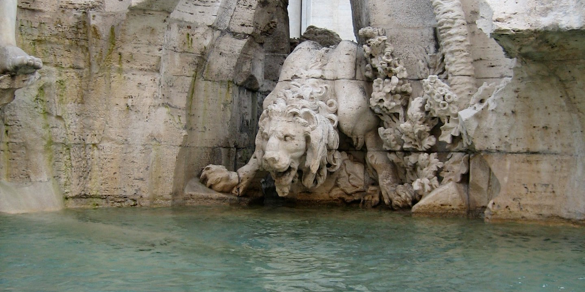 This summer has been a hot one in Italy but I’ve just learned how hot: 1.9 degrees Centigrade higher than the 30 year period documented from 1961-1990. Almost 2 degrees hotter than my first forty years on this planet. I don’t believe there is any serious scientific debate about the central role human civilization has played in this climate change. What is incredible is the general response on the street: complaints about the heat and retreats into air-conditioned cocoons, often automotive ones, ignoring the fact that such behavior is a principle cause of climate change. 80% of greenhouse gas emissions derives from burning fossil fuels, and yet their use continues to rise.
Now that Rome has finally cooled slightly and politicians are gradually returning to work from the long seaside vacations, the countdown to Copenhagen will pass with less urgency.
Thanks to Claudio Giambelli – GRE: Gruppo Risparmio Energetico di Reti di Pace – Laboratorio di Monteverde for this data. http://sites.google.com/site/grerdp/home
Cities Need Space for Junk
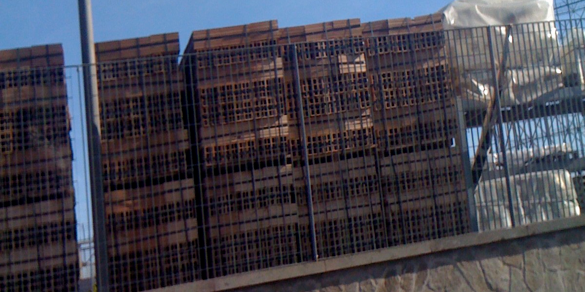 Like many architects, I am in love with simple, minimal elegance, with clean lines and stripped down, ordered space. But I have become increasingly aware of the cost which accompanies minimal design; behind any minimal looking design usual lies an inefficient mess hidden away somewhere, often far away. It is this dialectic of clean space/messy space which we need to recognize in design of any scale, including cities.
At the smallest scale of domestic space, this is the role of closets. In order to have a tidy, slick, minimal interior we do one of several things: 1. strip our lives of most of our objects, something many of us strive for but few really want to achieve, so we do 2. periodically throw the clutter in the trash, and when we need something go out and buy it, unless we are lucky to have sufficient storage space in which case we do 3. store the clutter but keep it nearby for when it might come in handy. Of course, #2 is the least efficient and (if we dismiss #1 as a pipe dream) #3 the most. It results in a place that is neither on stage nor discarded; a kind of wings where stuff can wait unobtrusively (a concept I recall as being key to the simplicity of Japanese homes).
I’m a packrat as well as a design snob, which means I fill this kind of middle space (my basement, storage lofts, walk-in closets) with things that I have no use for at present but anticipate some unknown future use.
At the scale of urban space a similar concept applies, but storage of detritus is rarely designed into master plans; it just happens. It fills the gaps alongside railroad tracks, it is tossed into landfills, and at best it shows up at flea markets and junk yards. These places usually go by the label “blight” and urban design seeks to eradicate them, which only serves to raise the cost of waste and the need for consumption. This is not the “Junkspace” Rem Koolhaas extols. It is closer to Alan Berger’s concept of Drosscape, “large tracts of abused land on the peripheries of cities and beyond, where urban sprawl meets urban dereliction”, which in turn derives from Lars Lerup’s use of the term “dross” in contrast to “stim”, the deliberate, developed urban areas. Kevin Lynch addressed the positive aspects of waste space in his last work The Waste of Place and Denise Scott Brown, in a talk called Art of Waste presented at Basurama makes similar observations. Observations of third world squatter towns provide abundant precedents for the smart use of what we in the first world often dismiss and discard as waste. Scott Brown tells of the Cape Dutch farmhouse she visited in South Africa where the floor was made of cow dung and and peach pits, “seen as valuable resources, not waste, in that society.” Enough material exists on the space of waste (not to be confused with the waste of space) to devote entire urban design studios.
But idealizing/romanticizing “dross” is at best unnecessary and at worst pathetic and counterproductive. It should be recognized as useful piece of the urban puzzle, considered and provided but not aestheticized. Of course, the gritty marginal spaces of the city feature prominently in fiction and films, think of Pasolini, Jim Jarmusch, Wim Wenders and countless others, but this is quite different from recreating the aura of abandonment in new design. Rather an architecture which deals appropriately with such space of waste should do so practically and ecologically, with the same approach we use for organic farming. The goal should be to reuse whatever is on a site as close to the site as possible without damaging the health and well-being of the residents but rather contributing to the on-site economy. [These are some of the issues I’m dealing with in the design project on which I am currently working, a zero-energy development in Rome’s Marconi district, which I will post in future blog]
Rivers of the World
 Sweet Thames, run softly, till I end my song.
The river bears no empty bottles, sandwich papers,
Silk handkerchiefs, cardboard boxes, cigarette ends
Or other testimony of summer nights. The nymphs are departed.
T.S. Eliot The Wasteland
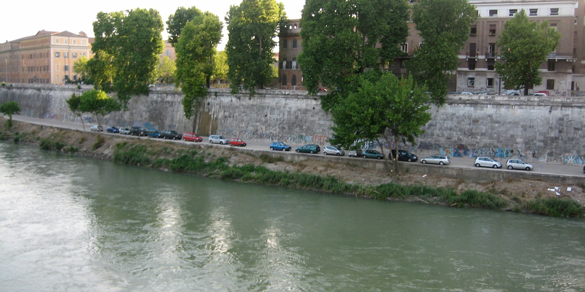
Pictured above is the Tiber River in central Rome, Trastevere side by the ex-convent San Michele, photographed yesterday. Long after last fall’s flooding, the lush trees along the river’s banks were left filled with plastic trash bags and other detritus. Finally in late spring a solution, after a long campaign to get the city to clean up the area, crews came in and removed the majority of the trees (including the trash of course) leaving a desolate landscape in the place of the previous green belt. Today the river’s banks are lined with commerce, mostly bars and restaurants, an annual tradition of questionable success, but what is worse is that this has opened the gates to a new flood, a flood of automobiles onto the pedestrian walkways and bike paths. Can’t we at least keep the city’s natural sites car-free?
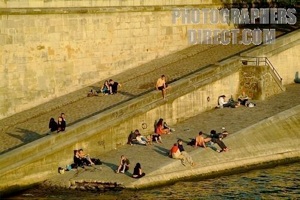
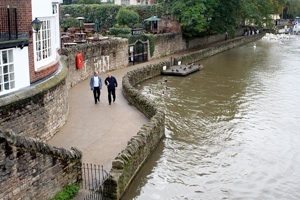
By contrast, here are some photo’s of other cities’ rivers (Boston, Paris, London).
More on Biking in Rome
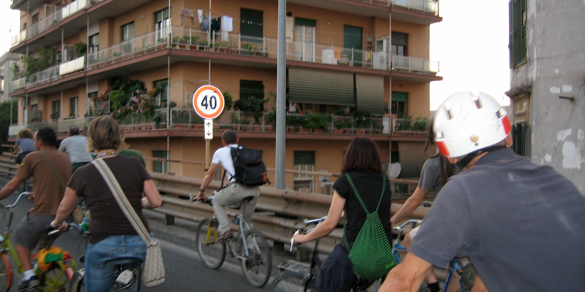 Last week hundreds of practical-minded and environmentally-motivated urban cyclists took to the streets and highways in Rome for the “Intergalactic Critical Mass”. For a few hours at the end of the day we swarmed through city streets from the Pyramid to the Colosseum, out the the Pignetto neighborhood and back to the Circus Maximus (where I had to veer off and head home). It was an uplifting and eye-opening experience. Expecting hostility from the “inscattolati” (or “canned” the delightful term CM-folk use for car-drivers), I was pleasantly surprised to hear voices of amusement and approval. Rome is a city used to demonstrations, strikes and motorcades, as well as infrequent road repair work, so it confronts such inconveniences with amazing patience. The cyclists followed the universal CM policy of appeasement merely reassuring drivers that they would soon be able to pass. I was able to suppress my own instinct to launch into diatribes about who the planet would be inconvenienced for centuries by their thoughtless petroleum consumption and toxic emissions.
The real compelling moment came after cycling out the Via Prenestina past public housing projects and under the elevated tangenziale roadway, when the swarm inverted its path and ascended the highway, effectively blocking all traffic on what is normally a bumper-to-bumper elevated nightmare. As we reached the peak, banging out music on the guardrails, residents of the apartments just meters from the road began to open windows and step out onto terraces that must normally remain sealed against the noise and fumes. The fresh air and human sounds seemed to bring joy to these people as well as to the bikers. My thoughts went to the project I designed for my thesis at Harvard which proposed housing alongside an under-utilized ring road in Sicily but also to the recently opened HighLine project in New York where a section of elevated railway has been transformed into an urban park.
Later that same week I found myself ironically on the other side of the fence, trying to get across Rome to an appointment and obstructed by the Giro d’Italia bicycle race which ended in Rome. Barriers had been set up and I was on the wrong side. I took it in stride, of course, and stopped to watch the victors race to the finish line, each one proceeded by a car with video equipment. Too bad, I thought, that cycling continues to be seen more as a sport than as a clean, efficient form of transportation.
Organizing Bicycling in Rome
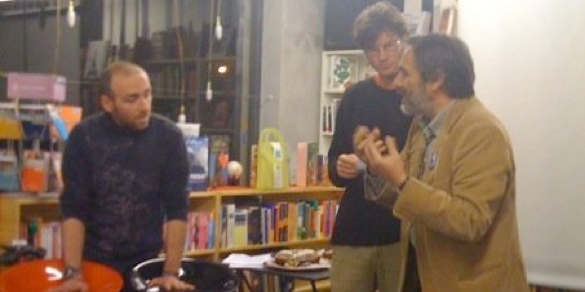 Yesterday I attended a meeting organized on Facebook (Quelli che osano la BICI a Roma is the group) at a bookshop in Garbatella. As community organization meetings go this was pretty well done. Several presentations were made about the current situation and upcoming challenges facing those of us who would like to see bicycles become a more normal form of urban transportation in this city. Discussion was quite civil and much emphasis was placed on the need for bikers to be accepted by the populace as a whole, which requires avoiding antagonistic behavior and forming alliances with others whose goals in some ways overlap. This was certainly a jab at the tendency of urban bikers toward a self-righteous disdain for non-bikers, especially those driving big death machines (see, there I go!). There was also a decided non-partisan message in the meeting, to the point of frequent statements that the right has been responsible for a lot of pro-bicycle progress; I interpreted this as a sign of deep frustration with the failures of the left in Italy recently.
What I was really struck by in this meeting and saw as a real disconnect from the reality of the city, was the praiseworthy but I think unrealistic insistence on legality in a fundamentally lawless city. The discussion about changing the laws to allow bikes on sidewalks or against traffic on one-way streets rings absurd when sidewalks are often used as parking (illegally but with impunity) for huge SUVs. Hand in hand with suggestions to loosen the laws applying to bikes should be an insistence on the enforcement of laws regarding parking. Someone pointed out that one proposal for a bike path was rejected because it occupied a divider strip which had become an illegal parking area; city officials actually argued that the reduction of parking spots, even illegal ones, was unacceptable!
What is amazing is that there is less outrage about this. We’re talking about city officials defending the illegal behavior of people driving lethal vehicles which consume valuable, limited resources, emit toxic substances directly tied to climate change and occupy prime space in an overcrowded city. Alongside the campaign to improve bike paths, provide for bikes on public transit and trains, increase bike racks, and other small but praiseworthy projects, I would expect at least a symbolic (and facetious) proposal to ban advertising–and eventually sale and possession–of automobiles.

As for urban biking, the fact is that it’s increasing and this is the best news. This Spring 34 architectural design students from Northeastern University in Boston are drafting proposals for (among other mixed-use functions) bike workshops, storage, rental, and meeting space alongside the Tiber bike path at Porta Portese. The bike sharing plan launched by the city of Rome, even if it doesn’t really work, is a visual sign that bikes have a place even in Rome. When Italian authorities and politicians start riding bikes instead of expensive cars to work, a really message will have been sent.
 SUSTAINABLE ROME