Traditional, Modern and Sustainable Architecture in Rome
This is my first real effort at using video on my blog; feedback is welcome as always. This discussion on architecture in the city follows up on discussions and readings by proponents of “traditional architecture” and of “new urbanism”, an unlikely term for a movement that on the surface comes across as fairly regressive. Both movements are polemically anti-modern and the architects who claim allegiance produce works eerily removed from history as it has evolved over the passed 80 years or so, like stage sets in a period film. Yet the observations and prescriptions of people such as Leon Krier or Andrés Duany, when stripped of their stylistic bias toward classicism, are pretty much on target. The charter produced in 1993 by the Congress for the New Urbanism states: “neighborhoods should be diverse in use and population; communities should be designed for the pedestrian and transit as well as the car; cities and towns should be shaped by physically defined and universally accessible public spaces and community institutions; urban places should be framed by architecture and landscape design that celebrate local history, climate, ecology, and building practice” It would be hard to argue with this, whether your aesthetic tastes tend towards Palladio or towards Gehry.
The Green Administration (back home)
 On the trendy but spectacular terrace of the ES Hotel overlooking the tracks of Termini Station and one of Rome’s most multi-cultural neighborhoods, the Esquiline, I and hundreds of other expats and Italians witnessed the beginning of the new administration and the new era of sustainable government. There was a fair amount of self-induced pinching to prove that the intelligent, charismatic man being referred to as President was not just a figment of a good dream. The overall atmosphere was not one of just self-congratulatory celebration but of energy and inspiration.
In fact, energy was part of the message, not just the medium. When Obama’s voice boomed across the crowds “We will harness the sun and the winds and the soil to fuel our cars and run our factories.” applause broke out in Rome. (OK, I may have started it myself but it sure caught on). Clearly, the eyes of the world are on the choices that will be made to help free us from our dependence on fossil fuels. The necessary paradigm shift is starting in the new world but enthusiasm has infected the old world as well and even stuffy old Rome may catch on and catch up.
p.s.
Follow up on my initiative to clean up the Tiber as a public service on pre-inauguration day failed miserably. I posted it as an event on Facebook as well as here on my blog, but didn’t really promote it. My hesitation was mostly due to the fact that I couldn’t find out which city office was responsible for such cleaning in order to get the OK, arrange for pick up of trash, etc. On the 19th I found many of the ramps/steps down to the bike path along the river blocked without explanation and only with difficult was I able to make it down to the chosen site. No one there but me and lots of trash. It was clear to me that to try to really clean up anything would have been pathetic so I kept it to a symbolic gesture, took some pictures and went back to my computer where I felt I could make more concrete inroads into the problems of Roman sustainability.
Time to Take Down the Decorations
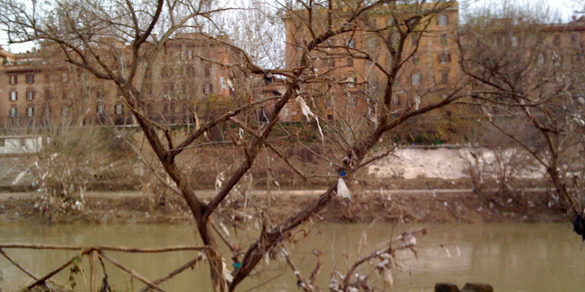 When the floodwaters of the Tiber subsided in late December, left behind was graphic evidence of the depth the river had reached. The trees alongside the river, submerged in polluted water for days, were left draped with plastic bags, bottles, shredded packaging materials, and other detritus of our throw-away culture. The resulting spectacle is one of the few conditions in Rome that is just plain depressing.
Some might see in this display a valuable message. Non-biodegradable trash that is usually hidden from view in landfills to secretly intoxicate our land here hangs visible to all in all its ugliness, a glaring reminder of our wasteful society. Some might see it as a poetic, sublime statement about our condition. OK, I can buy that. Let’s take some pictures, and then clean it up and get to work on the rest of our problems.
There is a public service movement in the air in the days leading up to Obama’s inauguration next week. Like so many phenomena in today’s networked world, it’s hard to say where it originated but it certainly didn’t just come from the top, although Obama’s “Renewing America Together” initiative is one of its bigger manifestations. It can be seen in pledges being made to roll-up-the-sleeves and try to fix the world popping up everywhere. I caught it in an email message from a friend in Boston’s North End where residents will be out sweeping the streets (“10 minutes with a broom”). And this morning, I saw it in the Huffington Post editorial emphasizing that the inauguration is for all of us, not just the President, where Arianna quotes psychologist Dr. Ervin Staub, saying “Goodness, like evil, often begins in small steps.”
Well, I’m committing some time on the eve of the inauguration to take some small steps to clean the trash from the trees (and bike path) along the Tiber. Monday morning 19 January 2009, 10-12 am the plan is to start along western banks of the river, below Ponte Sublicio at Porta Portese (see on google maps), with trash bags, gloves and poles for picking trash from the trees. Volunteers are welcome. It probably won’t be possible (or safe) to reach the upper branches, but we can at least harvest the “low lying fruit”. Over the next week I will look into what’s needed in terms of authorization and perhaps assistance from AMA (Rome’s environmental agency), look for expertise from environmental organizations like Legambiente that have taken on and carried out such projects for years. Please pass on to me any useful contacts or advice to make this possible and productive. I’m creating a signup sheet on Facebook and (for non-facebookers on a Wufoo form. Check in here for updates).
Rome and its River 2009
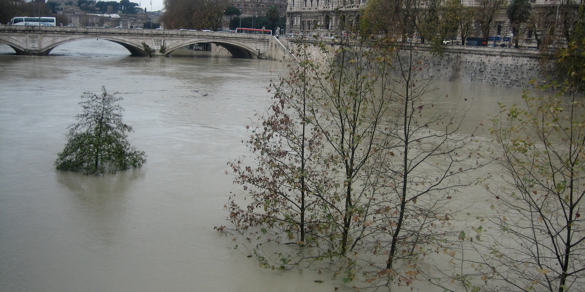 Images sent around the world from Rome this month provided gripping imagery for the changing climate. As heavy and continuous rainfall fell on central Italy, the Tiber river reached record heights, causing bridge closings and warnings by the city’s mayor to stay home. In mid December the water rose 5 meters in 2 days to surpass the springing points and start to fill the arches of ancient bridges such as Ponte Milvio and Ponte Fabricius. Boats moored near St. Peter’s came loose and were washed into Ponte Sant’Angelo where they piled up and further obstructed the flow, threatening a structure that dates its founding to the time of Hadrian. The Tiber has always flooded and it would be simplistic to point to this flood in particular as evidence of the worsening effects of global warning or even excessive urbanization of the river basin. Deforestation and subsequent erosion and flooding are as old as the Colosseum and plans for artificial diversion and channeling of the river go back to the time of Caesar. Now, once again, the danger has passed but Romans and visitors have been once again reminded of the forces of nature. The focus on the Tiber relieved some media pressure from the European climate change talks taking place at the same time in Brussels. Italian Prime Minister Silvio Berlusconi had threatened to veto the agreement to cut carbon gas emissions if he thought it would hurt Italy’s economic interests, prompting a series of protests and reprimands from Italian environmentalists and other European leaders. Eventually, these dangers, like the floodwaters of the Tiber, subsided and Berlusconi withdrew his opposition saying “I can’t use any veto … because I can’t cast myself in the bad-guy role.” While the real climate change package which should replace the Kyoto accord is slated for the end of 2009, the outcome of these meetings was and agreement to reduce greenhouse gas emissions by 20 percent from 1990 levels by 2020 and it came with a reasonable economic stimulus package to help this happen (along with disappointing concessions to big industry, especially in Eastern Europe). As the rain continues to fall on Rome this Christmas season it seems fitting (if somewhat ironic) to commit to renew our research efforts on alternative energy, especially solar, in the year to come. The global environmental problems need to be met with the same sense of urgency and coordinated effort with which the rising waters of the Tiber were confronted this month.
Change
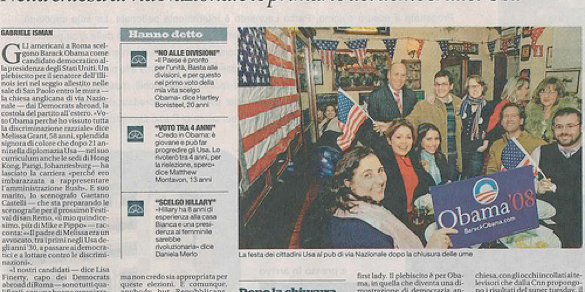
A few years back being an expat in Rome meant living in a progressive country with a liberal government working with other European governments to improve social conditions and the environment, while across the Atlantic we watched with disdain as Bush and his cronies reversed years of civil liberties gains and spent billions of inherited surplus. Then for a while, after last year’s election of Silvio Berlusconi and the “Liberty Coalition”, both my home country and my adopted residence left me wondering what had become of reason.
After Barack Obama’s landslide victory the USA has once again become a beacon of hope in the world. The question from Rome is how this beacon will illuminate a country which has been slipping farther and farther back into a new dark age. The most recent example has been the erroneously title “school reform” which is a drastic cut in the budget for public schools and universities. Its aim is not so much to save money–there is waste in all budget categories, and salaries and benefits for members of Parliament, already the highest in Europe, have seen further increases. The intention seems to many observers to be one of promoting ignorance, an ideal environment in which to govern corruptly and guarantee dumbed-down audiences for Berlusconi’s many television networks. The government strategy has been to push through this law with no dialogue, ignoring the protests from half of the nation including most of the educational profession itself. Already before Nov. 4th there was a rising grassroots movement against the Italian government’s education diktat, with millions marching in the streets throughout the country. A similar network organization to that which got Obama elected–rich in text-messaging and blogs and facebook– is driving the popular movement to replace Berlusconi and it can only derive encouragement from the victory of the campaign for change in the US.
What does this have to do with sustainable cities? Well, Barack Obama ran on a platform heavily focused on solving the crisis of climate change. (Just listen to his speech on energy policy.) Now it is time for discussion of ending our dominance on petroleum to move from rhetoric to reality. Obama won’t be doing this by himself but he has opened the door to the political/economic environment in which this will take place, thanks to entrepreneurs and organizers across the country and around the globe. Given the enormously positive reception with which Obama’s victory has been greeted in Italy, this can only be positive for the work we are doing to reshape preserve historic cities and mold their future evolution toward sustainable development.
Zero Emissions Rome
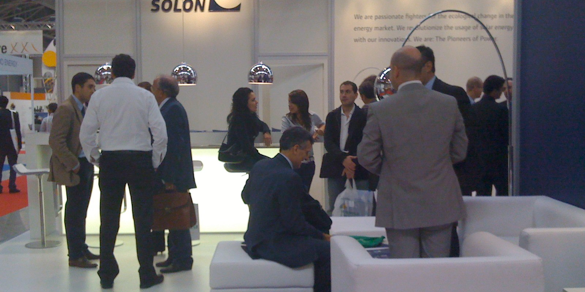 The fact that renewable energy is no longer the terrain of the radical green counter culture is illustrated pretty clearly in the photo above which I took at the Zero Emissions Rome trade fair yesterday. Green is turning officially gold in Italy. Or, more precisely, “Europe” since many of the exhibitors were from other European nations.
Two huge pavilions were dedicated to “sun” and “sun/earth” —the latter seemed to result from the fact that there were so many exhibitors in the solar energy field that one pavilion was not enough, but they shared space with green chemical companies and the like. Another was dedicated to wind, and a fourth that I didn’t make it to was supposed to address carbon neutrality.
I spent most of my morning looking at photovoltaic panels, by far the biggest sector of the growing market. Italy ranks fifth as producer of electricity through photovoltaic cells, after Germany, Japan, Spain and the USA. To date almost 200 Mw of production capacity has been installed here; in Europe as a whole the number is 3.4 Gw (thanks mostly to Germany). This may still sound small compared to the multi terawatt capacity of nuclear and hydroelectric plants in Europe, but it is growing rapidly. Italy has been slow to jump on the bandwagon but thanks to a combination of high government incentives, the most costly electricity in Europe, and its sunny climate, the boot is finally showing some interest in photovoltaics. Strangely, the region where it is most productive is Lombardia, not among the sunniest, but sunny and southern Puglia is in second place. The reason has to do with confused regulations, differing from region to region, in place of a much needed national guideline.
Lacking was any serious attention to design of photovoltaics above and beyond the standard rigid panel composed of 50-100 cells. It still seems like the days that computers were big grey boxes and monitors flickered with green text. Design was evident in the marketing materials (some great graphics and nice stand design) but not in the products or their representatives who from their looks could have just as easily been selling tractors or pharmaceuticals. While some stands showed sophisticated fastening systems and transparent glass panels without the ubiquitous aluminum frame, there was no real cutting edge application of the technology on display. And worse, none of it was put to use despite the sunny day. As far as I could tell there were megawatts worth of panels on display but the entire fair was being powered by the national grid. Did anyone even think of putting all these panels to use to demonstrate their functionality? I suppose that would be like suggesting that an automotive show actually had cars with their engines on; a logistic nightmare not to mention health hazard.
On a similar note, the Fiera di Roma (the convention center where the show was held) is urbanistically one of the worst buildings that could have been built in the current age of environmental crisis. Located far on the edge of town, near the airport, it was made for cars and in fact is surrounded by a sea of parking like any suburban shopping mall. Instead of being built adjacent to the Rome-airport train line it was placed just far enough away to require a shuttle bus to make the rounds, a degrading, polluting and time-consuming experience.
Temporary Shelter

I am writing from Puglia, the heel of the boot, at an immense campground called Riva di Ugento where we have rented a mobile home for a week. I spend my days reading and writing and occasionally walking through the woods to join the family on the sandiest, whitest beach with the clearest turquoise water I’ve ever seen.
There is certainly a rationale for prefabricated housing which on one level can be paralleled to prefabricated automobiles as conceived by Henry Ford. It seems bizarre that we even think of custom building single family homes on a site instead of buying the latest model from a dealer. It’s true that most of the components are modular, factory-built: Anderson windows, Rex kitchens, roofing systems, solar panels, etc. But it’s still quite rare that a home is designed as a product as is an ipod or an automobile.
The difference lies in the role of “place” in the home. While an ipod has little interface with the world around it and, in fact, helps separate one from that world, the home acts as a filter which must respond differently to different climates, orientations, views, acoustic conditions, etc. And while the ipod, or the car, are made to move around, the home in the end remains fixed to a site. True, a home can be manufactured and brought to a site (and this is becoming more common) but there it remains to age and evolve, very differently from the ipod that is destined to be replaced within a year or so by the newest model.
The urban slant of this blog, encouraging density as a precondition for sustainable living, adds another twist to the discussion of manufactured housing. While one might conceive of a futuristic city in which skeletal frames and infrastructure receive pre-fab units–ideas expressed by Le Corbusier, Archigram and others–there may be no way to insert a prefabricated home within an existing historical city center. The site in the city is not a plot of land with a buffer zone around it but rather a unique piece of 3-D real estate. There are very few sites for new construction in the city without demolition of historical structures (an option to be evaluated carefully because of the material, cultural and energy costs). Even if one considers, as I do, the urban apartment as a “site for new construction” within which walls may come down and go up, spatial organization can change, and new architecture can emerge, the insertion of a manufactured home into such a complex existing site requires it to be flexible, not rigid.
Actually, such a solution for the urban pre-fab home does exist and it’s called IKEA. No longer do we even consider built-in furniture, custom-designed kitchens, tailored curtains or the likes when everything is available so cheaply and so rationally from IKEA. Take a piece of raw urban property–an apartment gutted to its masonry core–and spend a few hours or days with the IKEA catalog or website and a home emerges with very little on-site work to be done. It can be order from the catalog to a large degree and delivered by courier, assembled on site in a simple, rational and generally ecological manner (packaging is designed to minimize environmental impact). There is enough choice to satisfy our need for personalization and the site’s need for adaptation.
As much as people whine about the pervasiveness of IKEA, it’s hard to opt for the alternatives when they are far more expensive, less environmentally sound, harder to purchase and assemble, or all of the above. What’s lacking, though, is a competitive market in which other IKEAs vie for our money. It’s as if we were back in the age when only Ford mass produced cars but a number of smaller manufacturers made cars by hand; they might have had more appeal but it would be hard to resist the cost-benefit analysis that drew one to Ford. Soon GM and others emerged to compete, just as other makers of MP3 players compete with the ipod and other PDAs competed with the Palm Pilot.
The PreFab Urban House needs work to be able to provide well-designed components that can adapt to the most complex of sites. Meanwhile, if the site allows for flexibility, the new mobile homes, based on our Puglia experience, are not so bad.
Across the Atlantic
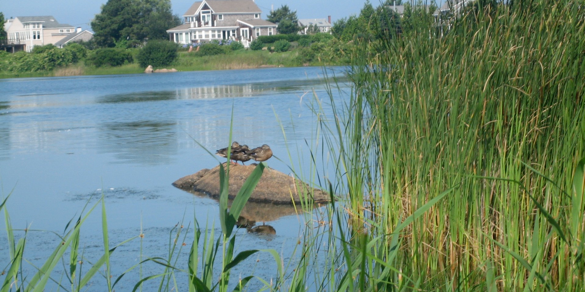
This summer I was back in the USA, vacationing on the Rhode Island coast, at a place very different from Rome. To many, this is a natural paradise. A rocky coastline with just a few scattered vacation homes frames some uncrowded sandy beaches. Produce stands sell locally grown corn and squash. Fishermen (and women) bring in boatloads of blues and bonitas each morning. Most of the architecture respects local traditions, uses local materials and has a pretty direct connection to its natural environment.
Yet something felt wrong. In order for the artifice of pristine nature to be maintained, massive quantities of energy are expended constantly. For every acre of productive farm there are hundreds of carefully manicured but essentially useless lawns, posing as natural but really neither part of a true coastal ecosystem nor used by a true human community. I can’t help feeling that each of these beautiful shingle-style houses, empty much of the year, exists because of a tenuous link to the real world beyond. SUVs head off to distant supermarkets to stock up on drinking water in plastic bottles because the local water table has been contaminated, (stopping for lattes and croissants at literally a dozen newly opened cafes along the way). Electricity and gas produced at a comfortably invisible distance keep life comfortable, and solid waste is trucked off regularly, out of site, out of mind. Whereas a generation ago you could still come down from Boston and stay for a whole vacation without needing a car (a general store at within walking distance at Sakonnet Point provided essentials like milk, bread and penny candy) now car trips to the mall are almost as frequent as walks to the beach.
I imagine what this place would be like when, fueled by climate change or thoughtful design — probably a combination of the two — a more sustainable human occupation of this natural paradise is instituted. Instead of evenly-spaced, over-sized mansions surrounded by picturesque but under-used “gardens” a couple of dense but small urban centers would host year-round and summer residents. At Sakonnet Point, the end of the peninsula, would be a vibrant coastal center with homes, shops, businesses, and rich cultural, natural and athletic opportunities all within walking distance. An electric train would connect this town to the Boston/Providence line and public boat service would cross frequently to Newport and other ports, eliminating the need for most private vehicles. Several other dense villages of 5-10,000 inhabitants would evolve around historic clusters in places like Little Compton Commons, Tiverton Four Corners, also served by the train line. Energy for these centers would be generated through solar, wind, and tide mills and connected to distributed networks. Local organic farms would provide almost all the food for these communities but instead of selling it at farm stands along the road they would bring their produce into town and sell it in farmers markets. Existing roads would remain for rare deliveries, emergency vehicles and ceremonial use (think classic automobile exhibitions, which in the future will include not just Model T’s but nostalgic Chevy minivans and Jeep Cherokees on display!) but they could be much narrower, require less maintenance due to reduced traffic, and augmented by highly-maintained bike paths. From any of the urban centers along the peninsula a 15 minute walk would take you to open countryside and a 30-minute bike or train ride through restored nature to another urban mini-center. As to what happens to the homes that litter the landscape today, I’m afraid that while some may be preserved and find second lives as special wilderness retreats, in my post-petroleum scenario most have little future beyond providing materials, to be dismantled and reconstructed in more sustainable locations.
Like so many eco-utopian fantasies, the place I envision combines elements of traditional (pre-petroleum age) communities like New England whaling villages with futuristic ones. Nantucket meets Naboo. What makes such places magical should not be watered down (as I’ve witnessed over the past few decades) but rather intensified, miniaturized and “complexified”. New England could learn from its own past but also from the example of the Italian hill-town surrounded by vineyards.
Image: Round Pond, Little Compton RI © photo: Tom Rankin
Preaching Sustainability on the Automotive Plant Floor
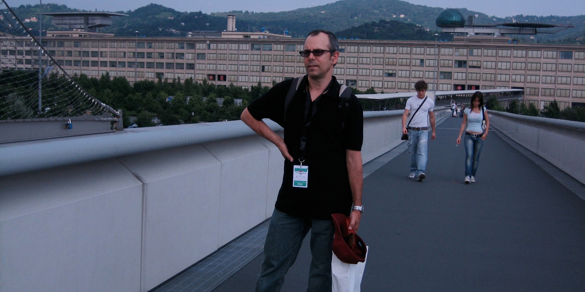
I just returned from Torino, after spending a day at the 2008 International Union of Architects World Architecture Congress. Hosted in the former FIAT factory at Lingotto, built by Mattè Trucco in the 1920s but converted to use as a convention and shopping center by Renzo Piano Building Workshop in the 80s. The irony of debating public space and environmentally sustainable design in a temple to car culture was amusing.
Mattè Trucco’s building is a great work of architecture, the kind of optimized materialization of the production process that drove early modernists and inspired Le Corbusier, who called it “one of the most impressive sights in industry”. It is most famous for the testing track on its roof, complete with canted turns at each end. Today, thanks to Renzo Piano’s design, the roof also hosts a number of other appendages: a heliport, a rooftop restaurant with a formally enticing green glass VIP bubble and saucer, and most interesting, the teetering wedge-like block which houses the art collection of the Fondazione Giovanni e Marella Agnelli.
My son and I visited the Agnelli Museum in the morning when the line at the Congress accreditation desk was so long and the ticket price so exorbitant I was ready to skip the Congress entirely (so much for one of the main congress themes: “Architecture is for Everyone”). Actually this was already after a two hour odyssey from the airport: the train being inoperative due to construction and the rickety old infrequent shuttle bus and the crowded local city bus both slowed to a crawl by road construction and traffic (so much for another one of the main congress themes: “Sustainable Cities”). But the rooftop/tracktop building for the Agnelli Collection was a delight; a tectonic jewelbox that offers a creative but appropriate response to a unique site. The design objects on display, from Macintosh to Jean Prouvè to Joe Colombo, were great as was the small selection of paintings from Canaletto to Balla to Matisse.
When we finally made it into the Congress, there was time for a quick look at the exhibitions and a choice of a number of enticing talks. We chose one entitled “Architecture for a Sustainable Future” but left after the language switched to Spanish and it became clear it was focused on one region: the Americas. We then shuttled over the Palavela, the huge concrete olympic hall, for “Building for the Future”. Mark Wigley moderated fascinating presentations by Mario Cucinella, Yansong Ma, Francois Roche and Mathias Sauerbruch. Again, the focus was primarily on sustainability, at least in the presentations of Cucinella and Sauerbruch which were the most architectural. Ma’s talk was mind-boggling for the view into the speed of change, a young firm getting caught up in the storm of building in Beijing, interesting in light of his expressed desire to design “slowly” in the face of radical acceleration. Saurbruch’s presentation showed off beautiful but also extremely performative buildings such as the Federal Agency for the Environment in Dessau. Among the principals he advocated for more environmentally sustainable buildings, alongside the obvious energy and materials efficiency and urban density, he included “intelligence and surprise” and “beauty”. Wigley wrapped up with the observation that all of these works were experimental and that to be practical today, one must be experimental, echoing gurus from the business world who preach “constant reinvention”. The question “what architecture for the future” was never really answered but Wigley ended on the note that it is the role of architects to define the future, not just to await it.
After this talk, as I manically scanned through the Congress guide to decide what else couldn’t be missed, I realized that such events today serve a strange purpose in this digital age. I’m sure all of the information exchanged, including images of all projects presented, is is available to me as I drink my coffee in my apartment in Rome. So why damage the planet further by flying to Torino? Only 2 or 3 excuses come to mind. One is the viewing of actual products: touching fabrics in the Arkitex textile show for example can’t be substituted digitally yet. Another is the thrill of attaching a face to a name, shaking the hand of a scholar like Joseph Rykwert (and introducing him to my 12-year-old son). Neither of these really justify the carbon footprint of the Congress though. What would justify it, and I don’t know if this happens or not, would be for true dialogues, work sessions, laboratories in which new solutions and answers emerge. This would require a radical redesign of the Congress structure to work effectively. First the presentations given on-line weeks before the Congress, then a chance to dialogue digitally, then a few days of concentrated face-to-face meetings and work sessions, interim presentations and a few weeks or months of digital follow-up toward publishing findings. From such a coordinated, digital and physical event, experimentation might breed results.
Image: Tom on the bridge from Lingotto © photo: John Rankin
The Eternally Cyclable City
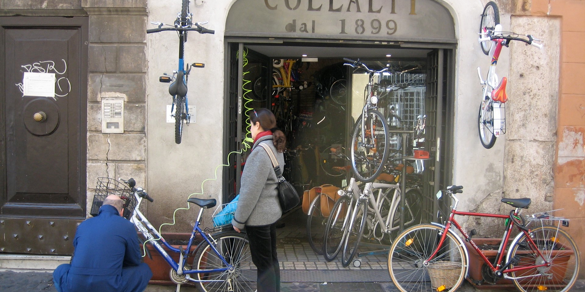
I’m a militant biker. Not the loud Harley-riding type, but (worse) the self-righteous self-propelled urban two-wheeler. I ride a Collalti, the bike of choice of many centro storico low-impact commuters. Locally made by Danilo Collalti on Via Pellegrino, these bikes are light but sturdy. He doesn’t just sell (or rent) the bikes, but provides ongoing service, usually for free or a minimum charge. Danilo’s shop is at Via del Pellegrino 80/82, just down the street from Campo de’ Fiori.
I make the ride from my home on the Janiculum down to the historic center daily if not more often. Of course, it’s the return trip up the hill that hurts, especially as I weave around and breathe behind motor vehicles parked on or belching their way up Via Garibaldi. An article in the New York Times last year called attention to the bikability of Rome, citing the anti-pollution laws. It’s true that there are days when cars are banned and having a bike comes in handy, but the real advantage is being able to blast through the pedestrian streets without feeling like a jerk, and being able to park with no risk of fines. Well, almost no risk. A few months ago I locked my Collalti to a post in Piazza Collegio Romano, just outside a police station (thinking that it would be safe there). An hour later it was gone so, fearing another theft, I walked in to the police station to report it. There was my bike, cut lock and all. They had not caught a thief red-handed, but rather cut the lock themselves, citing a law I should have know about that prohibits locking bikes to the post that bears police signage. I couldn’t help but point out that just down the street outside Palazzo Grazioli there were cars parked on the sidewalk at all hours with their engines running, causing far more damage than my little Collalti, but then a few days later the resident of that palazzo, Silvio Berlusconi, was elected Prime Minister. I have digressed.
Two initiatives in recent years should encourage more biking and less driving in Rome, but I have my doubts. One is the creation of bike paths. Great. Except that the main one is deep below the city streets along the Tiber river and even if you deem it worthwhile to go all the way down to cover a kilometer or two and come all the way up (carrying your bike up urine-stinking stairs, in most cases), the path itself is made of the bumpiest of cobblestones. And the worst of it is that during the summer months when more people might think about using bikes, the city sponsors a riverside festival consisting of temporary bars and cafes constructed on top of the path.
The second initiative is a public bike sharing program that I’ll write about in a future blog, when I have had a chance to evaluate it.
Image: Bike Shop of Danilo Collalti, Via Pellegrino, Rome © Tom Rankin
 SUSTAINABLE ROME