Green Buildings, Grey Streets
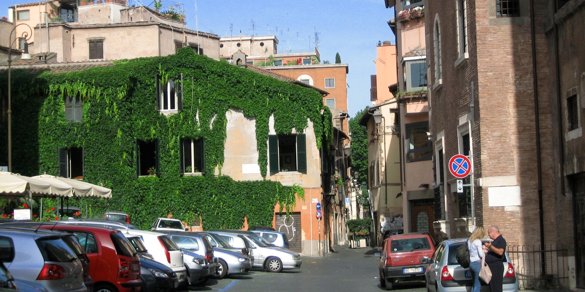
Thanks to the wealth of a limited number of noble families in the Renaissance and Baroque periods, and the end of that wealth in the last century when they opted to give up or lose their vast tracts of urban countryside, Rome has more green space per capita then any other European capital. Future entries in the blog will explore these “villas” (Italian for a public park, not just a private rural or suburban residential property). But nature being tenacious and pervasive, sometimes it just takes over. In addition to visual beauty this seasonal vegetation on buildings can go a long way in protecting walls from direct sunlight which would otherwise gradually traverse masonry walls to radiate heat to interior rooms. And since many creeping plants either drop their leaves or can be seriously pruned back in the winter, the walls tend to be exposed to the sun when the warmth is desired. So that’s what’s right with this picture.
What’s wrong is what occupies the ground: a sea of steel and plastic and glass. On a recent architecture critique I sat in on for the Yale Architecture Program I commented on the fact that all four walls of the large room at the American Academy in Rome were papered in wonderful drawings of public spaces and buildings in Rome– but there was not a single automobile portrayed! Although these were analytical drawings, I mused that they were quite successful as design proposals for a more livable city, without cars. Besides, between the grey basalt cobblestone of Rome, green is wont to grow when left un-trampled.
Image: Piazza in Piscinula, Trastevere © Tom Rankin
What makes Rome A Sustainable City?
When you think of Green Cities you probably don’t think of Rome. The European cities that come to mind tend to be those where progressive civic projects in recent years have promoted clean energy, efficient transportation, effective recycling systems and the likes. Malmo Sweden. Stuttgart, Germany. Even London, where a transit tax has reduced private automobile traffic dramatically. And outside Europe, Curitiba Brazil, with its revolutionary public transit system. Even New York is making headlines for major new green buildings.
But not Rome! Not a city where periodically air pollution readings reach emergency levels forcing partial city shutdowns. Not a city where the few recycling bins seen on the streets are often left overflowing for days without being emptied, adding to the already abundant litter that tourists and locals alike nonchalantly scatter. Not a city where parabolic TV antennas seem to outnumber solar panels on rooftops about a million to one. And certainly not a city where the automobile is ubiquitous and growing ever more so, occupying every possible horizontal surface, regardless of regulations, with apparent impunity.
So why Rome, the “still sustainable city”? For starters, there is probably no other city in the world where the quantity of new construction is so outnumbered by the existing building stock, the latter being adaptively reused again and again. I know of no better example of sustainable urban development than the Theatre of Marcellus, a Roman monument begun at the time of Julius Caesar, continuously in use in one way or another until the present day when it houses apartments and offices.
Not only has the massive masonry construction allowed these buildings to last centuries, it has continued to mitigate temperature extremes, keeping out the heat in the summer and keeping it in in the winter. A wealth of traditions and techniques developed over time help Rome’s buildings provide thermal comfort and daylighting with minimal energy expenditures.
Finally, urban density is tied directly to sustainability, the closer together people live the less land, energy and materials are consumed. Rome has always been one of the world’s densest urban centers, where the small footprint of private dwellings has allowed for proximity and been compensated for by extraordinary public spaces, usually within walking distance.
This just scratches the surface. In future entries to this Blog I’ll talk more specifically about other aspects of Rome that provide valuable test cases for sustainable living as well as glaring examples of the ramifications of non-sustainable building.
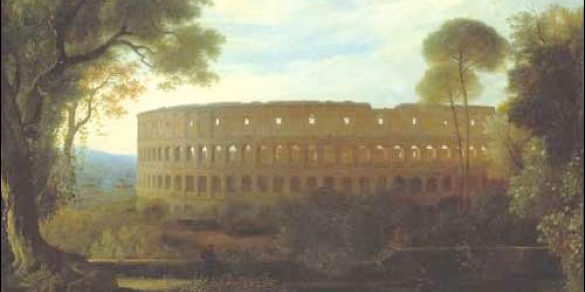
Image: Sir Charles Lock Eastlake The Colosseum from the Esquiline 1822 © Tate
 SUSTAINABLE ROME