Spring Holidays (repost)
I’m reposting an entry I wrote a few years ago in this season of back-t0-back holidays. Happy reading, and happy Easter, Pasquetta, Natale di Roma, Earth Day, Liberation Day, Workers Day (and happy anniversary to my wife Lucia!).
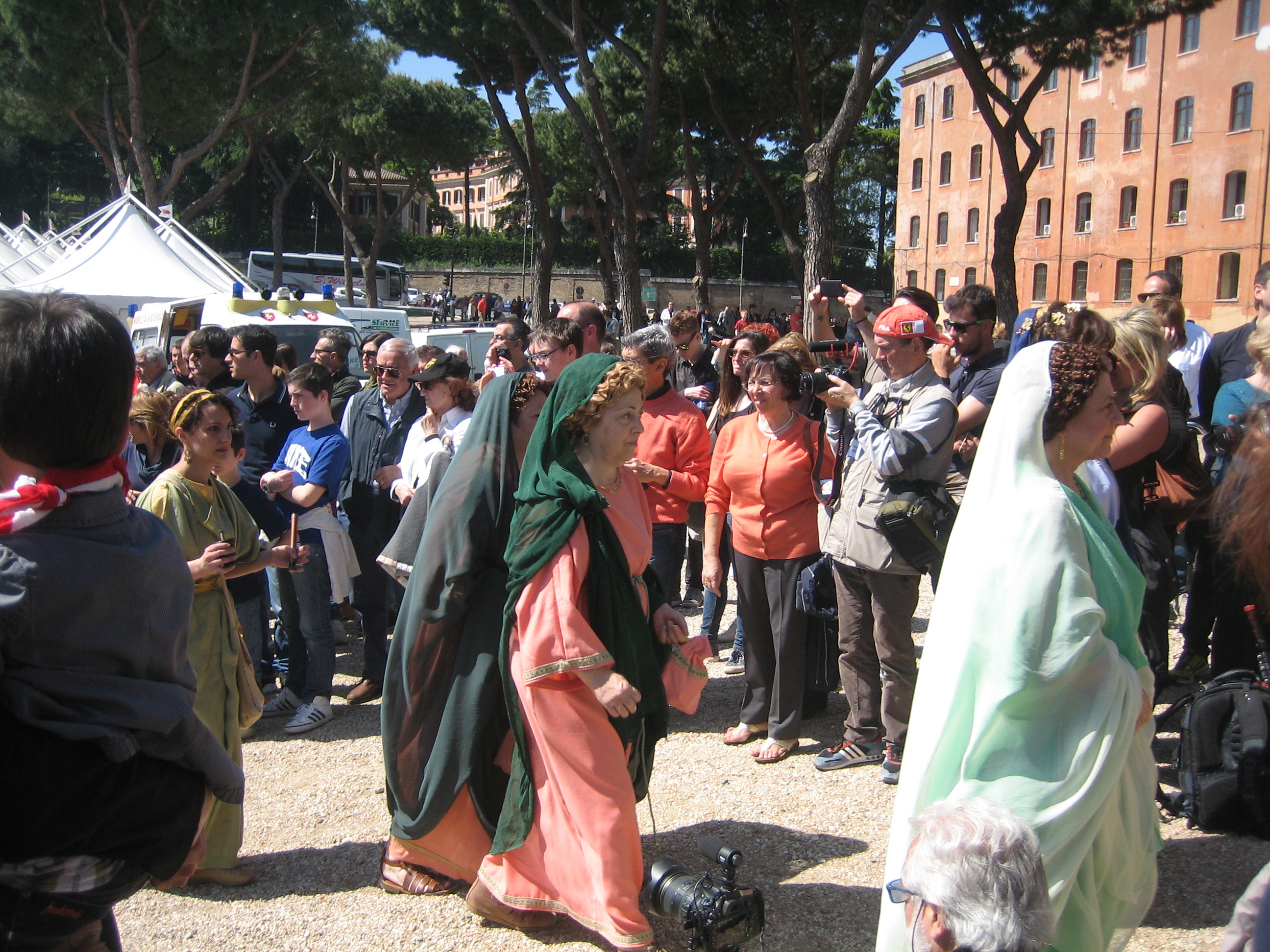
Rome’s founding holiday, 21 April, celebrated in costume at Circus Maximus
It has indeed been a strange spring so far in Rome. First, back in March we had the Ides (15) of March, the Palazzo Massimo alle Colonne “miracle day” (16), the Rome Marathon (20) and the Spring Equinox (20), some of my favorite rites of Spring, all overshadowed by the celebrations of the 150th anniversary of the Unification of Italy on March 17th. Italian flags, usually only seen during World Cup season, sprouted everywhere. The Comune di Roma (a title which roughly means “municipality” and which is held by all cities and towns above a certain size) had the previous year essentially dissolved and changed its name to Roma Capitale, an entity with a unique status as the nation’s capital. Now the city was decked out to earn that title, at least symbolically.
April saw no let up in the festivities. April 21, Rome’s 2763rd birthday. April 22, the planet’s 41st Earth Day. April 24 Easter , April 25 Pasquetta (Lunedi’ degli Angeli). Sorry, Easter Monday just doesn’t say much, but this is a big holiday in Italy, famous for picnics in the countryside. April 25th is also St. Mark’s feast day in Venice. And April 25th the national holiday marking the defeat of Fascism by the partisans, one of the more important secular holidays in Rome, but this year the secular meaning was overshadowed by the religious pomp.
Not even a week later hundreds of thousands of religious pilgrims started to arrive in Rome for the festivities marking the beatification of Pope John Paul II (JPII was the event’s catchy logo). Only six years after his death, he was on the fast track to sainthood and Rome was again decked out in kiosks and porta-potties ready for a big event. Where a month earlier there had been speeches praising Garibaldi and the defeat of the Papacy by the non-clerical Italian state in 1861, there were now images of the deceased Pope. Outside my studio the night of April 30, hundreds of thousands of pilgrims held a candlelight vigil. The following day, May 1, they flocked to St. Peter’s square to hear the current Pope officiate at the beatification ceremony.
But May 1 is already a holiday, one of the most important in Europe, celebrating workers and labor. Pasquetta had seen people out post-Easter picnicking instead of commemorating the defeat of Fascism; now a week later the Pope was stealing the thunder of the working class. After the morning’s events at St. Peter’s started to wind down, the annual union-sponsored free concert outside St. John’s in the Lateran started to get underway. Commentary about the “two piazzas” was not lacking. There were logistical glitches in both; many pilgrims couldn’t get anywhere St. Peter’s and the sound system at St. John’s, at least when I was there, was on the blink leaving the crowd confused but amused. At the latter, there was a strong presence of campaigning to promote the rights of socially precarious workers, the right to publicly managed water (a referendum will be held in June to fight planned privatization of this precious resource) and to reaffirm Italy’s long-held commitment to reject nuclear energy in favor of safer renewable alternatives. The other referendum in June is a vote to prevent the Italian head of state from avoiding to stand trial in the case of criminal allegations, and there has been a concerted effort on the part of the government to sabotage the referendum campaigns to lower the risk that any of these (but in particular this last one) should pass. I stayed clear of the pilgrimage events so I don’t know if the referendum was publicized there as well, but the Vatican has not to my knowledge taken a stand on any of the issues (although Vatican citizens can vote in the referendum).
During an interview with CNN several months ago I was asked about the Vatican and my only comment was that there seems to be a parasitic relationship between Rome and the “state within the city”, but that it wasn’t always clear which was the parasite and which the host. This weekend, Rome has “played host” on a big scale, plastering the city with images of JPII, kitsch souvenirs, setting up kiosks and toilets and turning a blind eye to pilgrims sleeping in the streets. This latter phenomenon is ironic since the city had just undergone a campaign to evict Rom residents and bulldoze their camps the week before to clean up the city for the event, causing the Rom to seek asylum in the extra-territorial church of St. Paul’s Outside the Walls. Meanwhile, the battle continues for ten families who have lived for generations farming the land in the Aquafredda Park but are now facing eviction, by land’s “owner”, the Vatican.
It’s hard to live in Rome in view of Michelangelo’s cupola, breathing the fumes and risking death under the wheels of “Christian Rome” tour buses and Vatican-plated Mercedes everyday, and not feel a bit cynical.
Grande Bellezza
Paolo Sorrentino’s Grande Bellezza is a feast for the senses, and as such is very much like the city it portrays. The city and the film are surreal, they make you laugh out loud, as Oliviero Toscani did on the program Piazza Pulita last week after watching a short expose on La Grande Monnezza, “the great trash heap” that is also Rome.
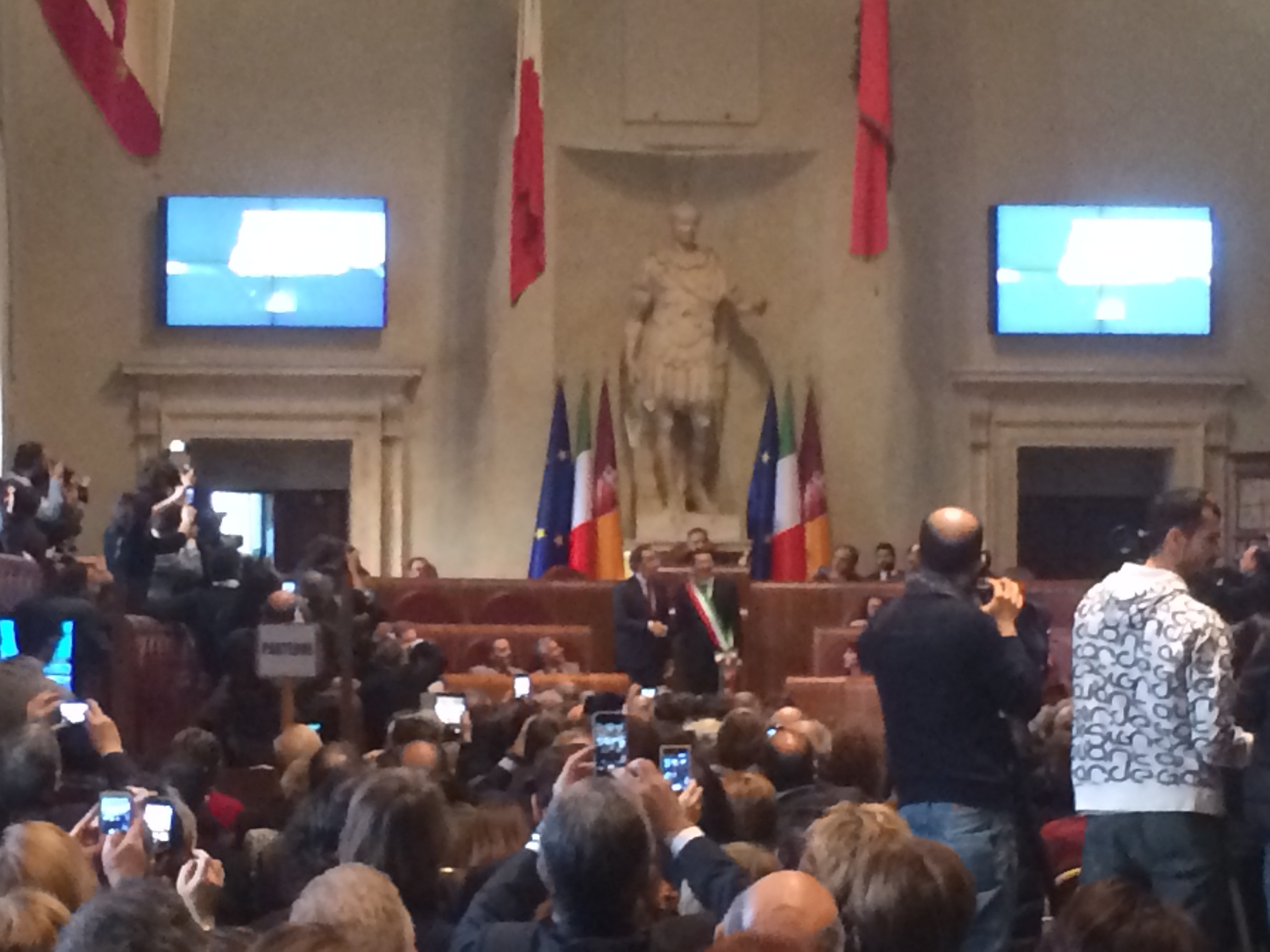
At the ceremony tonight to award Sorrentino honorary Roman citizenship, Carlo Verdone spoke eloquently of Rome’s state of “decomposition”, but also of how he believes Rome is always capable of resisting the decay into which it repeatedly falls. I was moved by Verdone’s words about the state of abandon of the Tiber and the importance of those of us who know how to love Rome, whether or not we were born here. Sorrentino, he pointed out, is just the latest in a long line of “foreign” directors who have shown Rome in a new poetic light.
Sorrentino’s words on the eternal city were less optimistic; he described Rome as a long series of errors from which the city never learns, a long and fruitless struggle to be contemporary. But he ended his poignant talk with an incredible list of “outtakes” from the film, “bellezze” that he has seen in Rome that didn’t appear in the film. A bizarre stream of consciousness description of those scenarios we can’t help but love, with all the decadence, hypocrisy and pure theatricality that makes Rome, well, Rome.

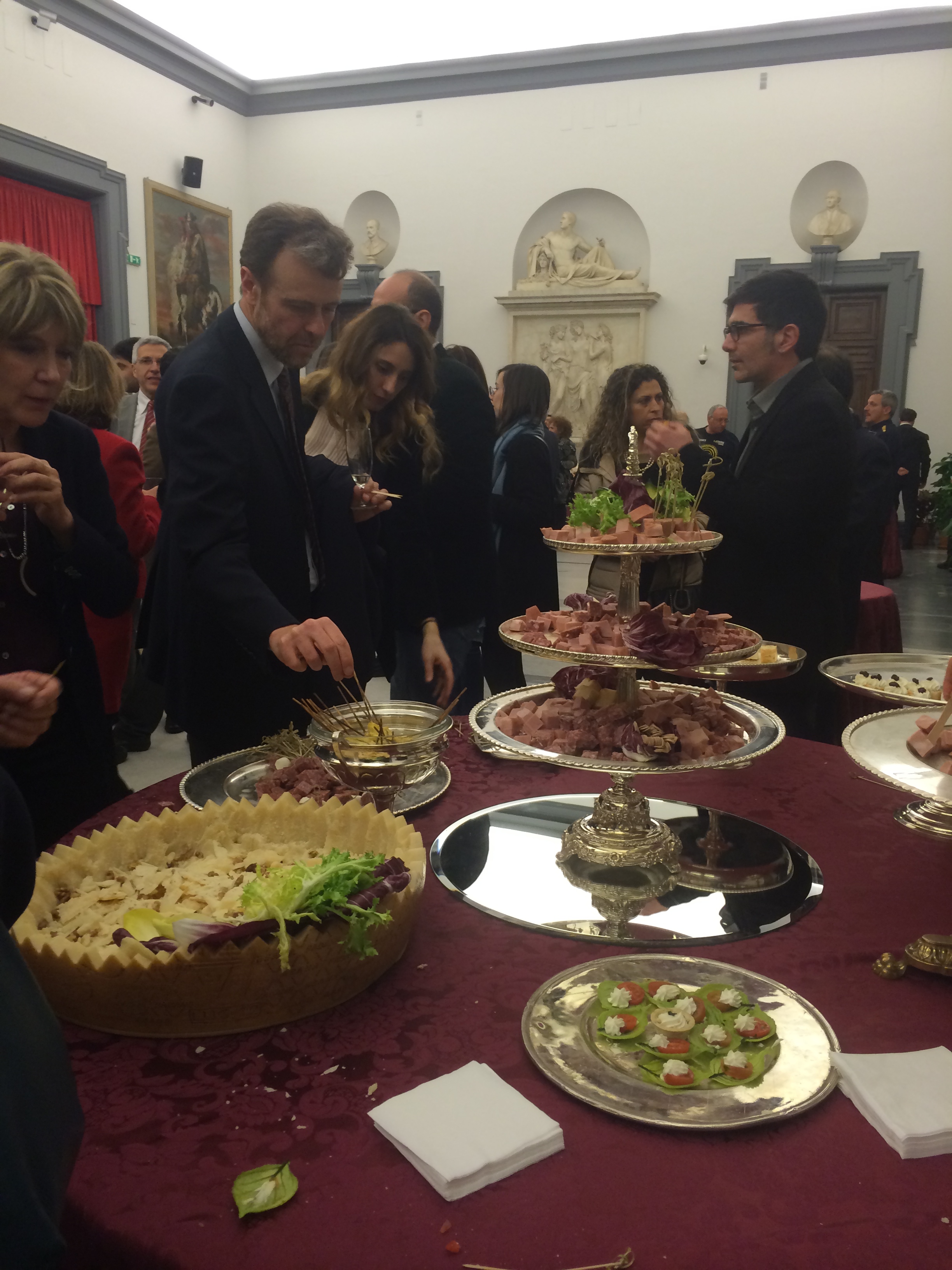
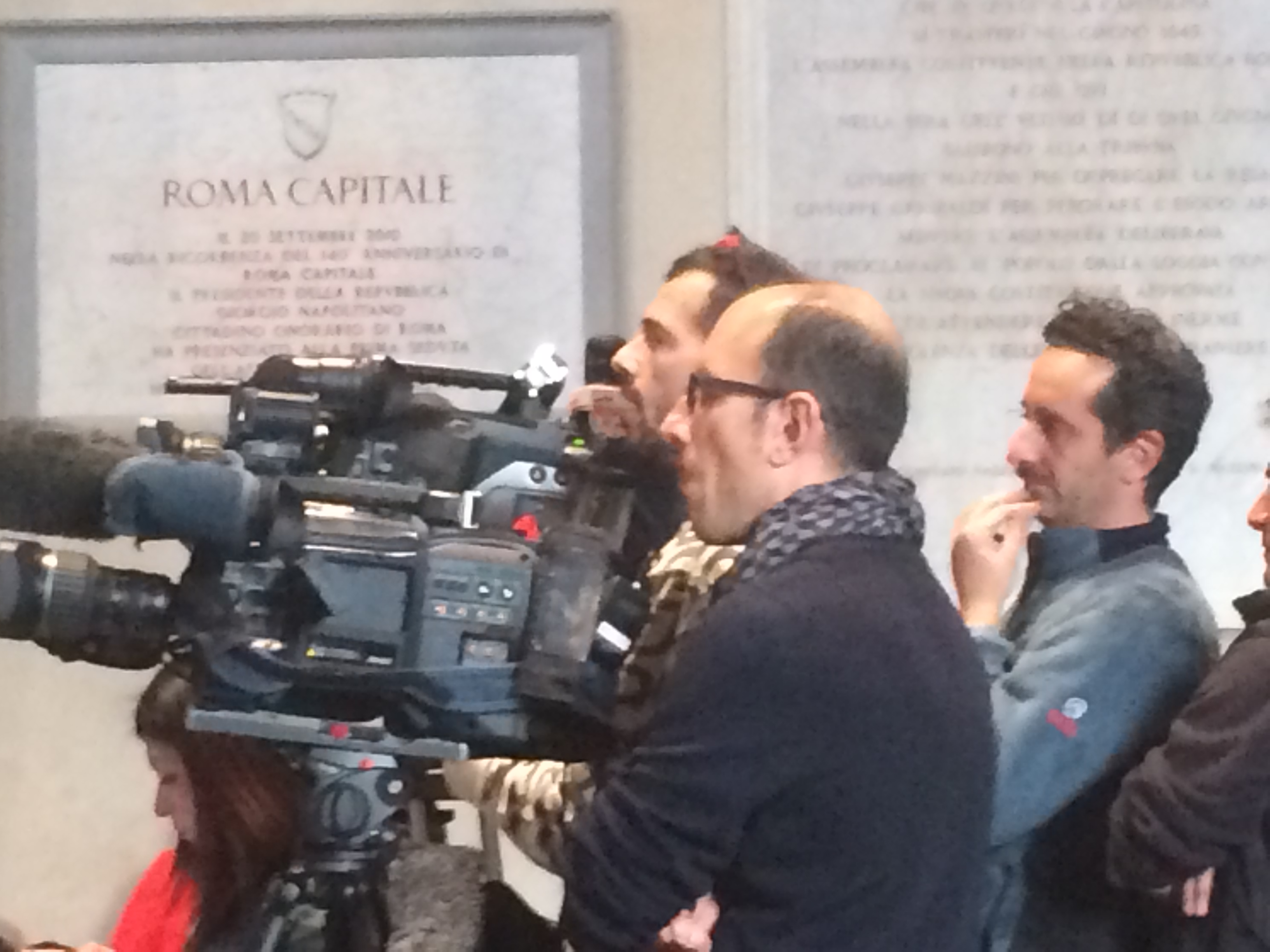
The party celebrating Rome’s new citizen was sedate compared to Jep Gambardelli’s parties in the film, but no less spectacular. Twilight on the Forum from the terrace of the Campidoglio, good company, abundant wine and food. What more could you want?
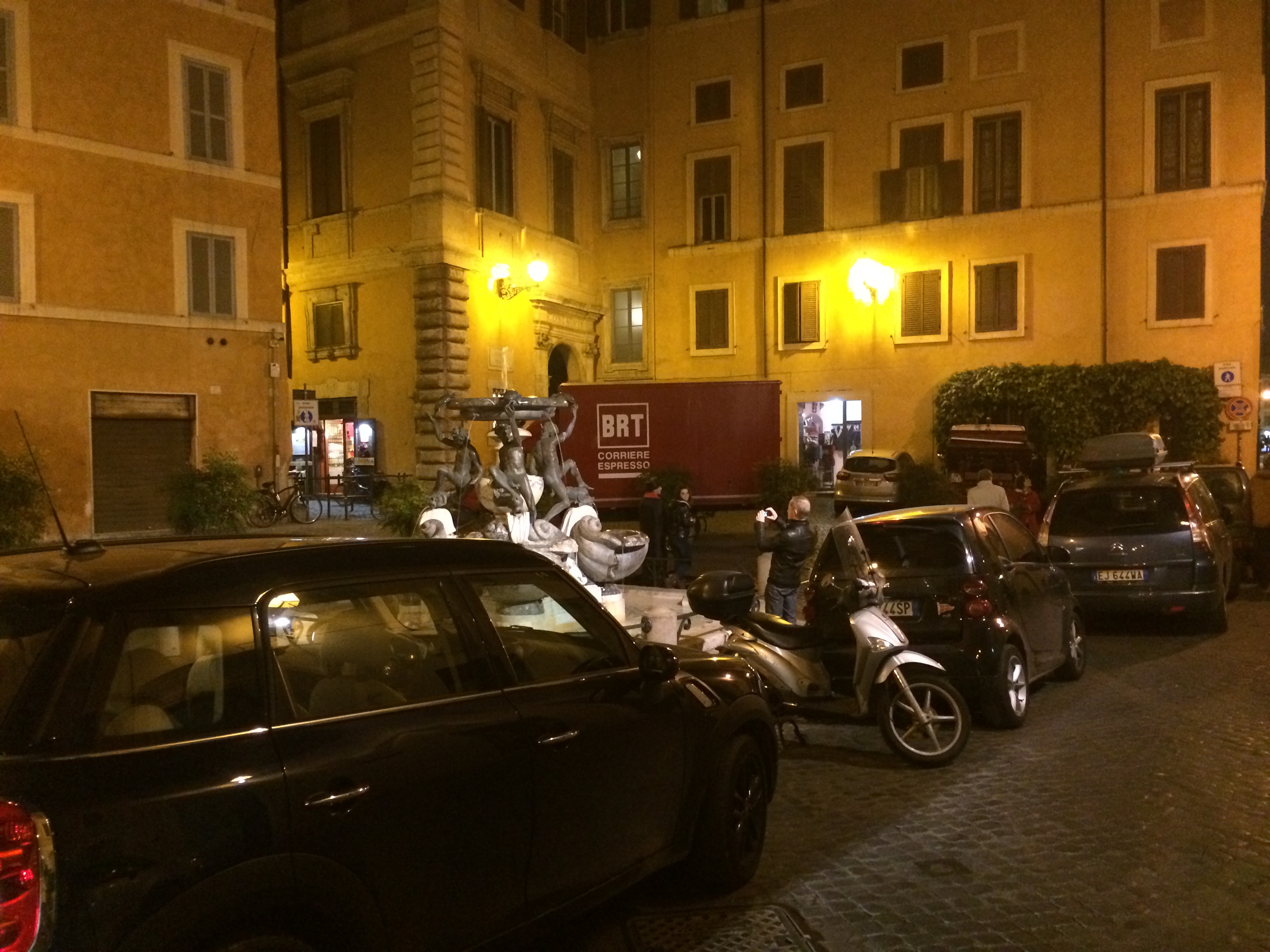
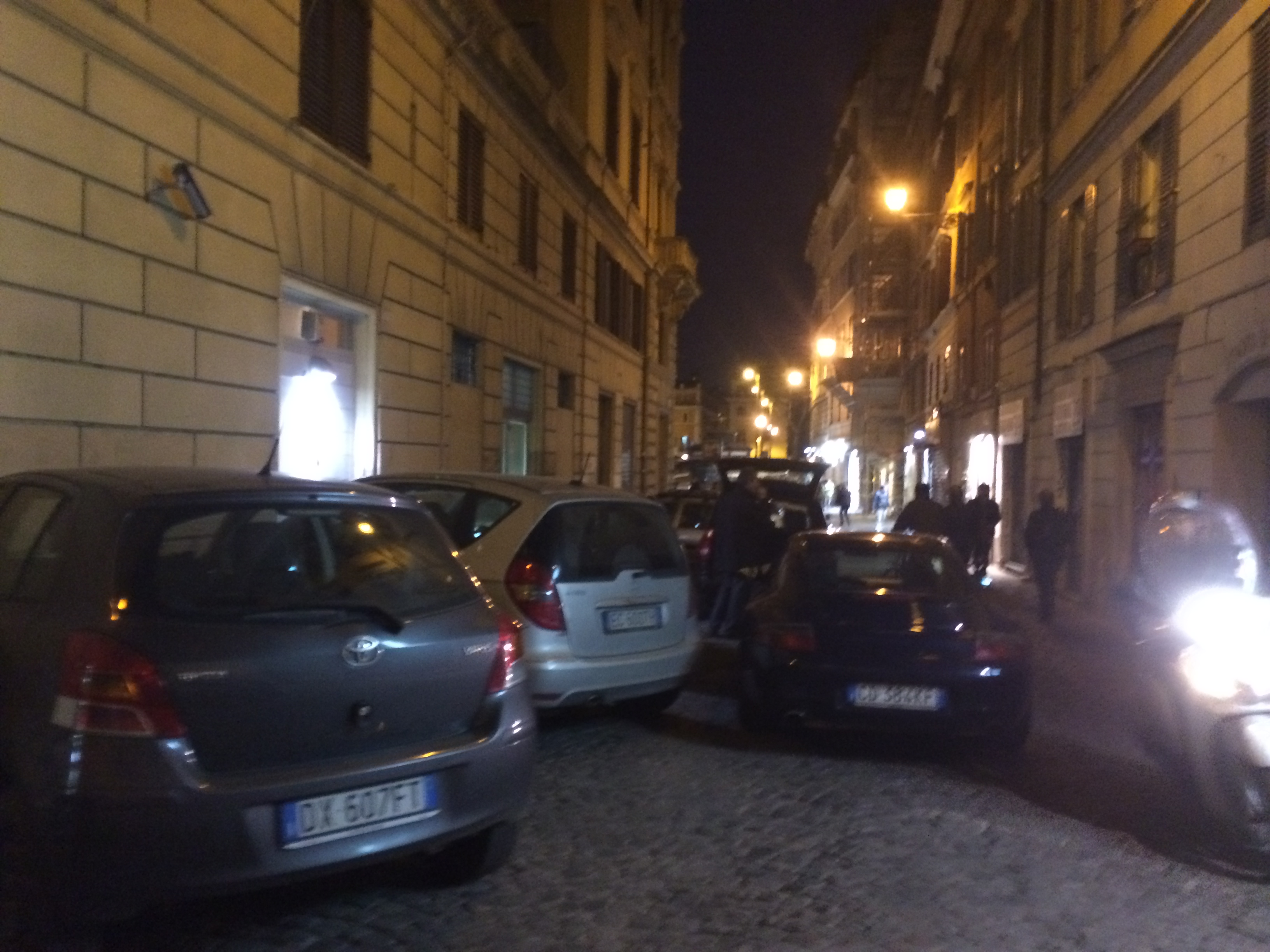
Spoiler alert: You may just want to skip the photos of the Roman “pedestrian areas” that greeted me upon leaving the Campidoglio. Yes, that is the turtle fountain on the left. No comments are necessary. Verdone is right, we who love Rome won’t let it fall again.
Rome: Resilient City
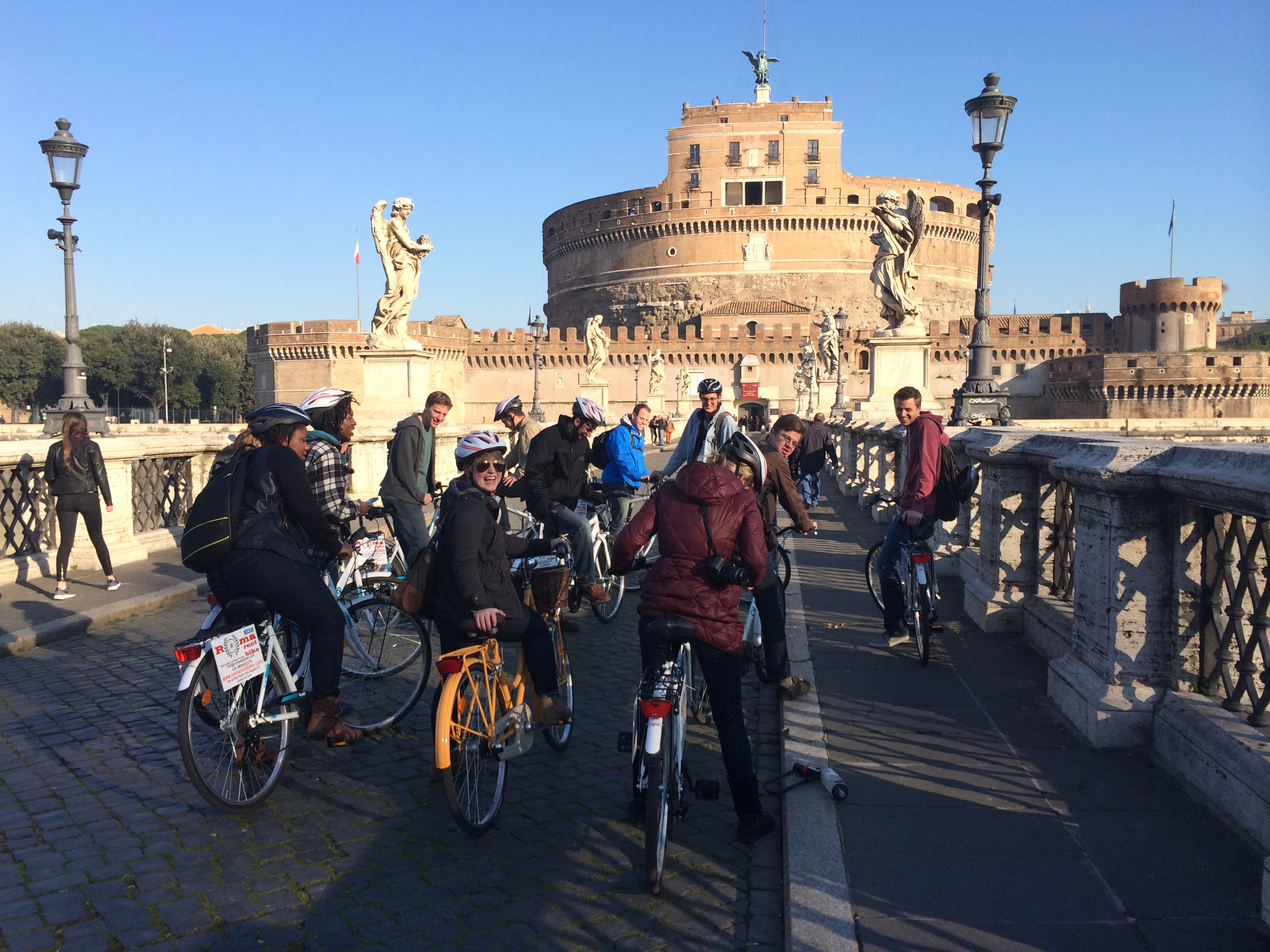
American Architecture Students exploring the neighborhoods of the still sustainable city.
I’ve been following the Resilient Cities project of the Rockefeller Foundation for some time now with great interest and was spurred to write about it after a visit to the city’s waterfront yesterday. The Resilient Cities is about “making people, communities and systems better prepared to withstand catastrophic events – both natural and manmade – and able to bounce back more quickly and emerge stronger from these shocks and stresses.” The “Still Sustainable City” blog is based on the observation that Rome has done this again and again, always bouncing back. Yet it is overdue for a rebound. I fear that if it falls again it may not be able to get back on its feet.
The promise and the risk of Rome lies both in its heart, the Rome known to millions of tourists, and in its hinterland, where agricultural land and natural areas still resist the onslaught of urbanization. The entire historic center of Rome is a UNESCO heritage site, a fact that should give the administration the political mandate to enforce civic guidelines. After all, the economy thrives on tourism and visitors stay longer, return more frequently and spend more money when they find the city clean, hospitable, ethical and safe. At present it is hard to apply these adjectives to this admittedly fantastic city. But that can change.
Outside of the center the traces of “campagna romana” are fast disappearing, giving way to shopping malls and housing projects. The culture of local food is strong but not strong enough to resist the “wall of money” that accompanies real estate speculation. This has to change if the city is to maintain its resilient evolution, and thankfully there are lots of organizations working toward this goal.
In Ostia yesterday with students from Iowa State University we met with Giacomina di Salvo, the Assessore (councilor?) of Urban Planning for the XIII Municipio who was very helpful in explaining the challenges facing her department and the opportunities presented by projects like the Rockefeller Foundation one. The contradictions between the dramatic coastline, breathtaking historical and natural habitat sites, and illegal or unplanned growth are striking. But the potential to change is huge!
ROME’S RESILIENCE CHALLENGE
The entire historical center of Rome is a UNESCO heritage site, which is highly vulnerable to stresses and shocks. Urban growth represents a significant challenge to the ability of the city—and its metropolitan area at large—to function as a whole, both under normal and exceptional conditions. The inheritance of decades of poorly regulated urban growth, informal housing developments, low-quality neighborhood planning, inadequate infrastructure provision, and sprawl, has made the city highly vulnerable to external shocks and stresses. Rome includes large expanses of still viable rural land and natural reserves, and sees resilience as a key component of a larger strategy aimed at making the city more sustainable and efficient in the long term. – from the Resilient City project website.
Magnificent Rome
Those of you who have followed this blog for a while might recognize some of this post, an updating of one entitled Extraordinary Rome from a year back. Having been selected by Guardian Cities as the #1 City Blog in Italy, I’m seeing a huge boom in readers and decided to bring to the top some writing that didn’t get read as much as it could have.
Between the posts I write on the bilingual Forum Roma Sostenibile, my tweets @tgrankin, or posts on Facebook as tgrankin or romasostenibile I am reaching a growing readership. I figure sustainability and the city are themes that should interest the administration of Rome. Occasionally I get indirect word of projects, conventions, press conferences, etc. on related themes so I thought I should get on the press list. Having met Marco Girella, Capo Ufficio Stampa, and having his business card handy, I recently sent an email but have not yet received as much as an automated response. Perhaps the “press office” is understaffed (though from the figures posted here not underpaid). It’s really surprising that I get answers from various government offices, including the White House, but not from the City of Rome press office, one that I would expect to be most savvy when it comes to communications. Today I got a nice phone call from a staff member at the press office apologizing for any confusion and explaining that she had inserted our contact into the city press list; in fact, she was surprised that nothing had arrived. But she didn’t understand that it is normal, when receiving an email with a request, to answer directly. I don’t know, something like “thanks for your query, we have inserted your name into the mailing list. Please let us know if you have other questions.”
I also got a confused phone call from another government office, that of the President of the First Municipio, apologising for having accidentally cancelled an appointment that the President herself had made. The “weather emergency” (it has been raining a lot as it does here in winter) was invoked as a justification for the impossibility of nailing down a 10 minute appointment. How hard is it to answer emails and schedule appointments, something that seems so “normal” in other cultures?
Rome is not a “normal” city but an extraordinary (straordinaria) one. In seeking to make it more “sustainable” I like to think we are making it more like itself and less like normal, standard, global cities. We don’t want Rome to be Tokyo or Vancouver or even Paris. Sustainability means providing the needs of the present without compromising the ability of future generations to provide for their needs, and Rome has been doing that pretty well for dozens of centuries—thus the “still” in this blog’s title.
A sustainable Rome doesn’t need to be less passionate, less chaotic, less magical, less comically astounding, less Roman. There are centuries of accumulated experiences, materials, traces, memories and more to be shared and only a fool would try to clean that up and replace it with a sanitized “green city.” A sustainable Rome would be filled with sounds, smells, tastes, chance encounters, vistas, poetry and contrasts. Minus certain blight that we have come to associate with the city: motor-vehicles, globalized advertising, disorganized waste, privatized common space and resources, and a handful of other common injustices. Fighting these doesn’t necessarily mean fighting Rome any more than curing a disease necessarily means killing the patient.
It’s not an easy task to get Rome back on course, but neither is it “idealism” as I so often hear. Italians adapt pretty well to change when it has clear advantages (the internet is pretty much ubiquitous now but I remember in the late nineties working for an internet company and hearing that Italians would never get on board!). This weekend we will see the streets of Rome filled with bicycles, as it has more and more of late, and those willing to make the switch will realize that cycling is another win-win for Rome. The same can be said of a return to more frugal lifestyles which consume less energy, water and other resources and produce less trash.
We’re talking about improving the quality of life for everyone, launching sustainable economic growth, and if you want to wave the sustainability flag as well, yes, ensuring that future generations can also provide for their needs. What’s not to like?
On the road
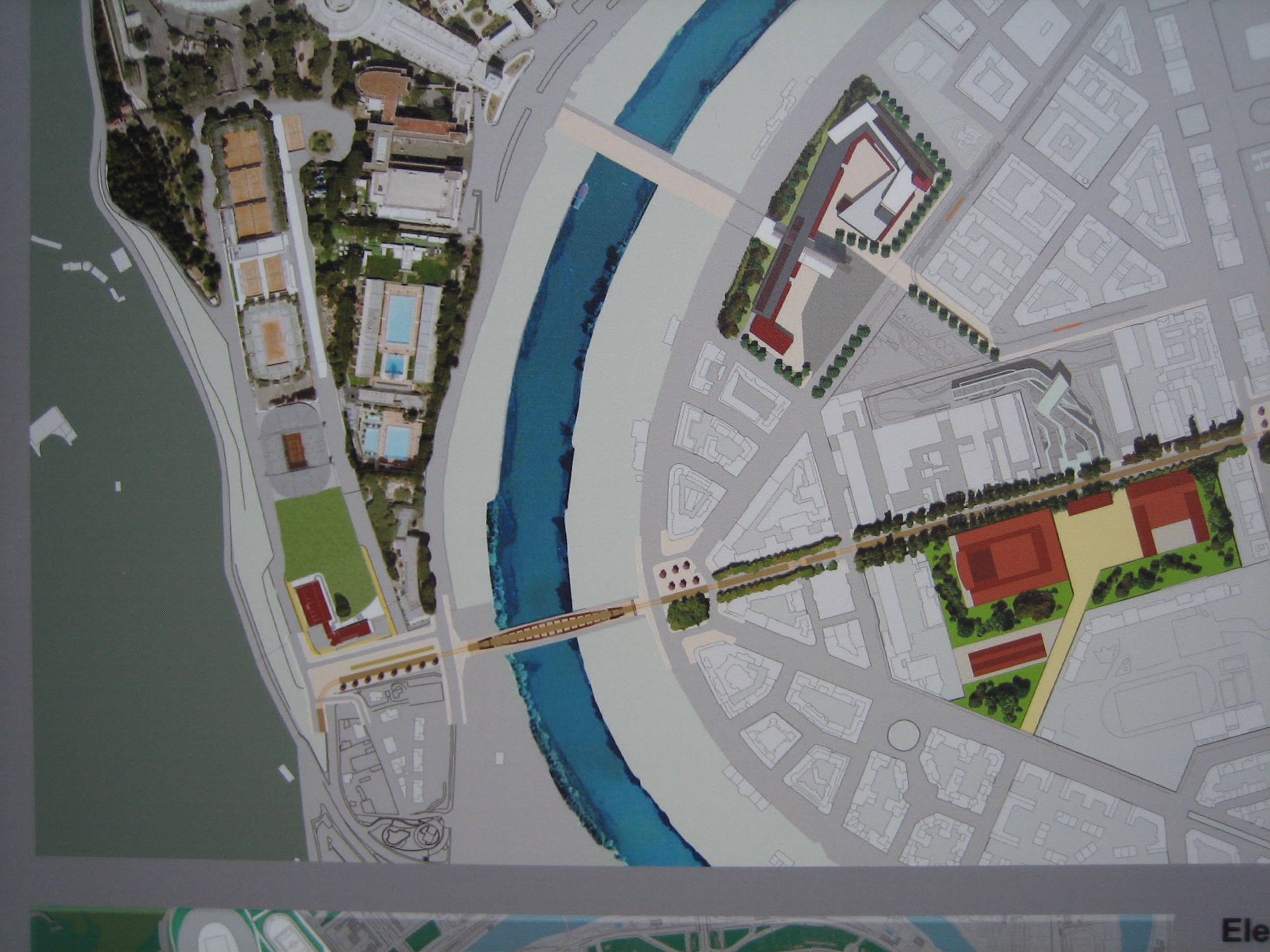
Project drawing for pedestrian connection from Auditorium to Foro Italico

Google Street View image of the pedestrian crossing at the end of Ponte della Musica
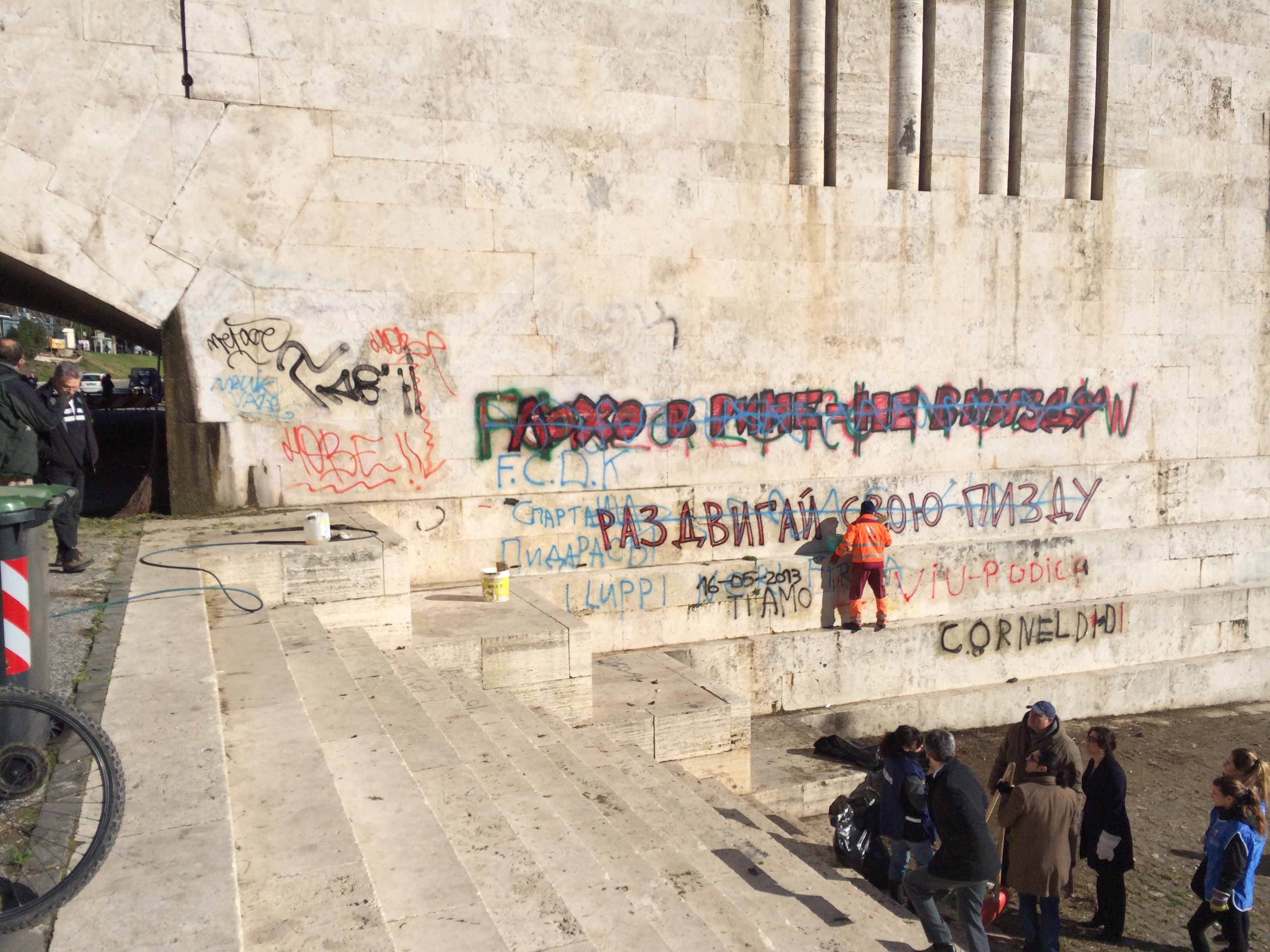
Cleaning up the Tiber banks near Ponte della Musica (Jan 2014)
In honor of this blog’s selection by Guardian Cities for the top city blog’s list, I am updating and reposting some past blogs, starting with this one written exactly one year ago but as relevant as ever. Update: the connection between the new Ponte della Musica bridge and the riverside walkway/bikeway below has been completed. The ramp from the bike path below to the road above is completed but still fenced off inexplicably. And, thanks to last weekend’s work by Retake Roma (along with participation of association’s like Tevereterno and various Rome-based university programs), the river banks are cleaner than ever. But…
The last step always seems the hardest in this city. New pavement is laid, at great expense, in pedestrian areas, but we can’t keep cars from driving over it. Great buildings are constructed, or restored, but we can’t keep the walls free from illegal posters or the sidewalk in front of them free for people to walk. Fuksas’ Nuvola is nearing completion, at a cost of well over 300 million euros, but the walk to it from the metro still takes you along the frightening edge of a high-speed road with no sidewalk, right through a roadside gas station! Interested new didactic signs have been exhibited in the well-constructed viewing area overlooking the Circus Maximus, but they are too far away to read through the gate, which has yet to be unlocked, although the project was completed years ago. A drinking fountain placed a decade ago in front of the Arch of Janus runs continuously, but no one has ever been able to drink from it because a fence keeps the public out.
It has been over a year since the inauguration of the impressive pedestrian bridge dubbed Ponte della Musica, design by London-based firm Buro Happold in collaboration with Powell-Williams Architects which I have written about previously. The parking garage at the end of Via Guido Reni seems open, although cars are still piled up on the sidewalk and pedestrian crossing all around. The expensive work has been done; now it’s time for the easy stuff. Like a safe way to cross the street.
Yesterday evening, at the end of a long day with architecture students which began at St. Peter’s, took us through EUR and Ostia Lido, and ended at Zaha Hadid’s Maxxi, we experienced the current state of the pedestrian route, and it was pretty disappointing. The sidewalk alongside MAXXI, in fact all the way from Piano’s Auditorium to the river, is in poor shape, and the intersections were blocked by cars as usual. Nothing indicates the “cultural axis” that is potentially so compelling. Simple street furniture or distinctive paving or signage would be a plus.
Once you arrive at the river, the redesigned Piazza above the parking garage looks ok but doesn’t lend itself to continuity; to get across the street requires elaborate zigzagging, a 20 meter detour off axis to a cross-walk with a light which is green for pedestrians and turning cars at the same time, a formula for disaster. Safely on the bridge, the views are great but there is still no connection down to the river banks, which are still a construction site.
The worst of it is at the other end of the bridge, though, where the axis continues to Luigi Moretti’s Fencing Hall and the other sports facilities of the Foro Italico. Street illumination is dim and four lanes of cars speed at upwards of 80 km/hour (despite the city-wide 50 kph limit). There is a faded crosswalk, and no light, between you and the bus stop. Needless to say, getting across is terrifying. I was not surprised to read that a pedestrian was killed by a car on this road late last night, adding to the already huge number of pedestrian and cyclist victims of killer cars in this city.
I can imagine a number of traffic calming solutions for this site, a traffic light being the most obvious, but not the most interesting or effective. The goal is to slow down cars, and discourage drivers from even using them in the city where they already wreak havoc. Narrowing the road to one lane in each direction, with lots of obstacles like trees, bollards, benches, etc. around which cars have to navigate, would have the effect of giving the street back to people. The only vehicles that should be allowed straight through are public buses, which brings me to the final part of the story.
Of course this location, where thousands of cars hurtle themselves toward the historical center on a Saturday night, is part of a larger problem. They go knowing they can park for free just about anywhere, or for a negligible 1 euro an hour. And they know the alternative is a transit system that fails o perform to standards.
A city like Rome cannot continue to accept a bus system which has vehicles, drivers, and even some sophisticated software but absolutely no dependability. We were trying to get a 271, an important bus, which connects Prati and the Centro Storico, in the early evening on a Saturday. You can make out the bus stop in the Google Street View image above on the left. When there are games at the nearby stadium the sidewalk is taken over by cars so you have to walk in the street to get near the bus stop. The electronic readout showed no trace of the 271, and when I connected my iphone to the ATAC real-time server the results were, well, disconcerting. No 271, and very few other buses. As we attempted to use the few buses running to get to our destination, I captured this listing for a busy stop in the heart of the bustling neighborhood of Prati. This is a sad state of affairs which Rome has to rectify.
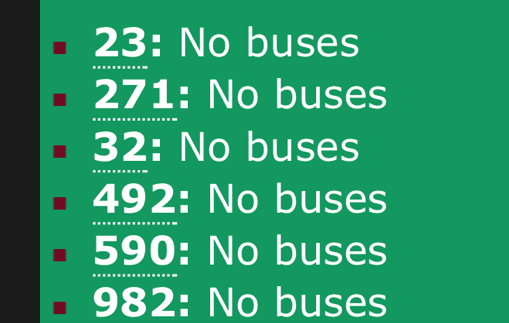
A screenshot of the bus availability at a busy stop in Prati at 7:00 pm on Saturday. Incredible.
6 obvious questions no one thinks to ask about Rome (or any city)
1. Why do public buildings close at night? So many big institutions such as universities, schools, museums, ministries, city offices are empty more than they are full. Why not employ more people in less space by letting work get done around the clock, in shifts? There are far more advantages than disadvantages. Think about it.
2. Vice-versa, why don’t more people work at home, rather than leaving their homes empty all day? Much of the work we do can be done anywhere we have internet. Instead of the daily exodus from home to work and back we should be seeing a constant buzz of decentralized movement in an efficient, constantly peak transit system.
3. Why do municipal police need cars? I mean, I understand why taxi drivers need cars, and UPS guys need trucks, but the police only use their cars to drive a few blocks and then leave them double-parked while they sit in them or stand next to them. They would be much more unencumbered if they just walked around like they do in other cities. If they really need to chase a criminal, a car isn’t going to help them in this city; bike would be faster by far. And if they need to get across town for some reason they can take transit or call a cab.
4. Why do we provide places for people to throw their trash for free? If people are going to acquire stuff they don’t need and can’t use, they should be willing to deal with it. If I bring home a bunch of junk I have to find a place to put it, or eventually rent more space, but we still act as if there is some “away” where we can throw our waste and forget about it. We should charge people rent on the space their waste takes up, for its full lifetime.
5. Why do people look up to politicians? People that work in public administration are really at the lowest rung in the ladder; they serve at the pleasure of the most common citizens who can vote them in or out and who pay their salaries, which by the way, are outrageously high. I respect good politicians and enjoy talking to them, as I would the barista or my barber, yet I don’t feel particular reverence for them. We would be in awe of our teachers, our farmers and our artists. But I don’t remember the last time I saw a motorcade cutting through red lights and blocking traffic because a farmer needed to get to her garden or a schoolteacher to his class.
6. Why do we let regular people drive motor vehicles? These things kill thousands of times more people than firearms, use priceless and finite resources, and have a huge negative impact on the quality of life in our cities and yet we just act as if it’s normal that a guy can drive one around to get from place to place. Cars should be used as rarely as chain saws and only for jobs for which they are uniquely suited, like carrying a bunch of people or stuff to remote, out-of-the-way destinations.
Pragmatic Optimism
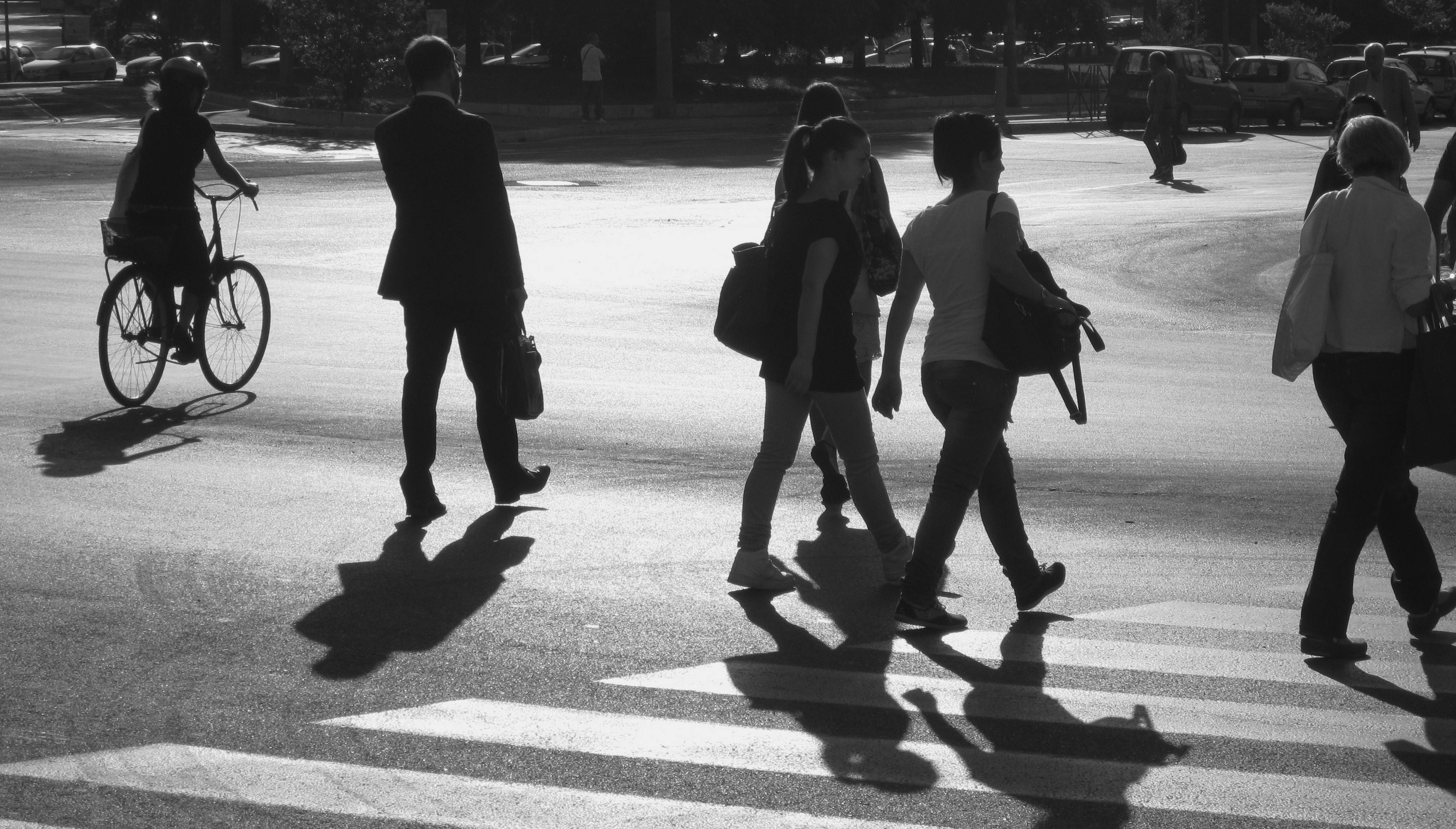
I was asked the other day how I thought the new administration of Rome, in office now since June, was progressing. My answer was positive, but with reserve. I shook hands with the new mayor on June 13th when he took often and pleaded with him to “make us proud”, which he promised to do. Yesterday we met again, at the presentation of Pietro Abbate’s interesting book Fare di Roma un capolavoro, and I congratulated him on living up to his promise, so far.
The “reserve” comes from the daily experience we all share in Rome–the long list of annoyances from the cars blocking the wheelchair ramps to the dirty, inefficient transit system to the blah blah blah, the list goes on. Numerous blogs and twitter feeds document this continuously and I have suggested previously that before the mayor expends too much effort on sensational new urban initiatives it would behoove him to enforce basic rules of civic behavior, starting with public officials. I think that is starting to happen.
After many failed attempts I recently received a fantastic response from a member of the mayor’s staff. I won’t quote it in full here, nor does it matter who the exact author is. The overall message was on-target: this city needs “maintenance” in order to become a “normal city” where daily life is less exhausting and where rules are respected. But the letter went on to affirm that Rome will never be a “normal city”; an observation I made in a previous post “Extraordinary Rome“. It must be an extraordinary city where normal civic standards are only the lowest common denominator.
Bit by bit, slowly (much too slowly), with growing citizen participation which Abbate points out is key, this is starting to become a reality. Yesterday I saw one less car in the pedestrian area outside the cultural superintendency (why not eliminate all these cars?), one more ticket on an car parked in a tow-away zone by the Campidoglio (why not tow them all?), one more bus departing on schedule.
Thus, I continue to hold a “pragmatic optimism” that Rome is on track to see a cultural, civic, and (why not) economic revival in days, months and years to come.
From 41 to 14 celsius in one kilometer
Rome in August used to be like Cape Cod in February. Where there were usually traffic jams, now there was peace and quiet, and hours of battling crowds turned to minutes of blissfully unhindered flow. While the contrast is not as totalizing as it once was–few can afford the long vacations and many have discovered the joys of August in Rome–there is still a refreshing seasonal shift. Yes, it is hot, and the plethora of air-conditioning units everywhere make the streets feel hotter, but stone monuments, dark medieval churches and the shade of rock pines still absorb and block the summer heat. A trip to the coast or to the mountains or both can still be made in a day.
In summer I start my days early, opening up all the windows to let the cool night air penetrate my home or studio. The alibi of August means any writing or drawing I do gets extra credit, what might normally seem stressful because of deadlines becomes satisfying in summer. It’s okay to take stay up late and sleep in the next morning. Gelato in the morning, why not? Sure, take a siesta. Everything is more relaxed in Italy, and still more so in August.
stone monuments, dark medieval churches and the shade of rock pines still absorb and block the summer heat
Cruising Napoli. Last week I spent two non-consecutive days in Naples scouting for a fall program, visiting Posillipo, Pozzuoli and Cuma one day, Herculaneum, Oplontis and (cringe) Pompeii another. The city emptied of its chaos felt strangely like going back in time, to an era of few autos zipping through grand spaces and along winding roads between craggy rocks and shimmering sea. Compared to Rome I found in Naples something I would never have expected, a respect for civic order. Even the gypsy parking attendants showed a certain conscientious attention to public space, directing us to park where the car wouldn’t be an obstacle. But I am probably just projecting.
Rolling Rome. In Rome, little more than an hour away by fast train, I spent a day with a couple from Washington, D.C., she a retired English teachier, he a retired architect confined to a wheelchair and interested in seeing modern and contemporary architecture. It wasn’t the first time I had faced this challenge–I had consulted with Howard Chabner on an evaluation of Rome from an accessibility standpoint in 2005 and again in 2012–but it hadn’t become any easier. A sweltering hot day, and a Monday to boot, when most museums were closed, the challenge of finding a shady, naturally cool or air-conditioned respite was made nearly impossible by small barriers that able-bodied travellers wouldn’t notice. Often there are curb cuts at one intersection but not at the other end, or when they are there are cars blocking them. Luckily my foodie friend Katie was along to facilitate, scouting ahead to find possible routes and potential obstacles. When slow-going meant finding a lunch spot earlier than expected she tracked down some options and we settled on Perilli al Flaminio which wasn’t bad, although a bit pricy for what we had. We were able to overcome the small step at the entrance (thanks to some scrap lumber and some helping hands from the construction site next door) and coax the owner into turning on the air-conditioning. In Rome people are always willing to help out, as long as it’s not really their job to do so. Sadly both Renzo Piano’s Auditorium and Zaha Hadid’s MAXXI were inaccessible, not by design but by management, the public spaces closed for construction and the Monday closing hours applied absurdly not just to the museum but to its piazza. A long day ended getting (good!) gelato at Neve di Latte while waiting for the (great!) accessible and air-conditioned taxi to arrive.
The next day, after a short and fast ride on the Freccia Rossa, I am baking on a terrace overlooking the Bay of Naples.
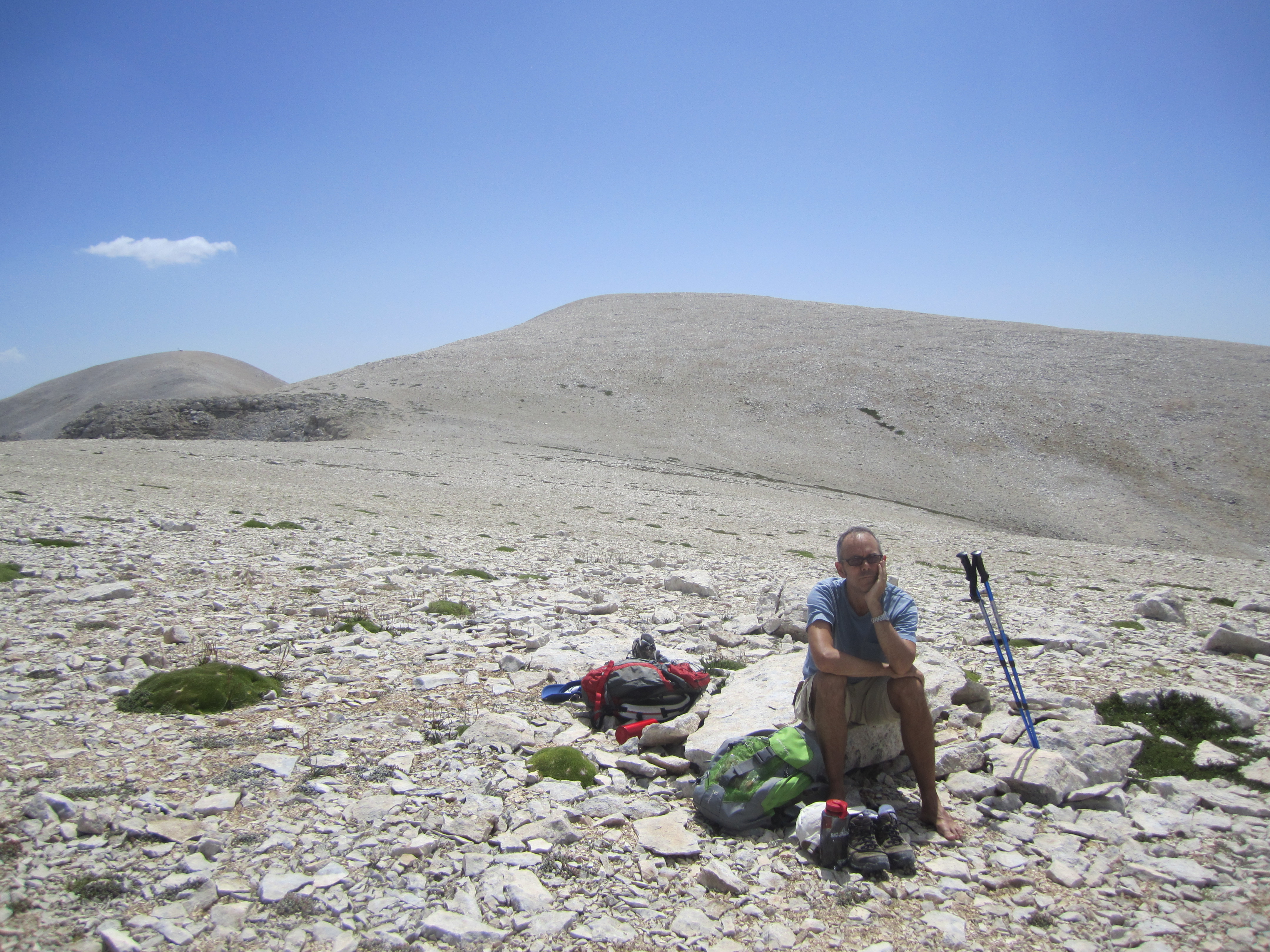
Hiking Abruzzo. And the following day, I am baking in a campground in Abruzzo on the other coast, 30 km. from the Adriatic Sea, at the base of the highest mountain I have ever climbed. La Majella (prounounced “my-yella”) is the second highest peak of the Appenines after Gran Sasso. From the fantastic campground we happened upon, Kokopelli,http://www.kokopellicamping.co.uk/index.html run by a delightful English couple Kevin and Jackie (sp?), it was a half-hour drive to the end of the road but the temperature dropped from 41 to 14 centigrade (105 to 57) as the elevation rose by a kilometer. We encountered two Tibetan monks (!) descending from the trails; I bowed instinctively and was greeted with a smiling, accented “buon giorno”.
The next day, we left camp at 7:00 am, were at the bakery preparing sandwiches at 7;30 and packed and walking away from the car at 8:00. For the next 3 hours we climbed and climbed, through cool pine forests (Pino Mugo) and up rocky inclines. At a certain point we paused in a crevice which was cool and shady and I took off my sweat-drenched t-shirt to dry it in the sun and put on a warm sweatshirt and ate dried fruit and drank cool water. We still had a ways to climb to reach the “bivacco Fusco”. There we saw a herd of chamois running across the snow and up the steep slopes of Monte Focalone. When we finally got to Monte Focalone, the chamois were nowhere to be seen and the landscape was hot and dry, shards of flaky grey stone like slate crunching under our feet. By day’s end we had been hiking for close to eight hours straight, covering almost a vertical kilometer!
Finally, to complete the picture of extreme contrasts, the week ended in ice. Not the glacier visible in the north-face of La Maiella but the aftermath of a sudden hailstorm that struck Caramanico Terme and left the ground thick with white ice and the rooftops of the village looking like ski season. Glad we weren’t on the mountain at the time, or at the beach, or anywhere but under cover. I’ve come to expect weird weather, and seen snow, flooding, earthquakes and drought within the same region and almost the same season, but this week drove home the magnificent, spectacular power of nature.
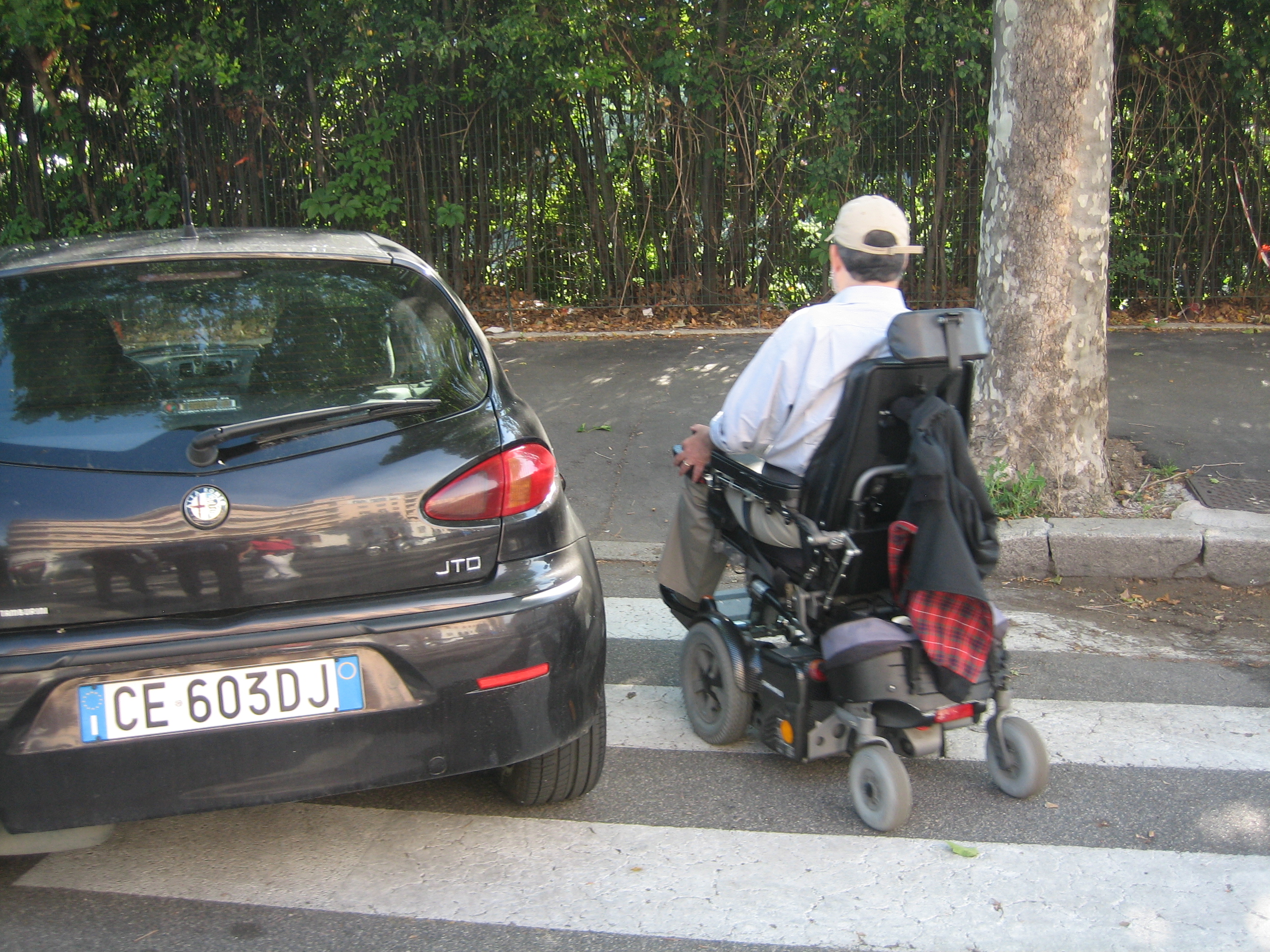
- Negotiating accessibility-challenged streets of Rome
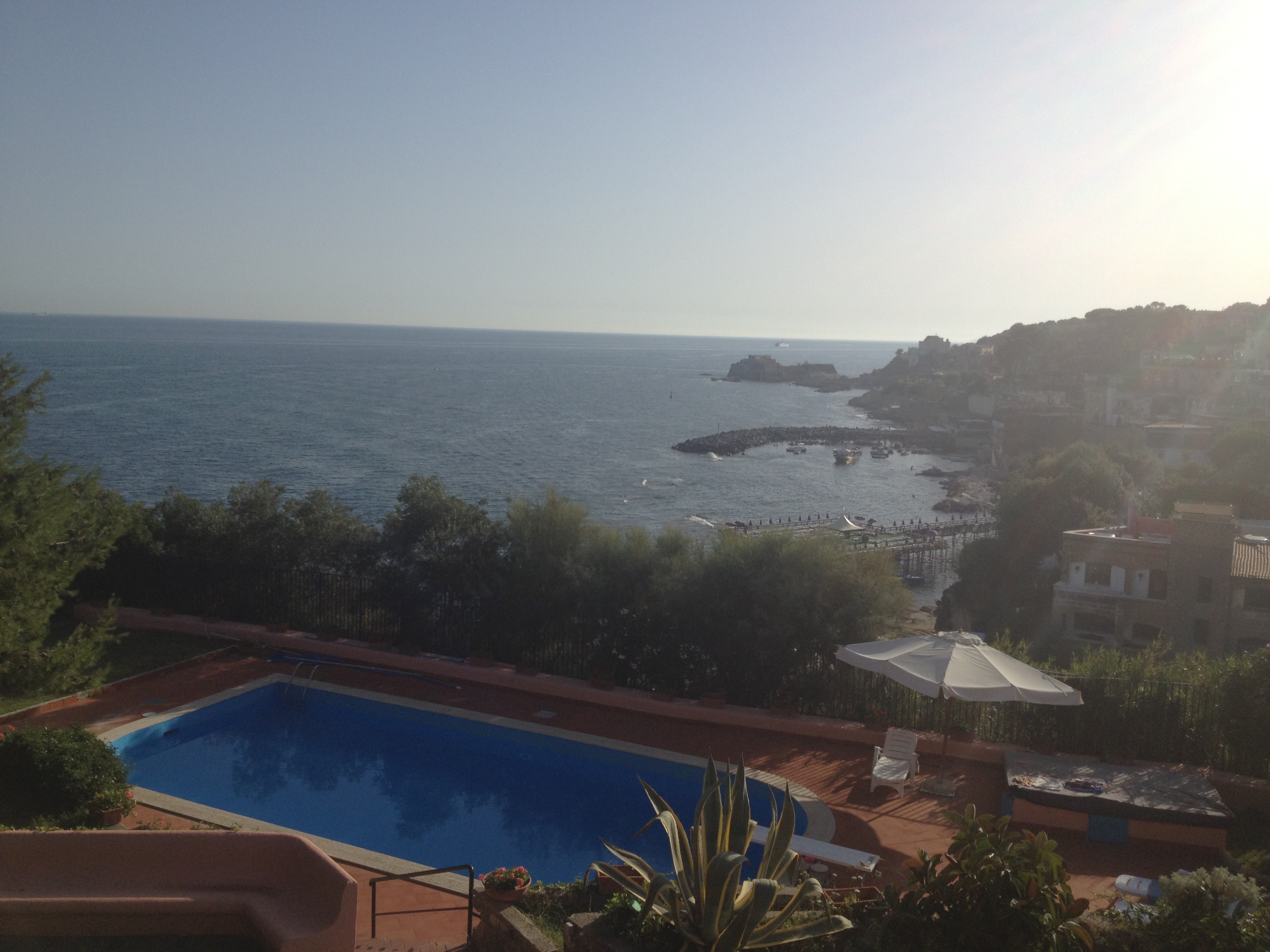
Posillipo, Naples
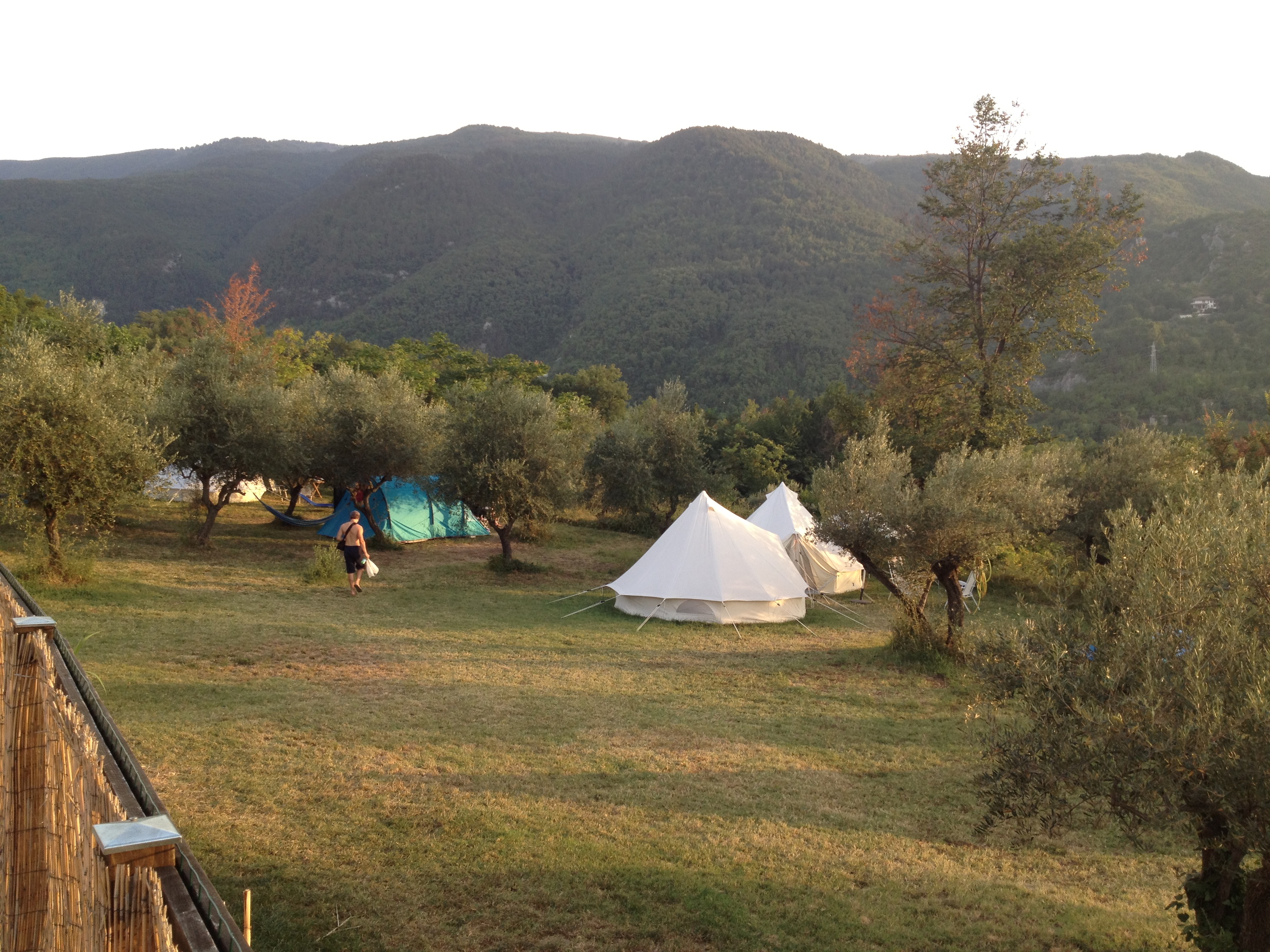
Camping Kokopelli, Abruzzo
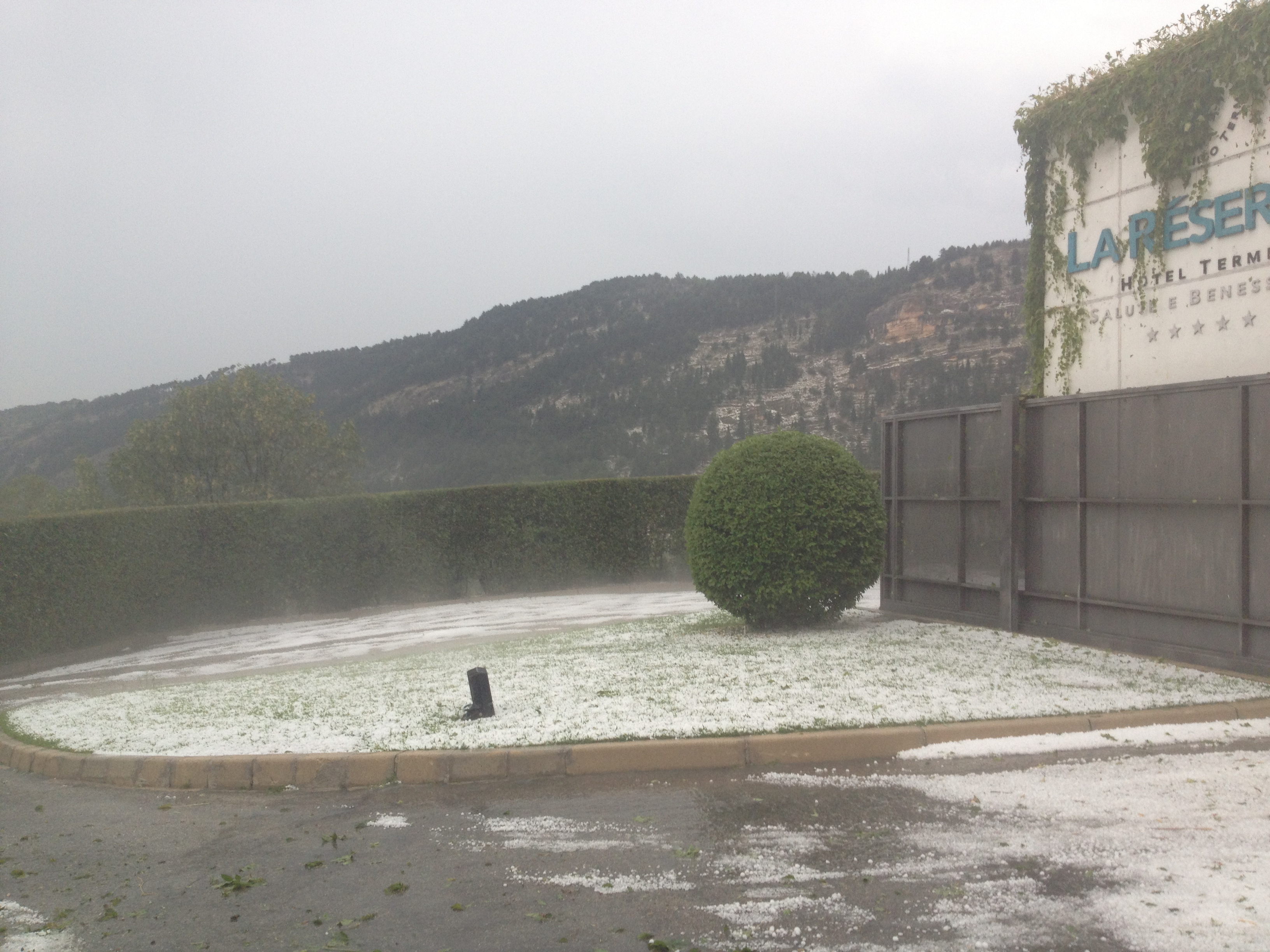
Caramanico post-hail storm
SOS Some Obvious Suggestions
While waiting for the Rome’s mayoral candidates to come up with 7 points for a more sustainable city , here are some simple suggestions, actions which don’t even require any consensus or additional legislation:
- insist that the municipal police enforce the traffic code, ticketing and towing all motor vehicles that violate the law, including vendors parked in violation of code, and remove from duty those officers that neglect to perform their duties or violate the traffic code themselves. (cost = 0, revenue = €millions)
- remove all illegal advertisements and fine the companies and their clients responsible for them (cost = €thousands, revenue = €millions)
- insist that AMA remove all trash from Rome’s public spaces, including abandoned vehicles, illegal dumping sites, advertising and constructions (cost = 0, part of AMA’s existing job description)
- insist that AMA return all trash receptacles to their appointed locations and begin fining residents who use them inappropriately (such as putting paper, plastic or glass in the green bins). (cost = 0, part of AMA’s existing job description)
- require that all public transit respect published schedules and that employees be held accountable for not doing so (cost = 0, part of ATAC’s existing job description)
- ensure that all public employees and contractors perform adequately the jobs with which they are tasked (cost = 0, potential savings from eliminating ineffective jobs)
- place a moratorium on all construction projects in violation of the city’s master plan, regardless of variances which have been declared. (cost savings from not paying for unnecessary infrastructure and services = €millions)
These actions are just ordinary maintenance, necessary to restore normality to a city which has fallen into a state of disrepair in recent years. They require decisiveness and determination by administrators, not new posts and programs. Above all, they require inverting the perceived pyramid of public administration, placing the citizens at the top, civil servants working for directly for them, managers supporting civil servants, and at the bottom of the inverted pyramid the mayor working to make function the entire system. Only once a minimum of decency has been restored, should projects to really improve the city (bike-sharing, new transit projects, cultural initiatives, smart-city infrastructure, etc.) be discussed.
Next mayor for Rome? #romasindacosostenibile
This weekend Romans will be going to the polls to elect a mayor to replace Gianni Alemanno, the far right-wing politician who has been in power for five years and been mired in scandals from nepotism to budget overruns. They may not succeed and Alemanno may be re-elected. Although I confess I haven’t had the time or patience to wade through the bureaucracy to register to vote, although as a foreign resident I am technically entitled to (if I go to some office on the edge of town and wait in the right line with the right certificates) I am not disinterested in the outcome. So who are the candidates opposing him and what are their programs?
I currently count 19 candidates who support (or are supported by?) 40 different “lists” which include candidates for other offices. Lists with names like “let’s cut politician’s salaries in half” or “Christian militia” or “Italia Reale” (I think I still own a website with that name, an idea for a spinoff of my company Scala Reale). Or Casapound, the neo-fascist club housed in a palazzo given them by the current administration who paper the Esquiline with illegal posters announcing strong measures to restore respect for the law.
I will only mention a handful of specific candidates who haven’t already demonstrated their disrespect for the city by littering it with flyers and posters, clogging the streets with advertising trucks, or contributing to the mafia of illegal billboards.
In truth, I was optimistic months ago that change was coming to Rome. I was excited to see what candidates would emerge, what their programs would promise. But then I started to realize how it works, or doesn’t work. No one knew the date for the election, there is not process to limit the number of candidates, no pre-selection, no enforcement of election spending and advertising laws. Some candidates spend millions and are always on tv while others are never invited, some make blatant lies and get away with it. Politics, in short.
In a post several months ago on roma sostenibile I invited the mayoral candidates to propose 7 policies or points to transform Rome into a more environmentally sustainable capital. Of the two responses, one (Umberto Croppi) has stepped out of the running. Most of the candidates running didn’t reply which could mean several things. a. they didn’t get the message, indicating lack of promotion on my blog’s part but also a less than attentive campaign staff. b. they didn’t want to take the time to submit their answers.
Other than the current Mayor, there are 5 candidates worth considering. Here’s what I know and think about them.
Sandro Medici. A quick look at the program of Repubblica Romana, Medici’s list, confirms that we see eye to eye. And Medici was the only candidate still running who responded to the request of Roma Sostenibile, with some good ideas. His background is very “old left” meaning ex-communist, counter-culture, bottom-up, but his website is up-to-date and uses social media pretty well. In his camp there are people like Lorenzo Romito of stalker and urbanist Paolo Berdini. Not a bad choice, if there were a chance of him winning.
Alessandro Bianchi. Another accomplished urbanist, founder of ProgettoRoma, he appears about the same generation as Medici, not exactly young, and his program also says the right things. Although ProgettoRoma didn’t respond to the Roma Sostenibile appeal, it also hasn’t offended the city through illegal advertising that I have seen. Which unfortunately means its chances of winning are slim.
Marcello De Vito. The candidate of the Movimento 5 Stelle, Beppe Grillo’s party, is younger and more aggressive, and far more present in the press than the previous two, but it took me a while to find the actual program. But now that I have read it, I’m hooked. I couldn’t agree more with its aims, and appreciate the specific reference to “transition towns”, to the green economy, and even a proposal for local currency. We’ve been reading the same books. Now I’m really excited, three great candidates competing against each other and not only.
Ignazio Marino. Seems to be the front runner, the preferred moderate left candidate. Respectable, likeable, professional. He’s a top surgeon, although this leads me to ask the obvious question, why and how is he planning on running Rome in addition to saving lives. The program, while respectable, is a bit disappointing in its reliance on spending. For every problem the solution seems to be a new competition, a new position, a new budget item. To make the buses run on time and safely, he calls for new video cameras rather than just enforcing a schedule and firing drivers who don’t perform. It’s a try-to-please-everyone kind of program. And when I see the first item on the mobility page “la cura del ferro” (rail as a solution) I realize how antiquated this thinking is. But, I can’t say I disagree with most of the ideas, so if Marino wins I’ll celebrate.
Alfio Marchini. Incredible, here again the program is great, hitting all the right points and presenting them with graphic clarity and conviction. I’m hooked. Even if I see his flashy slogans and grinning Mel Gibson face everywhere, and hear that he is rich because of his ruthless developer father, and well-connected in banking, big business (where many of the projects failed but he made out alright) and counts some pretty seedy political leaders such as Berlusconi, Cossiga and D’alema among his friends, I still would like to see this man in office.
It’s scary, but they’re all pretty good.
But I’m curious, what is Gianni Alemanno, the current mayor saying? The web site is not so sexy, and showcases far more the political aspect of consensus, photos of events, links to supporters, etc. but once I dig through to find the program, there it is: just about the same rhetoric as all the others. Sustainability, Participation, Solidarity, etc. etc. Great, I’ll support this program, too!
But wait, everyone is saying such great stuff, even the current mayor who has been in power for five years. But then I look at the current state Rome, which I have not seen in such a state of decay in twenty years. In a strange way it recalls the Rome I first visited in the 80s but then the lawlessness and corruption was endearing, partly because everything was dirt cheap and still pretty provincial. It would be easy to say that Alemanno has failed; the city is dirtier, more dangerous, less green, more corrupt and just downright more dysfunctional and absurd than it was five years ago, and because this is a blog based on personal observation, I will just say that without feeling the need to back it up with numbers. (I could if I took the time, and many others have). And then it would be easy to say we should replace him with someone who will do the job.
But that’s the problem with politics, no one is ever accountable for very long. Our memories are short, we see the state of the city but forget how it got that way, we read today’s promises but forget about the unfulfilled ones of times past. It’s like all the people I know who say this place sucks, I’m going to live somewhere else (I left the US to find the good life in Italy and now spend a lot of time complaining about it). Maybe it’s time somebody finished the job and was held accountable.
I like all the candidates running against Alemanno, and I tend to dislike Alemanno based on his violent distant past and incongruent administration (I’ve seen lots of law-breaking on the part of his pro-law and order government). But I’m almost ready to say that this blog endorses Alemanno. All these smart opposition candidates are so divided and divisive with people they really should get along with, they can’t even get organized to run an effective campaign to beat the one right-wing leader (ok, when it gets down to it there will be a runoff between Alemanno and one opposition candidate, but what an inefficient system!). If they succeed in doing so, it will be out with the old, in with the new, huge learning curve, realignments, spinning wheels while promises are postponed, blame is cast (probably rightly) on the former government, and excuses are made. But if Alemanno gets re-elected, Rome can keep him in the spotlight and demand that he do the job he was paid for. And of course, since he won’t be running again, he may not be so inclined to distribute jobs and favors and other prizes to his constituents. He may actually prove that he cares about Rome as he says he does, and start standing up to the “mafia” (his words) that controls advertising, or the other mafia that controls vending trucks, or the corruption within the police force or his friends and relatives in ATAC and AMA who have contributed to the complete failure of the public transit system and the stagnation of Rome’s waste management.
If I hire someone to paint my house and he spends all the money I advance him on favors for friends, holds drunken parties in the living room, orgies in the bedroom and, instead of painting, pastes old sports posters on the walls, I can either fire him and bring in someone new hoping they’ll do a better job, or I lock the door and say hey, you’re not leaving until you fix this, and even after you do there’s no promise I won’t press charges. I personally would insist on the second solution.
I never understood how Romans are so willing to let their elected officials, or in fact all public servants, perform so poorly with no consequences. Prior to this campaign, I don’t recall any of the opposition candidates doing much to demand that the city perform up to standards, but this is the right of any citizen. I have no patience for the “if you don’t like it go somewhere else” answer when it comes from someone I’m paying to get the job done. So if Alemanno should win and stay in office, I’ll just keep doing what I’ve done for years, insisting that Rome function like the fantastic city it could be, and not stand for anything less. Is that too much to ask?
 SUSTAINABLE ROME